

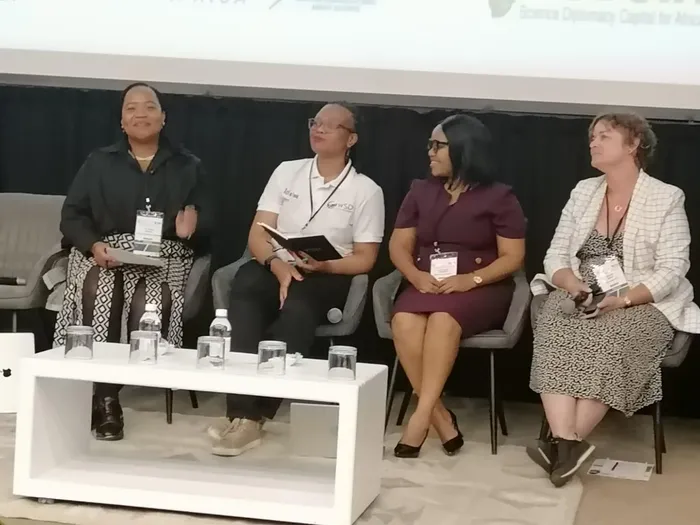
Discover how women are challenging these obstacles and driving innovation at the Science Forum South Africa 2025.
Image: Supplied
Achieving substantive gender equality remains elusive despite South Africa having made tremendous strides in promoting the status and the role of women in society by passing progressive laws.
This was the overwhelming view shared by the majority of women who took part in the discussion hosted by the Organization for Women in Science for the Developing World (OWD) as part of the Science Forum South Africa 2025.
OWD is a global entity that provides research training, career development and networking opportunities for women scientists at different stages in their careers.
The participants emphasized that promoting women’s representation in scientific institutions must remain a top priority. They stressed that women’s roles and contributions should be actively acknowledged and supported.
According to them, women continue to face numerous obstacles that significantly hinder their ability to contribute meaningfully to science, and to advance further in their careers.
A high level panel of academics addressed the topic of the conversation: ‘Women driving science, innovation, and societal transformation in South Africa. The Star spoke with Nokukhanya Thembane, one of the presenters, to elaborate further on some points she raised in her presentation.
Thembane is currently a lecturer in the Department of Biomedical Sciences at Mangosuthu University of Technology. An environmental health practitioner and member of the South African Institute of Environmental Health, Thembane is strong advocate for STEM education.
She said women are not just simply participants in the science, technology and innovative ecosystems. Instead, “we are leaders, innovators, and system-changers.
From digital health platforms improving maternal care, to community-driven surveillance systems for infectious diseases, women scientists have proven that academia can be for society when re-engineered,” said Thembane.
She pointed out that currently less than 9% of patents in South Africa list women as inventors. Thembane said the inventions are not only a reflection of women’s ingenuity, but it is also about addressing serious human challenges such as saving lives, building businesses, and transforming communities.
What they need is for the system to recognise and support them, she said. “Yet, structural barriers remain: funding gaps, under-representation in decision-making, and outdated promotion incentives continue to limit the full expression of our expertise,” she argued.
Thembane said women have their own agency and continue to come up with projects and value-adding and innovative inventions.
She highlighted some of the groundbreaking initiatives that have left enduring impact on the local communities, saying this confirms that when women lead, these tools reach communities and promote inclusivity.
One of the areas in which women’s projects have been very critical is on digital innovation and health equity.
According to Thembane, digital tools such as health platforms, remote monitoring, and diagnostics innovations, radically improved and re-shaped the entire healthcare system. Some of the women whose innovations are directly impacting lives include:
Dr Shikoh Gitau who has developed mobile health platforms that deliver essential health services, including maternal care, directly to communities via mobile devices.
Dr Precious Lunga who has led healthtech initiatives that enable remote, data-driven care, improving access for chronic disease patients across Africa.
Regina Honu, a Ghanaian software developer, drives techeducation initiatives that empower women to build local digital solutions, including health-related apps.
Phyllis Kyomuhendo, an Ugandan innovator, co-founded a portable ultrasound device called m-SCAN, designed to bring pregnancy scanning services to communities that lack full hospital infrastructure. This is a powerful example of how women are creating context-aware, life-saving health technologies for under-served populations.
She attributed the success of these projects to the continued support they received from networks like the African Women in Digital Health (AWiDH). They ensured that these innovations are designed by those who understand local realities, Thembane explained.
“These examples show that women are not just participants, they are shaping health systems, building culturally responsive solutions, and proving that science can serve society when led with vision and expertise,” she added.
She said these technologies were not only effective, but also relevant because they are designed for local realities, and “not imported from the global North”.
Thembani believes that Africa must build its capabilities to provide its own solutions, rooted in our context, priorities, and knowledge systems. “Vaccine apartheid was a stark reminder: global solutions will always prioritize the global north first,” she added.
For instance, during the Covid-19, said Thembane many peri-urban and rural communities hesitated to take vaccines because at critical stages of implementation science, trust-building, contextual engagement, adaptation, were skipped.
Science must support Africa’s sovereign agenda; it must strengthen local capacity, solve local problems, and prioritize people over metrics alone. “Innovation is not optional it is a national imperative. If our work does not uplift communities, it is not innovation,” she added.
Thembane argued that universities must re-think and re-imagine what they reward, saying that “innovation cannot be measured solely by the number of papers published. Recognition must extend to products, patents, and social impact”.
She said entrepreneurship is a critical strategy that is dependent on culture, adding it cannot be taught in isolation, it is lived, practised, and nurtured over time.
“From undergraduate through PhD, it must be integrated into curricula, internships, and experiential learning. Cross-sector exposure, industry, business, government is essential. Academia cannot work in silos,” observed Thembani.
She warned against the polarising and exclusionary nature of science but says women are better suited to understand its ecosystem and their role in social justices.
As a result, they are able to turn it into a tool for transformation and financial inclusion. “These examples show that academics, when re-engineered, can be engines for social change. But for this to scale, universities, funders, and policymakers must invest in women-led innovation, said Thembane.
Women have shown to be prolific innovators, she said, adding that if government is serious about inclusive, resilient, and African-centered innovation, it must provide funding, mentorship, and cross-sector platforms to support women scientists and entrepreneurs.
Thembane called for the universities to be re-engineered to reward innovation and societal impact, saying they must also integrate entrepreneurship as a culture, not just a module.
“Women-led, community-informed innovation is not optional. It is essential for building a South Africa and an Africa that leaves no one behind,” she concluded.
Partnered Content