

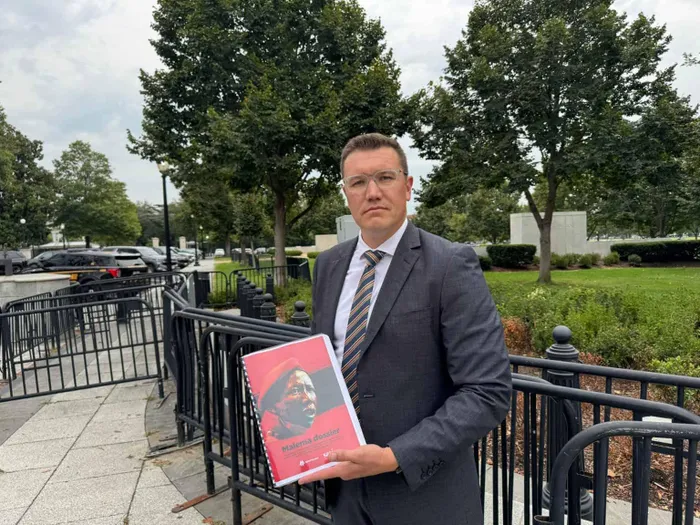
AfriForum intensified its campaign against Julius Malema with a dossier delivered to the White House.
Image: Supplied / AfriForum
AfriForum's decision to deliver a dossier on EFF leader Julius Malema to senior officials at the White House has raised warnings about potentially undermining the already fragile relations between South Africa and the United States.
Political analyst Zakhele Ndlovu said the move risks complicating diplomatic and trade engagements while feeding narratives of racial tension.
“This group from South Africa has shown more confidence in the US government than in the South African criminal justice system,” Ndlovu said.
He noted that Trade and Industry Minister Parks Tau was in Washington trying to repair ties strained by trade tariffs, while AfriForum and its partners were sending a contradictory message abroad.
Ndlovu also discussed the contentious “Kill the Boer” chant, which has been at the centre of AfriForum’s campaign.
“The courts have made a decision and ruled that this song is consistent with free speech. It is not unlawful to sing it. But AfriForum argues that by allowing it, the song promotes hatred and undermines reconciliation,” he said.
He warned that pushing the issue internationally risks amplifying claims of “White genocide” in South Africa, a narrative that could further strain US–SA relations.
“By taking this matter to the US, AfriForum risks feeding into the perception that Afrikaners are a persecuted minority facing genocide, which could create unnecessary international tension and complicate trade negotiations,” Ndlovu said.
AfriForum, the civil rights organisation representing Afrikaner interests, handed the dossier alongside the Solidarity Movement as part of its ongoing international campaign to hold Malema accountable, both domestically and abroad.
The dossier, published earlier this month, details Malema’s alleged history of violent rhetoric, including repeated use of the “Kill the Boer” chant, support for terrorist organisations such as Hamas, and praise for authoritarian regimes including Russia, China, Cuba, Venezuela, Libya, Zimbabwe, and Iran.
AfriForum argues that these actions pose a threat to South Africa’s stability and international reputation and asserts that South African authorities have failed to take action against him.
Professor Sipho Seepe, a political analyst, said the move by AfriForum was consistent with its longstanding campaign to advance Afrikaner interests.
“AfriForum sees Malema as the number one enemy of the Afrikaners. They are not alone in that regard. John Steenhuisen of the DA has expressed the same sentiments with regard to the party's position on the EFF. This much was expressed in no uncertain terms when President Ramaphosa led the SA delegation to the White House,” Seepe said.
He added that South Africa is a contested political space, with multiple parties influencing foreign policy, and noted that contradictory messages from the government have complicated engagement with international partners.
Ernst van Zyl, AfriForum’s head of Public Relations, said the dossier was handed over because Malema has not faced consequences in South Africa for his alleged incitement to violence.
“From everything we've seen, government officials are refusing to address the US' clear criteria for normalising relations and thus worsening the diplomatic crisis,” Van Zyl said, responding to criticism that the organisation was running a parallel diplomatic process.
He dismissed accusations that AfriForum’s actions reinforced white supremacy narratives as “laughable and desperate attempts to discredit AfriForum”.
The organisation’s broader aim, Van Zyl said, is to repair government-induced damage to South Africa’s relationship with the US by highlighting corruption and advocating for trade normalisation without penalising the country as a whole.
“AfriForum will ensure that pressure grows on the South African government to address Malema’s hateful, dangerous rhetoric and violent chants such as ‘Kill the Boer’,” he said.
AfriForum’s dossier also highlights Malema’s alleged involvement in corruption, including the On-Point Engineering case (2011), linked to fraudulent tender deals benefiting Malema’s family trust; alleged benefits from the 2018 VBS Bank collapse, which cost South Africans R2 billion; and outstanding tax obligations to SARS amounting to R16 million between 2005 and 2011.
AfriForum claims that prosecutions in these matters were deliberately avoided by the National Prosecuting Authority (NPA) and the Hawks.
The organisation also flagged Malema’s extreme political positions, noting his public support for Hamas and repeated criticism of Western governments and institutions.
AfriForum cited recent international developments, including the UK rejecting Malema’s visa application over his extremist rhetoric and the US State Department highlighting farm murders and the continued use of the “Kill the Boer” chant.
According to Van Zyl, the dossier aims to provide a foundation for international consequences, such as targeted sanctions under the US Global Magnitsky Act.
He stressed that the intervention is part of a years-long campaign to ensure Malema faces accountability abroad, in addition to domestic legal processes.
The visit to the White House forms part of a follow-up liaison mission by AfriForum and Solidarity, which also focused on land expropriation without compensation, farm attacks, and other issues affecting Afrikaner communities.
Werner Human, a member of AfriForum’s board, handed over the dossier during meetings with senior Trump administration officials.
While the South African government has so far avoided directly condemning Malema’s rhetoric, AfriForum argues that international pressure could compel authorities to take action.
“The Trump administration has already demonstrated that it finds Julius Malema’s hateful, dangerous rhetoric and violent chants very concerning. One of its demands to the South African government, to normalise relations, has been to condemn the chant, which the South African government has unfortunately refused to do until this point,” Van Zyl said.
Political observers note that AfriForum’s move illustrates tensions in South Africa’s domestic politics spilling over into international relations.
Seepe said: “President Ramaphosa failed to defend the EFF's stand on the ‘Kill the Boer’ song. Alternatively, he failed to confront the EFF in case he was utterly opposed to the song. This contributes to a perception that the South African government is inconsistent on issues that matter to the international community.”
AfriForum maintains that its actions are aimed at accountability, not racial politics.
The organisation intends to continue engaging influential international contacts, documenting Malema’s alleged transgressions, and pressing for measures to ensure justice is served, both at home and abroad.
The EFF did not respond to requests for comment.