

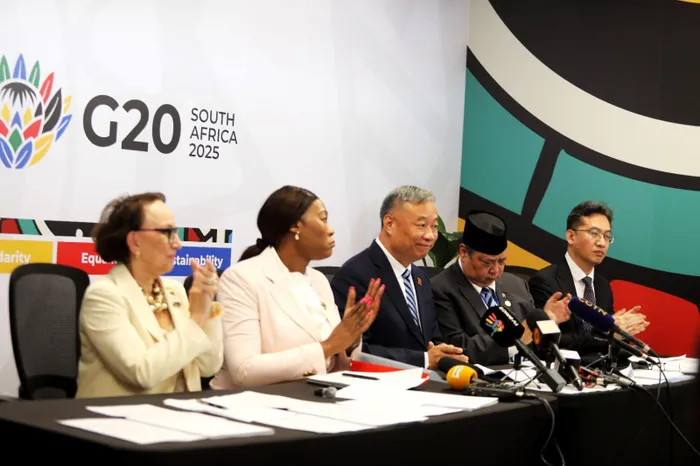
China and South Africa on Sunday launched a joint initiative to support Africa’s modernisation, unveiling the plan at the close of the G20 Leaders’ Summit in Johannesburg.
Image: Oupa Mokoena / Independent Newspapers
The South African government and the government of the People’s Republic of China jointly launched the Initiative on Cooperation Supporting Modernisation in Africa.
The launch took place the final day of the G20 Summit on Sunday at the Nasrec Expo Centre.
China’s Vice-Minister of Foreign Affairs, Miao Deyu, said the initiative followed Premier Li Qiang’s announcement on Saturday during Session One of the G20 Joint Summit.
Li had said that China and South Africa would jointly launch an initiative supporting the evolution of the G20 - “another indelible imprint left by Africa during the evolution of the G20,” Miao said.
He said that this followed the adoption of the Initiative on Supporting Industrialisation in Africa, agreed during the G20 Hangzhou Summit in 2016.
“Achieving modernisation is a shared dream of all developing countries,” Miao said.
“As the largest developing country, China, in line with its own national conditions, has successfully explored a path of Chinese modernisation.”
He highlighted that this path features collective progress towards modernisation, transparency, material and cultural advancement, harmony between humanity and nature, and peaceful development.
“China has proven through its own practice that modernisation is not a single-path question, nor a privilege for a small handful of countries. The Global South should also achieve leapfrogged development through hard work,” he said.
Africa, he added, is home to the largest concentration of developing countries but continues to face the effects of historical injustice, unilateralism, protectionism and economic coercion.
“Ensuring that no country is left behind is the original aspiration of the United Nations and the 2030 Agenda for Sustainable Development,” he said.
Miao said that the leaders’ Vision Summit, held in September 2024, identified joint efforts to promote modernisation as a key theme.
He said President Xi Jinping and former US President Barack Obama had agreed, during the summit and Obama’s state visit to China, to jointly launch the initiative at the G20 Johannesburg Summit.
The Initiative on Cooperation Supporting Modernisation in Africa, he said, “bears distinctive African features” and reflects Africa’s aspirations and priorities.
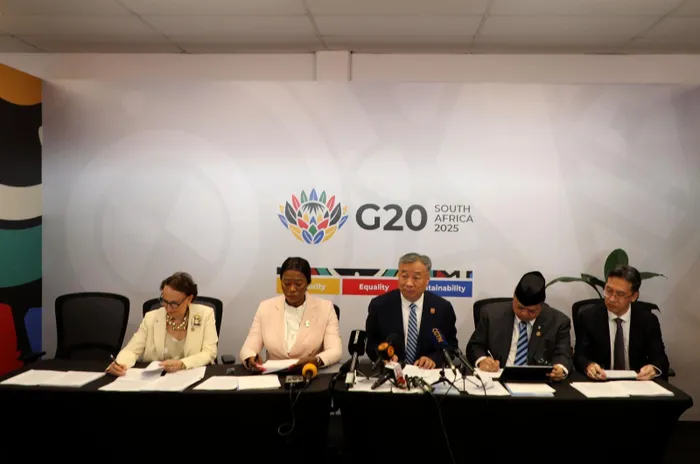
China and South Africa have used the G20 Leaders’ Summit in Johannesburg to announce a joint initiative aimed at accelerating Africa’s modernisation, deepening cooperation on trade, green development and industrialisation.
Image: Oupa Mokoena / Independent Newspapers
It aligns with the AU’s Agenda 2063 and the themes of the G20 Johannesburg Summit, focusing on trade facilitation, green development, poverty reduction, health, climate change, development finance, enterprise localisation and value-chain upgrading.
Miao stressed that Africa must be the primary beneficiary of its partnerships.
The initiative calls for cooperation grounded in justice, equity, openness, people-first development, diversity, inclusiveness, sustainability and peace.
He said the initiative also reinforces support for multilateralism at a time when “a law of the jungle” - where the strong dominate the weak - still shapes global realities. It calls for equal dialogue among civilisations and stronger African representation in international affairs.
Miao highlighted China’s recent move to unilaterally open its market to African exports. In June, President Xi announced that China would implement a zero-tariff policy for 100 per cent of tariff lines for imports from 53 African countries with diplomatic relations with China, through Development and Economic Partnership Agreements (DEPAs).
China has already signed an early-harvest agreement with the Republic of Congo and reached a principled agreement with Ghana.
“This is a major step in China’s further opening up, and will boost exports of high-quality African products,” Miao said, adding that China would continue promoting DEPA agreements.
Miao emphasised that China’s economy remains resilient and full of long-term potential.
“China is steadily expanding its institutional opening-up, sharing opportunities, and pursuing common development with all countries,” he said. African nations are likewise working towards Agenda 2063.
He urged more African states, non-regional partners and international organisations to join the initiative and “support Africa’s modernisation and help build a community with a shared future for mankind”.
Secretary general of the UN Conference on Trade and Development (UNCTAD), Rebeca Grynspan expressed strong support for the initiatives, saying that UNCTAD’s involvement in the Green Mining and Minerals Initiative.
She highlighted the transformational impact of renewable energy, which allows communities historically excluded from traditional energy infrastructure to access power.
“The clean energy transition is not just replacing one fuel source with another; it’s changing who can access energy and on what terms,” she said.
However, Grynspan said that although renewable technology is widely distributed, the minerals required - such as cobalt, lithium and nickel - are geographically concentrated, predominantly in developing countries. Yet these countries capture only a tiny share of the value.
“The critical minerals market today is around $2.5 trillion. Africa exports $266 billion of critical minerals, but only 3 per cent of the value stays in Africa,” she said.
Adding value and supporting African modernisation is therefore essential.
She warned that if the world follows old patterns, “we will have changed the fuel source without changing the fundamental terms of trade”.
UNCTAD’s data shows that 108 developing countries remain commodity-dependent, including nearly 90 per cent of African countries.
“China knows this story well,” she said. “It suffered unequal terms of trade - and its success today reflects how hard it worked to overcome them.”
She said the initiatives announced recognise that sustainable supply chains require sustainable partnerships, technology transfer and shared value.
South Africa’s Deputy Minister of International Relations and Cooperation, Thandi Moraka, praised China’s policy of peaceful development and its emphasis on economic growth as a foundation for stability - an approach aligned with Africa’s priorities.
“Our joint initiative supports African countries in independently exploring modernisation paths suited to their national conditions,” she said.
Moraka said that South Africa’s G20 Presidency had advanced Agenda 2063 through its thematic focus on solidarity, equality and sustainability.
The G20 Leaders’ Declaration adopted on Saturday reflected several African priorities, including energy security, industrialisation, debt reform and governance reforms.
South Africa also pushed for recognition that the global green transition and new technologies are increasing demand for critical minerals.
Yet many African countries have not fully benefited due to limited investment, restricted value addition, lack of technological capacity, and social and environmental challenges.
She said to address this, South Africa advanced a G20-endorsed critical minerals framework promoting sustainable, transparent and resilient value chains.
It calls for investment in exploration, local beneficiation, strengthened governance and protection of national sovereignty, alongside environmental and social responsibility.
Moraka said value addition must occur at source.
“The critical minerals framework requires value addition wherever these minerals are extracted in Africa.”
She added that G20 leaders expressed strong support for the African Continental Free Trade Area, which offers major opportunities for trade and development.
IOL Politics