

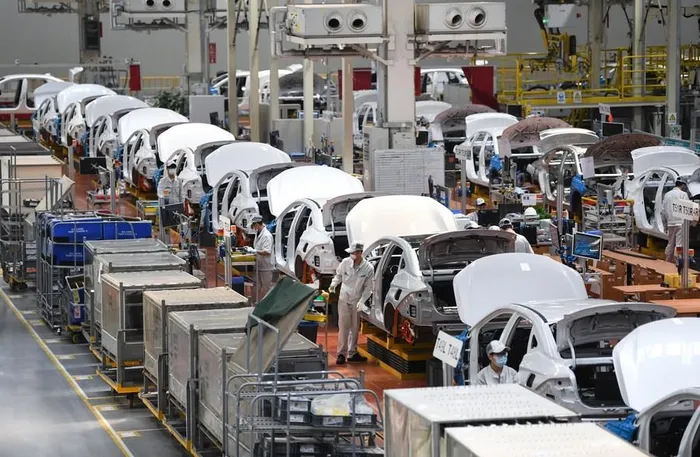
This photo shows the assembly line of GAC Aion, an NEV subsidiary of Guangzhou Automobile Group Co., Ltd. (GAC Group), in Guangzhou, Guangdong, China.
Image: Xinhua
Electric mobility is reshaping global industrial policy, and nowhere is this shift more pronounced than in the Global South. China’s acceleration in electric-vehicle (EV) manufacturing and technological integration has triggered a significant re-ordering of global value chains—particularly for BRICS and BRICS+ economies seeking industrial upgrading, green-tech capability and new export power. Beijing’s latest move, the full commissioning of Volkswagen’s new development hub in Hefei, represents not only a milestone for the company but a broader sign of China’s dominance in EV supply chains and the emergence of new South-South technological ecosystems.
Combined with insights from the recent BRICS policy dialogues—highlighting the need for localisation, industrial coordination, and new standards for EV technology—Volkswagen’s strategic pivot demonstrates how major global firms increasingly align with China’s innovation architecture. The outcome is a rapidly evolving landscape in which BRICS nations are positioned to shape, rather than merely follow, future mobility trends.
Volkswagen Deepens Its China Integration: Hefei as a Strategic Turning Point
Volkswagen (VW) has announced ambitious plans to cut its EV development costs in China by up to 50% following the full activation of its new test and development centre in Hefei. The facility, part of Volkswagen Group China Technology Company (VCTC), consolidates functions that were previously spread across multiple sites; including hardware and software testing, battery validation, powertrain optimisation, and full-platform vehicle analysis.
The Hefei complex spans 100,000 m², hosts more than 100 laboratories, and is now VW’s largest development centre outside Germany. By integrating its entire EV development pipeline in one location, the company expects to shorten its development timelines by roughly 30%, enabling faster innovation cycles and more competitive products specifically tuned to Chinese consumer expectations.
This investment is driven by two primary pressures:
VW’s shift reflects a broader trend: Western automotive firms are no longer simply selling into the Chinese market; they are embedding themselves deeply into its innovation ecosystem.
China’s Technological Environment: A New Global Norm
What makes Hefei important goes far beyond VW’s internal efficiencies. The city has become a national EV innovation hub, hosting firms across batteries, semiconductors, AI mobility systems, and smart manufacturing. As BRICS policymakers emphasised in recent discussions, China’s approach; collapsing R&D, testing, prototyping, and supplier integration into single ecosystems; has become the model for Global South industrial modernisation.
VW’s new Functions Integration Test (FIT) laboratory, set to open in mid-2026, will simulate extreme environmental conditions for full-vehicle testing. This brings China’s testing capability close to complete autonomy, reducing reliance on traditional European testing environments and reaffirming the region’s shift toward self-sufficient, world-class automotive R&D.
China’s ability to host such high-tech, multi-layered EV development environments is precisely why BRICS+ states increasingly look to Beijing for industrial partnerships, technology licensing, and capacity-building.
Industrial Strategy: How China’s EV Model Shapes South-South Cooperation
Key themes that align with VW:
Localisation and Technology Transfer
BRICS countries are increasingly demanding that foreign firms localise manufacturing, bring engineering talent into the domestic market, and support the expansion of regional supply chains. VW’s China facility is a prime example of this strategy in action: complete end-to-end localisation, embedded engineering teams, and extensive domestic supplier integration.
Mobility as a Strategic Industrial Cluster
Within BRICS+ discussions, EV manufacturing is seen not merely as a green transition priority but a structural industrial anchor capable of boosting GDP, creating high-skilled employment, and linking sectors such as batteries, critical minerals, software, and electronics manufacturing.
China as an Export Gateway for the Global South
China’s EV technological maturity positions it as a launchpad for exports to ASEAN, the Middle East, Africa, and Latin America. VW’s Hefei site will validate vehicles and technologies destined for these very markets—aligning neatly with BRICS aspirations for South-South trade expansion.
Speed, Adaptability, and Local Market Understanding
Chinese EV firms have shown unmatched speed in releasing new models, adjusting supply chains, and designing for local preferences. VW’s decision to consolidate testing, shorten decision loops, and run parallel software-hardware validation is effectively an adoption of the Chinese development rhythm.
Global EV Value Chains: BRICS+ at the Centre of New Competition
The BRICS+ bloc, which now includes major energy, mineral, and manufacturing nations, is uniquely positioned to dominate the 21st-century EV ecosystem. The transcript analysis emphasised how new industrial centres—from São Paulo to Johannesburg to Riyadh—aim to build competitive EV industries while leveraging China’s technology as a base.
China’s EV leadership intersects naturally with BRICS+ needs:
South Africa provides critical minerals (manganese, platinum group metals).
Brazil offers industrial capabilities and renewable energy for green factories.
Saudi Arabia and the UAE anchor capital-intensive industrial clusters.
Russia adds metallurgical and battery material capacity.
China remains the technological nucleus.
Volkswagen’s reliance on China is therefore not an isolated development; it reflects a historic realignment where BRICS+ countries are emerging as the gravitational centre for EV innovation, standards, and production.
Implications for Global Auto Markets and South-South Cooperation
With China’s EV industry now shaping global standards, foreign automakers must embed themselves deeper into Chinese technological ecosystems or risk obsolescence. VW’s integration into Hefei signals:
The end of the era where Western companies develop core EV technologies at home and merely assemble vehicles in emerging markets.
A Turning Point for Global EV Leadership
The commissioning of VW’s Hefei development centre is far more than a corporate milestone. It is symbolic of a new industrial paradigm where China’s EV architecture drives global innovation, and BRICS+ countries increasingly leverage these capabilities to build their own high-tech industries.
From the integration of local suppliers and foundational EV software, to the alignment with BRICS+ strategic objectives and South-South industrial cooperation, the developments in Hefei reflect a decisive shift: the centre of gravity in global automotive innovation has moved East and South.
As BRICS+ nations position themselves for the next generation of industrialisation, China’s model—fast, integrated, adaptive—will continue shaping the future of mobility, technology, and green development across the Global South.
Written By:
Cole Jackson
Lead Associate at BRICS+ Consulting Group
Chinese & South American Specialist
** MORE ARTICLES ON OUR WEBSITE https://bricscg.com/
** Follow https://x.com/brics_daily on X/Twitter for daily BRICS+ updates