

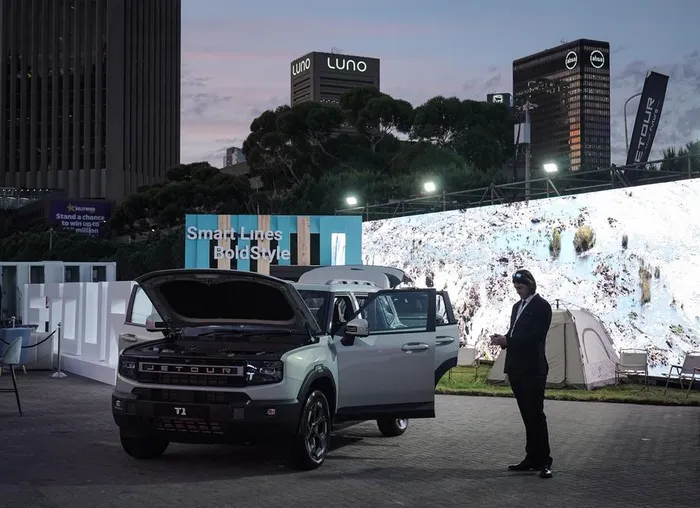
This photo taken on Oct. 24, 2025 shows Chinese automaker Jetour's new SUV during a launch event in Cape Town, South Africa.
Image: Xinhua
The global automotive landscape is undergoing one of the most dramatic shifts in decades, and China is unmistakably at the centre of this transformation. While Western headlines often emphasise the challenge Chinese automakers pose in Europe or the United States, the real battleground is elsewhere. Across Asia, Africa, the Middle East, and Latin America, Chinese car brands; especially leaders like BYD, Changan, GWM, and Chery; are rapidly becoming the preferred choice for millions of new buyers. Their combination of affordability, modern technology, and strong electric-vehicle (EV) capability is reshaping consumer behaviour in regions long dominated by Japanese, European, and American manufacturers.
BYD Expansion
At the forefront of this expansion is BYD, China’s largest automaker and the world’s leading EV producer. In December 2025, BYD made headlines by launching its first plug-in hybrid vehicle (PHEV) in Japan, historically one of the world’s most protected and brand-loyal automotive markets. The new Sealion 6, equipped with BYD’s latest DM-i hybrid system, enters a country where Toyota and Lexus have long held overwhelming dominance in hybrid technology. Despite this, BYD’s arrival marks a significant shift: Japanese consumers are now willing to explore foreign electrified options, particularly those that offer lower prices and compelling technology. The Sealion 6, priced from around US$25,000, undercuts many domestic alternatives and demonstrates China’s strategy of offering technologically advanced vehicles at highly competitive prices.
This strategic entry highlights a broader trend: Chinese automakers are finding their strongest traction not in saturated Western markets, but in emerging economies where affordability is essential. Consumers in developing countries are typically more price-sensitive, and Chinese brands offer modern designs, generous features, and EV options at far lower costs than their European, Japanese, Korean, or American competitors. The pricing advantage has made Chinese EVs, previously perceived as niche or premium, accessible to the mass market. As a result, Chinese companies have moved from the periphery to the centre of the global automotive industry within a remarkably short timeframe.
Long-established brands losing ground
The data tells a compelling story. Across Asia, Africa, and Latin America, the rise of Chinese automakers has coincided with a noticeable decline in market share for long-established brands. Japanese manufacturers such as Toyota, Nissan, Honda, Mitsubishi, and Suzuki; Korean firms like Hyundai and Kia; and European brands such as Fiat, Renault, and Volkswagen are all experiencing the impact. Even major American producers, including Chevrolet and Ford, have faced erosion of their once-secure positions in emerging markets.
Brazil, the largest car market in Latin America, illustrates the shift clearly. Chinese brands increased their share from 6.8 per cent in 2024 to 9.1 per cent in 2025—enough to place them collectively among the top four manufacturers in the country. In Australia, another important market where Japanese and Korean brands have long dominated, Chinese automakers now command nearly 17 per cent of sales, an increase of more than five percentage points in just one year.
The pattern repeats across numerous countries. In Ukraine, Toyota and Renault have ceded ground as BYD surged from 3 per cent market share in early 2024 to 7.7 per cent in 2025. Across Latin America, similar dynamics are taking shape: in Chile, Chevrolet is losing ground to GWM and Changan; in Colombia, BYD has entered the top ten, pushing out Ford; while in Ecuador, Panama, and Uruguay, Chinese vehicles are becoming mainstream choices for middle-class households.
In Asia, the trend is even more pronounced. Thailand, the region’s most important automotive hub, now records a staggering 32.4 per cent Chinese market share. Israel, one of the most advanced EV adopters globally, shows a nearly identical 32 per cent market share. Indonesia, the largest economy in Southeast Asia, has seen Chinese cars rise to over 12 per cent of the total market, driven largely by affordable EVs and well-equipped SUVs.
Africa is experiencing a similar trajectory; with South Africa, traditionally dominated by Japanese and European brands, now reaching 15 per cent Chinese market share. As African countries increasingly shift towards greener mobility and more accessible pricing, Chinese automakers are well positioned to expand even further.
Market-share data confirms the accelerating shift. Outside Europe and the United States, Chinese brands enjoy remarkable levels of penetration:
Chinese Brand Market Share (Selected Countries)
Meanwhile, year-on-year growth figures underline both the momentum and the durability of this shift. Uruguay’s Chinese market share rose by 12.6 per cent in one year, Israel by 11.5 per cent, Indonesia by 6.5 per cent, and Australia by over 5 per cent. These gains reflect not only competitive pricing but also increased consumer confidence in Chinese engineering, battery technology, warranty coverage, and dealership support.
EV as a major cultivator of China's global success
Chinese brands also benefit from strong capabilities in electrification. BYD, for instance, has mastered the full EV supply chain—from mining and battery production to software engineering and manufacturing. This vertical integration enables them to produce EVs far more cheaply than Western competitors, giving them a decisive edge in emerging markets where EV adoption hinges on affordability. Their cars typically offer high-density batteries, long driving ranges, modern interiors, and advanced features previously available only in premium models.
As the automotive world shifts towards electrification, connectivity, and affordability, China’s global influence is set to grow even further. With robust investment, strong technological capacity, and an expanding international dealer network, Chinese automakers are reshaping markets that were long perceived as impenetrable. The rise of brands like BYD is not just a trend, it is a structural transformation with long-term implications for global mobility.
What becomes clear is that the future of the global automotive industry will not be decided in Europe or North America, but in the emerging markets of Asia, Africa, and Latin America. And in this new reality, Chinese carmakers are not only competitive, they are leading the way.
Written By:
Cole Jackson
Lead Associate at BRICS+ Consulting Group
Chinese & South America Specialist
** MORE ARTICLES ON OUR WEBSITE https://bricscg.com/
** Follow https://x.com/brics_daily on X/Twitter for daily BRICS+ updates