

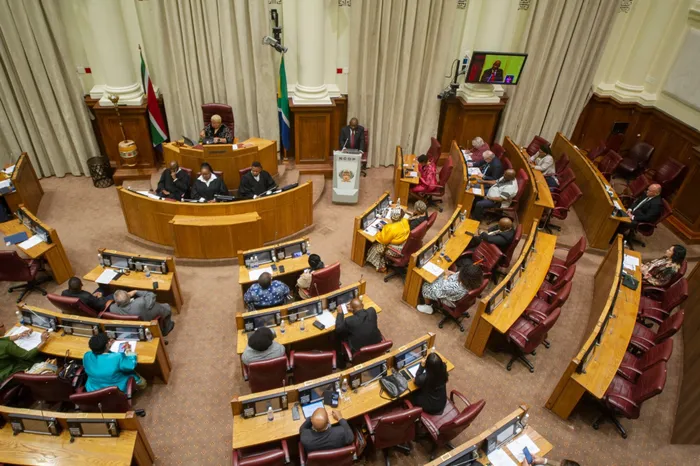
The National Council of Provinces gives a green light to the 2025/26 Division of Revenue Amendment Bill, which makes changes to allocations for the three sheres of government.
Image: Armand Hough/Independent Newspapers
The National Council of Provinces (NCOP) passed the 2025/26 Division of Revenue Amendment Bill on Wednesday, with all nine provinces voting in favour of the important legislative measure.
The decision came after the Select Committee on Appropriations presented its report, which was subsequently adopted by the NCOP.
“We, therefore, want to declare that the Bill has been agreed to in accordance with Section 65 of the Constitution,” said NCOP Chairperson Refilwe Mtsweni-Tsipane when announcing the results.
The Bill was sent to the NCOP by the National Assembly for concurrence last month.
Its passage followed its tabling by Finance Minister Enoch Godongwana, who introduced it as part of the 2025/26 Medium-Term Budget Policy Statement.
This was a big step towards the adoption of the Adjustment Budget when Parliament reopens in January.
One of the key features of the Amendment Bill is additional allocation of R386.8 million specifically earmarked for the reconstruction and rehabilitation of provincial infrastructure that suffered damage from adverse weather conditions.
Moreover, local government conditional grants received a boost of R2.9 billion, aimed at facilitating the reconstruction of damaged municipal infrastructure.
A total of R454m was added to the Education Infrastructure Grant for the Eastern Cape and KwaZulu-Natal, and R150m to the Provincial Roads Maintenance Grant for the two provinces.
An amount totalling R93.8m was allocated to the Health Facility Revitalisation Grant, with R40m being for the reconstruction and rehabilitation of health infrastructure damaged in the Eastern Cape and KwaZulu-Natal.
The Bill also set aside R8 million in provisional funding for planning new health infrastructure projects at Belhar Regional Hospital and Klipfontein Regional Hospital in the Western Cape.
A reduction of R342.5 million was made to the School Infrastructure Backlogs Grant, facilitating funding for the workbooks project and infrastructure assessments to improve educational resources.
A total of R32.6m was rolled over in the National Health Insurance Grant for the construction of the Limpopo Central Hospital (R14 million) and the rebuilding of the Borwa (R9 million) and Clocolan (R10 million) clinics in the Free State.
Tabling the report on the Division of Revenue Amendment Bill, Select Committee Chairperson Tidimalo Legwase emphasised the importance of public engagement throughout the legislative process.
The committee consulted with the National Treasury and invited public submissions, ensuring transparency and inclusivity in the development of the Bill after it was referred to the NCOP.
Legwase detailed several recommendations aimed at enhancing the financial framework of allocations to the three spheres of government.
Among them, the National Treasury is expected to provide a detailed technical explanation of provincial share adjustments, highlighting implications for provinces in future budget cycles within 90 days.
“National Treasury, in consultation with the Financial Fiscal Commission, should, within 120 days, provide Parliament with an analysis of real per capita provincial allocations in key sectors, particularly in health and education, together with options to mitigate rising cost pressures of frontline services,” she said.
Legwase also said the Department of Basic Education, together with provincial departments, should, within 90 days, submit mitigation plans outlining how reductions to school infrastructure grants will be managed.
“In addition, the National Treasury and the Department of Basic Education should provide a consolidated impact analysis on the school infrastructure backlogs, including corrective measures to address delays in eliminating unsafe school infrastructure.”
Other recommendations are that the National Treasury and the Department of Cooperative Governance and Traditional Affairs should, within 60 days, submit a plan to enforce the settlement of outstanding debt owed by national and provincial departments to municipalities, as well as a strategy should be developed to address municipal revenue collection challenges.
“The committee is of the view that these recommendations will strengthen the intergovernmental fiscal system and address structural challenges that cannot be resolved through technical adjustments alone,” Legwase said.