

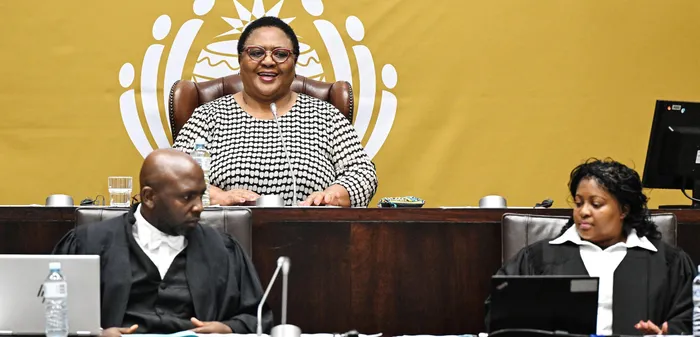
National Assembly Speaker Thoko Didiza presides during the sitting of the National Assembly when the Special Appropriation Bill was passed
Image: Photo: Phando Jikelo / RSA Parliament
Finance Minister Enoch Godongwana on Tuesday said the Special Adjustment Bill underscored the need for self-sufficiency and the need to move with speed in addressing universal health access through the implementation of the National Health Insurance (NHI).
Godongwana said the court cases challenging the NHI will delay implementation of the legislation.
He noted that both protagonists in the court action proclaim they support universal coverage and access.
“It is my submission that these parties must meet and craft a settlement. We want to move ahead with implementation of NHI. These cases are going to delay for more years,” he said.
Godongwana made this statement in response to the debate during which the National Assembly passed the Special Appropriation Bill, aimed at addressing the funding gap created by the withdrawal of the US President’s Emergency Plan for Aids Relief (Pepfar).
Tabling his Medium term Budget Policy Statement late last night, Godongwana allocated an additional R750.4 million to the Department of Health.
A total of R590.4m has been allocated for provinces through the District Health Program grant for the comprehensive HIV component and R130.2m for the South African Medical Research Council (SAMRC) for critical research.
Speaking during the debate on the bill, committee chairperson Mmusi Maimane said the fundamental question was to ensure the health department and health systems remained sovereign.
“We must see through the eyes of ordinary people who depend on the well functioning public health care system that ensures that there isn't a financialisation of their own personal health and ensures that HIV treatment can be given effect,” Maimane said.
ANC MP Michael Segede said the withdrawal of Pepfar funding was not an administrative oversight, but a deliberate political decision taken by the US government led by President Donald Trump's administration. and amplified by anti revolutionary forces within in South Africa, especially Afriforum.
Segede said the bill was a pivotal instrument of ensuring palpable inroads against HIV, AIDS and TB infections, but also for socio economic growth.
MK Party MP Sanele Mwali said the withdrawal of Pepfar funding has had severe consequences, including the loss of skilled healthcare workers, closure of clinics, and significant reduction in essential HIV services.
“We must acknowledge the failures of the Government of National Unity and the Department of Health in the provinces, the corruption, the maladministration, the dependency on foreign aid, have compromised our state sovereignty,” Mwali said.
DA MP Kingsley Wakelin the discussions around health funding revealed urgent questions about sustaining vital programmes and building a resilient system that serves all the people.
“A primary concern is maintaining current infrastructure and systems for essential health services. When external support changes, we must ensure there is no backsliding in life,” Wakelin said.
EFF MP Nonhlanhla Mkhonto said her party has consistently made it clear that it rejected the continued reliance on foreign aid to ensure that all South Africans have access to quality and dignified medical services.
“For more than 20 years, we have allowed this government, the former liberation movement and the National Treasury, to implement continuous budget cuts and below inflation increases to the health budget.
“This deliberate underfunding has pushed the public health care system to the brink of collapse. Clinics are overwhelmed, hospitals are understaffed, and communities are left vulnerable,” said Mkhonto.
IFP chief whip Nhlanhla Hadebe said the Special Appropriation Bill has once again exposed South Africa on over-reliance on external donor funding for essential health services.
“For many years donor support has effectively subsidised functions that should be sustainable integrated in the national fiscus,” Hadebe said.
ActionSA MP Alan Beesley said South Africa should not depend on overseas donor funding to meet basic health obligations.
“We should decisively shut the taps that bleed corruption and self enrichment within the health sector,” he said.
His sentiments were echoed by UDM’s Nqabayomzi Kwankwa, saying South African can't depend on foreign funding to fund its essential services.
“Dependence weakens our sovereignty and exposes our people to decisions taken in foreign countries. We must never allow critical programmes to rely on programe of other countries,” Kwankwa said.
Earlier, the National Assembly passed the Tax Administration Laws Amendment Bill and the Taxation Laws Amendment Bill with the MK Party, EFF, UAT, ATM and National Coloured Congress objecting.
Also passed was Adjustment Appropriation Bill, which made R10.1 billion allocation to budgets of departments with the MK Party, EFF and UAT registering their objections.
Responding to the debate Godongwana stated that Adjustment Appropriation Bill made provision for unforeseen spending, repairs and rehabilitation of infrastructure damaged during disasters.
“If you do not vote for this budget, you are actually saying that infrastructure must not be repaired,” he said.
The bills will be sent to the National Council of Provinces for concurrence when it sits on Thursday.