

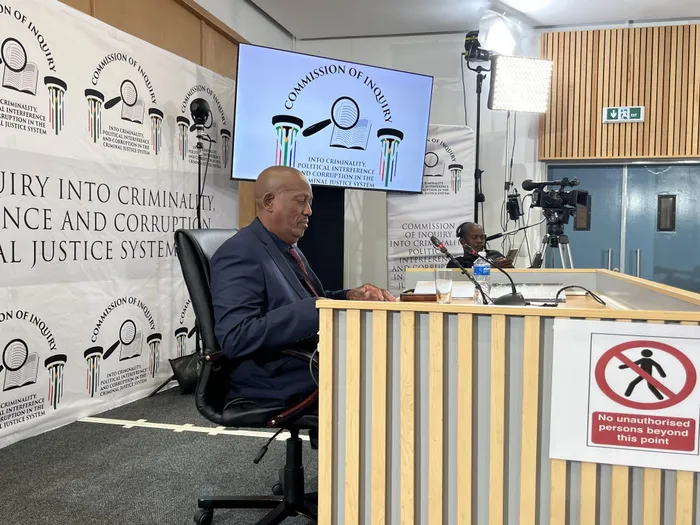
SAPS Senior Forensic Analyst, Captain Laurence Makgotloe, had admitted that the ballistics section suffered a lot of pressure.
Image: Kamogelo Moichela / IOL News
SAPS Senior Forensic Analyst Captain Laurence Makgotloe has admitted that the ballistics laboratory prioritises the volume of cases processed over the quality of forensic work, a reality he said inevitably leads to errors.
Testifying on Monday at the Madlanga Commission, Makgotloe said analysts operate under intense pressure to meet production targets, leaving little room for careful, detailed examination.
“The errors will always be there because we push quantities, not quality. The errors will arise, not intentional errors,” Makgotloe told the commission.
His testimony adds to mounting concern over the state of SAPS forensic services and follows earlier evidence by SAPS ballistics expert Brigadier Mishak Mkhabela, who revealed that 41,846 criminal cases are currently stuck in the forensic pipeline.
Many of those cases depend on ballistic evidence that has not yet been analysed, largely due to a shortage of trained personnel.
While evidence remains backlogged, courts continue to issue warrants of arrest, creating a widening gap between investigations and prosecutions and placing additional pressure on an already strained system.
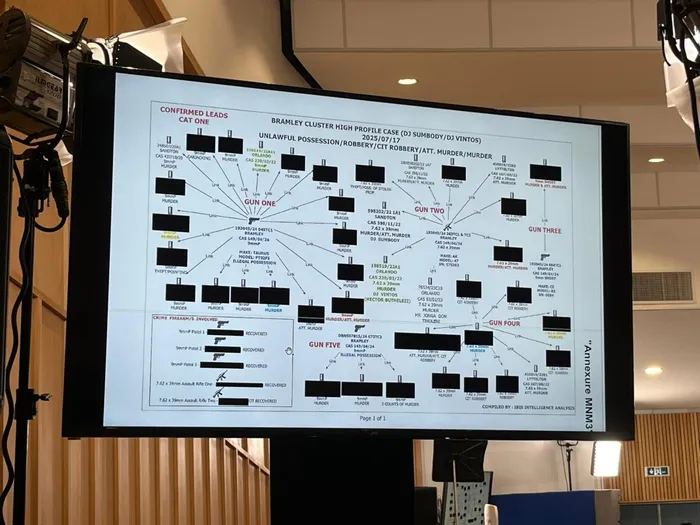
Here is a graphic that shows how weapons used in the murders of engineer Armand Swart, Oupa “DJ Sumbody” Sefoka, and Hector “DJ Vintos” Buthelezi are linked to over 20 cases. Ballistic confirmation is still pending.
Image: Kamogelo Moichela/ IOL News
Mkhabela previously painted a picture of a forensic environment nearing collapse, describing severe staff shortages, inadequate resources and overflowing evidence storage facilities.
“We have repurposed a museum, and even that is full,” Mkhabela said.
Makgotloe sought to explain how errors are assessed within the FSL, telling the commission that mistakes are classified as either critical or non-critical.
He said non-critical errors fall into four categories: incorrect dates on affidavits, unconfirmed defects or edge results, administrative errors and incorrect log numbers.
“These are non-critical errors,” Makgotloe said, adding that the issues raised during his testimony fell within this category.
The acknowledgement that errors are effectively built into the forensic process alarmed commissioners.
Commissioner Justice Mbuyiseli Madlanga said the explanation did not lessen the seriousness of the problem, warning that systemic pressure cannot excuse weaknesses in a criminal justice system that relies heavily on forensic evidence.
“I understand the background you give for the observation, but it doesn’t change the fact that it’s a very disturbing observation,” Madlanga said.
IOL Politics