

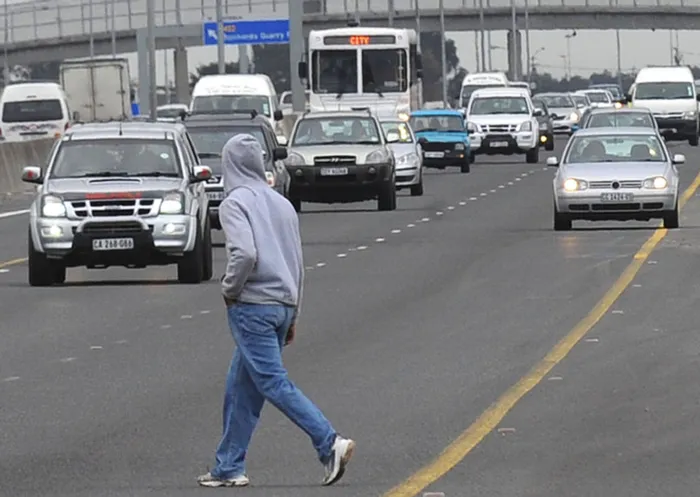
The GOOD party in the Western Cape has criticised the N2 wall, saying it entrenches apartheid-era spatial planning while failing to address the root causes of crime and inequality.
Image: File
The GOOD party in the Western Cape says the N2 wall built along the route between the Cape Town CBD and Cape Town International Airport is a continuation of apartheid-era spatial planning and reflects what it describes as misplaced priorities by the City of Cape Town.
This comes after the City of Cape Town allocated more than R100 million towards the N2 highway wall in a bid to address high levels of crime, including smash-and-grab incidents and stone-throwing attacks.
GOOD City of Cape Town councillor. Siyabulela Mamkeli, said the safety of motorists on the N2 was non-negotiable, but warned that it should never be used to criminalise poverty or strip residents of informal settlements of their dignity.
“The safety of motorists on the N2 is non-negotiable. However, it must never be weaponised to criminalise poverty or strip people living in informal settlements of their dignity,” Mamkeli said.
He said crime along the N2 and across the Cape Flats was “the direct consequence of decades of spatial injustice, economic exclusion, and state neglect.''
He added it required “decisive political will and coordinated action across all three spheres of government”.
Mamkeli accused the Democratic Alliance-led City of Cape Town of persistently failing to advance bold, progressive and people-centred solutions.
Instead of addressing deep service delivery backlogs in Kanana, Barcelona, Europe and surrounding informal settlements, he said, the City had opted for “divisive and cosmetic interventions” that prioritised image management over meaningful change.
He further said that Cape Town’s transport and railway systems were deliberately designed under apartheid to segregate communities rather than promote integrated urban mobility.
According to Mamkeli, the N2 wall was a continuation of that “racist spatial logic” — a physical barrier intended to hide poverty from tourists travelling between the Cape Town CBD and Cape Town International Airport, while leaving residents trapped in unsafe conditions with inadequate services.
“The N2 wall is a continuation of this racist spatial logic – a physical barrier intended to hide poverty from tourists travelling between the Cape Town CBD and Cape Town International Airport, while leaving residents trapped in unsafe conditions with inadequate services,” he said.
The party has called on the City’s Safety and Security Directorate to account publicly for the effectiveness of law enforcement officers that were promised to be deployed along the N2 highway.
Mamkeli said the public deserved to know whether these deployments were genuinely aimed at improving safety or whether they were merely a public relations exercise “to create the impression of action while the City pursued its real agenda of building this divisive apartheid-style wall”.
He said the Safety and Security Directorate must take the public into its confidence by disclosing how much was spent on deploying the officers, the duration of their deployment, and what measurable impact they had on crime along the N2.
“It is deeply concerning that the City continues to advance a wall that is not even adequately budgeted for, while failing to invest meaningfully in long-term safety, housing, and service delivery solutions,” Mamkeli said.
He added that a democratic city did not hide poverty to comfort tourists, but governed transparently, confronted inequality directly, and treated residents of informal settlements as equal citizens whose lives, safety and dignity mattered.
IOL Politics