

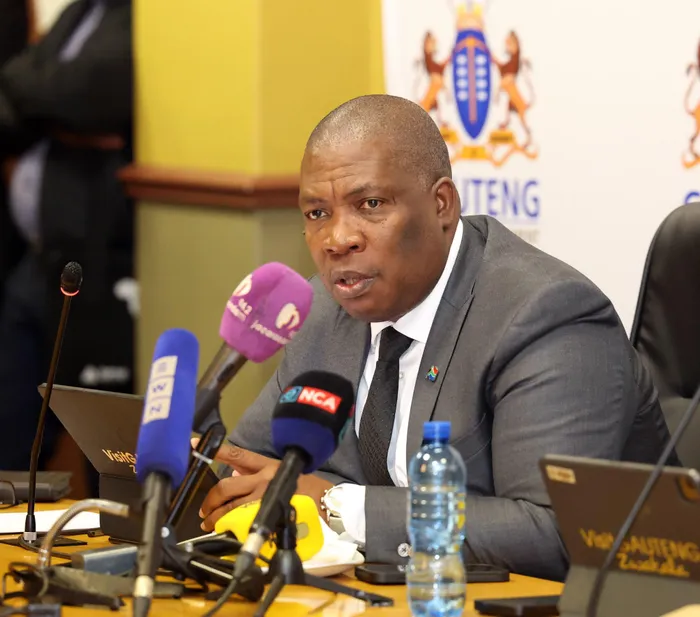
Gauteng Premier Panyaza Lesufi Opposition parties in Gauteng have called on Premier Panyaza Lesufi to use his upcoming State of the Province Address to explain delays in service delivery and provide clear timelines to fix ongoing service delivery failures.
Image: X/GPG
Opposition parties in Gauteng say Premier Panyaza Lesufi must stop making promises in his upcoming State of the Province Address (SOPA) and instead explain why past promises were not kept and how he plans to fix service delivery problems.
Lesufi is scheduled to deliver the annual address on Monday at the Nasrec Expo Centre in Johannesburg, with proceedings expected to begin at 6pm.
The speech provides an opportunity for the premier to reflect on the government’s performance over the past year and outline priorities for the year ahead.
In February 2025, Lesufi identified 13 priorities in his SOPA, aimed at tackling Gauteng’s most pressing challenges.
These include water shortages, cable theft and vandalism, non-functioning traffic lights, potholes, crime, the growth of informal settlements, electricity supply constraints including load shedding and load reduction, rising gender-based violence and femicide, drug abuse, strained healthcare services, a shortage of schools, deteriorating infrastructure and central business districts, and unemployment.
Despite these commitments, service delivery across the province remains under strain, with many townships and informal settlements grappling with water shortages, recurring power outages, crime and crumbling roads.
The Democratic Alliance (DA), the official opposition in Gauteng, said residents should brace for more unfulfilled promises.
“Premier Lesufi will make bold commitments and portray a government that is working for the people despite failing dismally to deliver basic services such as water, electricity and sanitation, and to fix roads,” said DA provincial leader Solly Msimanga.
“These SOPA addresses have become stories of a parallel universe, devoid of the reality residents experience daily.”
Msimanga said communities across the province were struggling with service delivery failures.
“Every community, from Tshwane to Merafong, except the DA-led Midvaal, is complaining about one or more of the following issues: water, electricity, sanitation, schools, hospitals, roads, social services, housing, unemployment or corruption,” he said.
He added that some areas had been without water for weeks, while others had gone years without electricity because broken transformers had not been repaired.
“Johannesburg residents have taken their frustration to the streets, but not enough has been done to resolve water outages,” Msimanga said.
“Water infrastructure, particularly reservoirs and pipes, has not been maintained or replaced for years. Despite population growth in several townships, sewer upgrades have not been carried out.”
He pointed to the Emfuleni local municipality as an example of a municipality where sanitation had collapsed, with sewage flowing into homes and streets.
“Infrastructure has deteriorated due to a lack of regular maintenance and poor governance. Roads are riddled with potholes and sinkholes, posing dangers to motorists and pedestrians. Forty-four percent of Gauteng’s provincial traffic lights are not functioning, despite promises to bring roads up to standard,” he said.
Msimanga also said schools, hospitals and clinics were overcrowded and under-resourced.
“Residents die waiting for cancer treatment, and learners are deprived of quality education due to a lack of chairs, desks and learning materials,” he said.
He accused the provincial government of failing to curb corruption, saying repeated promises of lifestyle audits had yet to yield results.
ActionSA Gauteng provincial chairperson Funzi Ngobeni said many residents would be listening “one thing” and plans to address the ongoing water crisis.
“For far too many households and businesses, unreliable water has become part of everyday life,” Ngobeni said.
“This is no longer just a policy discussion. It is about whether the system is functioning as it should and whether basic maintenance and management are being taken seriously.”
He called for clear timelines, straightforward progress updates and accountability where failures had occurred.
“Residents do not need more committees or new structures. They need stable, reliable water,” he said. “Water is not a favour from the government; it is a constitutional obligation.”
Ngobeni said communities were weary of water tankers being treated as a long-term solution, adding that businesses, clinics and families could not function properly without consistent supply.
“If there are infrastructure failures, tell us what is being repaired, by when and who is responsible,” he said. “If there are budget constraints, be transparent. If contractors have failed, there must be consequences.”
Meanwhile, GOOD Party national chairperson Matthew Cook called on Lesufi to provide an honest account of progress, clear explanations for unmet commitments and concrete, time-bound plans to address the province’s challenges.
In 2023, the premier committed to accelerating economic recovery, fighting crime and corruption, transforming townships and informal settlements, strengthening state capacity and improving health services,” Cook said.
“In 2024, he repeated his promise to eradicate shack settlements and upgrade informal settlements into habitable communities, including providing water, electricity and sanitation, and formalising 68 informal settlements.”
Cook said that in 2025 Lesufi identified Gauteng’s 13 problem areas and outlined plans to invest in infrastructure and job creation. However, he argued that too many of these commitments remained unfulfilled.
“Informal settlements continue to grow, service delivery failures persist, infrastructure remains inadequate, and many communities still lack reliable water, electricity and decent schools,” Cook said.
He added that previous SOPAs had been criticised as heavy on rhetoric and light on actionable plans.
“A State of the Province Address must assess not only aspirations but also past performance,” Cook said.
“It must include clear action plans that citizens can measure, monitor and use to hold the government to account.”
IOL Politics