

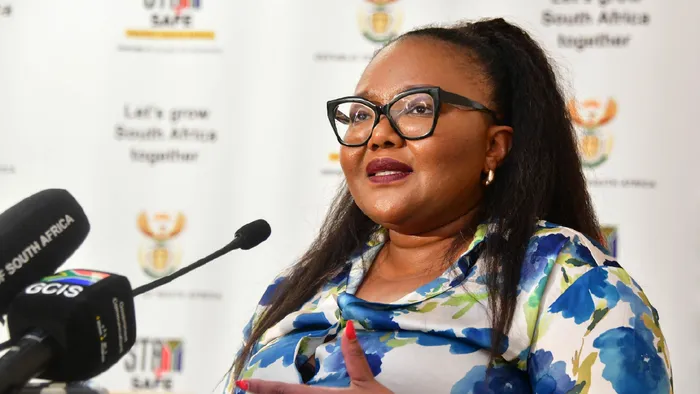
Basic Education Minister Siviwe Gwarube says the real challenges confronting the education system could not be simplistically attributed to the 1.8% of foreign learners in public schools.
Image: GCIS
Basic Education Minister Siviwe Gwarube has categorically dismissed claims that foreign learners are “overrunning” South African public schools.
Gwarube stated that the assertion lacked any factual grounding and was not supported by statistical evidence.
She was responding to parliamentary questions from MK Party MP Pinky Mngadi, who queried the justification the Department of Basic Education allocated public resources to foreign learners when such action impacted on the access to quality education by South African learners.
Gwarube pointed out that only 1.8% of learners in public schools are foreign nationals, thus far below any threshold that would suggest an overwhelming influence.
“The Department of Basic Education notes that, according to verified national enrolment data, foreign learners constitute only 1.8% of the total learner population, while 98.2% of learners enrolled in public schools are South African citizens. The claim that foreign learners are 'overrunning' schools or are the primary cause of system pressure is, therefore, not supported by evidence.”
The minister elaborated on the role of provincial Education departments, which oversee learner enrolment, while the national department provided national policy direction, oversight, and support to ensure that admissions were managed lawfully, equitably, and sustainably.
“Schools and educators are not responsible for immigration enforcement. Immigration management is the function of the relevant border control and immigration authorities,” she said.
Gwarube insisted that educational institutions must remain sanctuaries for all children, irrespective of their legal status.
“Schools must remain spaces of learning, inclusion, dignity, social cohesion, and safety for all children,” said Gwarube.
Mngadi also raised concerns regarding schools like Addington Primary in Durban, which reportedly admitted learners whose parents do not possess legal residency papers.
“What are the reasons children of undocumented and/or illegal foreign nationals are allowed to enroll in public schools in the Republic?” she asked.
In January, there were protests at the Addington Primary School over allegations that South African learners were kept out of school because foreign learners took their space.
Gwarube said her ministry was aware of issues relating to the admission of learners who did not have all the documents ordinarily requested at admission.
However, she reiterated that the South African Constitution guarantees every child the right to basic education, with the best interests of the child as a top priority.
“These provisions are read with the constitutional rights to equality and dignity, which apply to all persons in the Republic.
“South African courts have confirmed that these constitutional protections apply to all children in South Africa and are not limited by citizenship or immigration status.”
Gwarube also said denying a child access to schooling based on documentation or migration status constituted unfair discrimination.
Gwarube referenced a court judgment that affirmed constitutional guarantees that applied to all children in the country.
The South African Schools Act made a provision that a public school must admit learners and serve their educational requirements without unfair discrimination.
She said the Basic Education Laws Amendment Act prohibited the refusal of admission of a learner to attend school based on the non-submission of required documentation.
“The real challenges confronting the education system - such as infrastructure backlogs, overcrowding, funding constraints for the appointment of additional teachers, and broader resource limitations - are systemic and structural in nature and cannot be simplistically attributed to the small minority of foreign learners in public schools.”
Gwarube said that where learners lack documentation, the provincial departments and schools support processes to regularise documentation by liaising with the Department of Home Affairs, while ensuring that the child’s right to basic education was not unlawfully interrupted.