

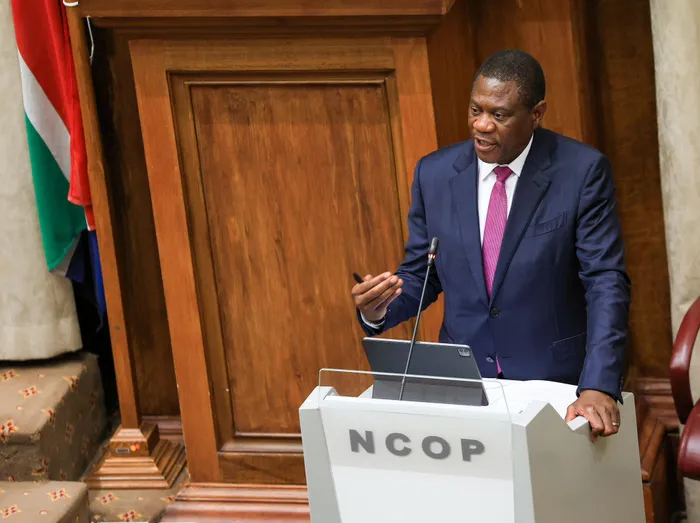
Deputy President Paul Mashatile vows to strengthen SAPS anti-corruption measures after Madlanga Commission interim report, promising visible action, recovered funds, and accountability to restore public trust in policing services.
Image: Paul Mashatile / X
Deputy President Paul Mashatile says the government has already implemented a range of measures aimed at detecting and preventing corruption within the South African Police Service (SAPS), but acknowledges that further reforms will be required following the findings of the Madlanga Commission.
Responding to oral questions in the National Council of Provinces (NCOP) on Thursday, Mashatile said the Justice, Crime-Prevention and Security (JCPS) Cabinet Committee had introduced several mechanisms before the commission was established to strengthen accountability and curb corruption within policing structures.
The question, posed by Dennis Ryder of the Democratic Alliance, asked what corrective measures the committee had implemented before the commission, particularly after the July 2021 South African unrest exposed serious weaknesses and alleged misconduct within SAPS.
Mashatile told the House that the JCPS Cluster remained central to coordinating the government’s response to crime, violence and corruption in the criminal justice system.
He said several initiatives had already been put in place to strengthen oversight and improve detection of wrongdoing.
“As the Chair of the JCPS Cluster Cabinet Committee, I wish to emphasise that the JCPS Cluster remains central to ensuring a coordinated whole-of-government response to crime, violence, and corruption within the criminal justice system,” Mashatile said.
He explained that measures introduced before the commission included the establishment of the Anti-Corruption Task Team, as well as the rollout of an integrated technology-driven case management system aimed at reducing interference and institutional vulnerabilities.
Government had also worked to strengthen forensic and investigative capabilities across the security environment.
Mashatile said the JCPS cluster had also intensified accountability mechanisms through SAPS’ Ethics Management Strategy and its Fraud and Corruption Prevention Strategy, which are overseen by internal governance bodies, including ethics, risk management and audit committees.
To improve reporting and detection of corruption, he said the police service had enhanced whistleblower protection through National Instruction 18 of 2019 on Integrity Management.
This enabled safe reporting through platforms such as the National Anti-Corruption Hotline, internal ethics lines and external oversight bodies including the Independent Police Investigative Directorate, the Public Protector South Africa and the Auditor‑General of South Africa.
Operational reforms have also been introduced, Mashatile said, including improvements in crime scene management, strengthening investigative capacity and the creation of specialised units such as the Anti-Gang Unit and the Economic Infrastructure Task Team.
Technology, including CCTV in high-risk areas and an integrated personnel management system, also forms part of the broader integrated justice system.
He said SAPS had also strengthened internal vetting and screening processes for personnel in sensitive positions, including senior management, members in crime intelligence, supply chain management officials and members of the Directorate for Priority Crime Investigation.
These processes include lifestyle reviews and financial disclosure analysis, as well as reactive lifestyle audits where allegations arise.
Where serious allegations of fraud and corruption are identified, Mashatile said forensic audits and criminal investigations follow and those found guilty are prosecuted.
He added that following interim findings by the Madlanga Commission indicating prima facie wrongdoing, the President had already directed the acting Minister of Police and the National Commissioner to establish a special task team to investigate criminality involving senior SAPS members and other implicated officials.
During a follow-up, Ryder questioned whether the government had failed to alert South Africans to the scale of corruption in SAPS or whether the criminal justice system had collapsed despite the measures listed.
Mashatile responded that the intention was to show that action had been taken before the commission’s work began.
“I want to make sure that people must not think that before the Madlanga Commission, nothing was being done,” he said, adding that although numerous measures had been introduced, the commission’s work was highlighting areas where controls still needed strengthening.
“What is coming out of the Madlanga Commission is that indication to say, yes, you have all these measures, but there are still loopholes,” Mashatile said.
He added that government was awaiting the commission’s final recommendations so that preventative systems could be strengthened to ensure corruption was stopped before it occurred.
Mashatile also stressed that the goal was to ensure systems prevented wrongdoing rather than only responding after crimes had been committed.
“The system must be such that it prevents this from happening, so that there is no opportunity for criminality in the system,” he said.
Responding to another question from Onica Medupi of the African National Congress about monitoring progress in anti-corruption efforts, Mashatile said several coordinating structures were already in place and were being strengthened.
He said government was reinforcing the work of NATJOINTS and its provincial counterparts, which bring together multiple security agencies including police, intelligence, correctional services and the military to coordinate operations and responses.
Mashatile added that the Anti-Corruption Task Team had already made significant progress, including recovering more than R11 billion through its investigations.
He also indicated that the Investigative Directorate Against Corruption would be strengthened to help address corruption more decisively.
Virgil Gericke of the Economic Freedom Fighters raised concerns about the alleged selective application of recommendations and claimed that some implicated officials had been effectively shielded.
Mashatile rejected the suggestion that anyone had been cleared by the President.
“As far as I’m concerned, the President has not exonerated anyone. Not that I know of,” he said, explaining that individuals such as the police minister Senzo Mchunu had merely been placed on leave while investigations continued and that the President was awaiting the commission’s full report before taking further action.
He acknowledged that the revelations emerging from the commission were troubling but cautioned against painting the entire police service as corrupt.
He added that SAPS employs over 100 000 officers and that targeting corrupt individuals would protect the integrity of the entire service.
“Sometimes they say that a few rotten potatoes can make the whole bag of potatoes rot. But because we are now zooming in on these individuals, we’ll protect the entire system,” he said.
He added that many police officers were committed to serving communities and should not be judged by the actions of a few.
Hendrick Van Den Berg of the Freedom Front Plus asked how the government would restore community trust in the policing cluster and whether there were measurable timelines for doing so.
Mashatile said trust would be rebuilt through action rather than words.
“The important thing that I can indicate is that the trust will be restored when there’s action, not talking,” he said. He added that once the commission’s report was received, the President would act to ensure those responsible were held accountable and that the system was strengthened.
Mashatile said transparency and visible action would be critical in restoring public confidence in the police service.
“So as we act, we must be transparent, there must be reporting, communication, so people know that the government is acting and dealing with the problem,” he said.
“We’re going to clean up the system and that’s what we’re going to do.”
IOL Politics