

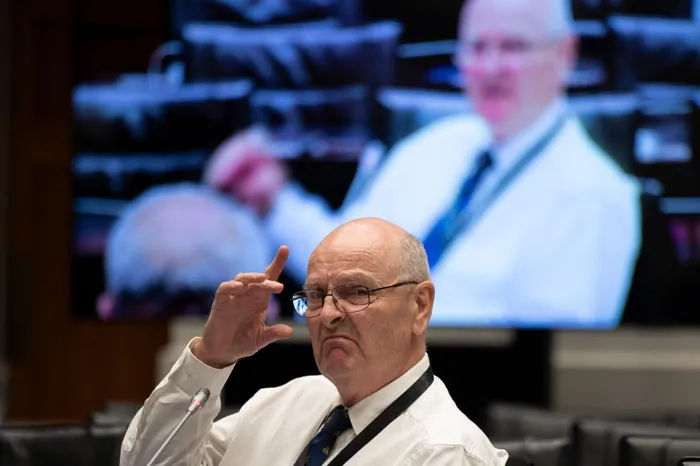
Forensic investigator Paul O’Sullivan says after he realised his family could be killed if he did not fight back against those he accused of corruption, prompting him to move his family overseas for their safety.
Image: Armand Hough / Independent Newspapers
Forensic investigator Paul O’Sullivan told Parliament’s ad hoc committee that he realised if he did not fight back forcefully, he or his family could be killed, and as a result, he moved his family overseas for their protection.
“I apologise for being rude and for taking the fight to them,” O’Sullivan said while appearing before the committee on Thursday.
He also apologised for leaving last week’s meeting while he was still being questioned, explaining that he had been rushing to catch a flight.
O’Sullivan was responding to a detailed statement by Damien Klopper, a DA MP who commented on O’Sullivan’s conduct and the tone of his evidence.
Klopper began by acknowledging O’Sullivan’s experience and long career.
“First, I have respect for you for your age and your experience, which comes with a lifetime of work,” Klopper said.
“Few people reach a stage in life where they have spent so many years involved in matters of justice and crime. In itself, Mr O’Sullivan does deserve acknowledgement.”
However, Klopper said he struggled to reconcile that record with the language used in some of O’Sullivan’s emails.
“Where I do find myself in conflict is when I read some of the words you have chosen to write,” he said, adding that O’Sullivan had threatened individuals who appeared as witnesses before the committee.
Klopper said some of the emails presented to the committee were “plainly rude and threatening”.
“They do not resemble what I would expect from a routine professional engagement,” he said.
“While I appreciate that you may view your conduct as a defence against bullying, it is still no way to conduct yourself - especially when speaking to the NPA prosecutors - because your threats may be construed as interference with the independence of the NPA.”
He added that if similar threats were directed at the committee’s evidence leaders or members, Parliament would not tolerate them.
“At the same time, it is also clear - and consistent - that you have pursued corruption with determination,” Klopper said.
“Your effort is not undeniable.”
However, he said the pursuit of justice becomes problematic when accompanied by language that undermines credibility.
“When emails cross the line into threats and personal attacks - including attacks on a person’s family - it risks bringing your own reputation into disrepute,” he said.
“Now I will say this: it is entirely possible that many of the suspicions and allegations you raise in those emails may contain truth. It is not for me to judge whether someone is guilty or not. They may indeed contain truth.”
Klopper said that if this were the case, it should not come at the expense of proper conduct.
“Perhaps it is part of the environment in which you have worked, where you feel you need to appear tough. But there is a very short distance between demonstrating toughness and becoming unnecessarily rude or overreaching the limits of what one is permitted to do,” he said.
“That is a rule that binds everyone in this room.”
Klopper said directness is sometimes necessary but can quickly become threatening.
“Being firm can quickly become attacking,” he said.
He added that O’Sullivan had also been subjected to disrespect from some committee members.
“There has been name-calling, insults and comments that are plainly defamatory,” Klopper said.
“In my view, that is morally wrong and completely indefensible.”
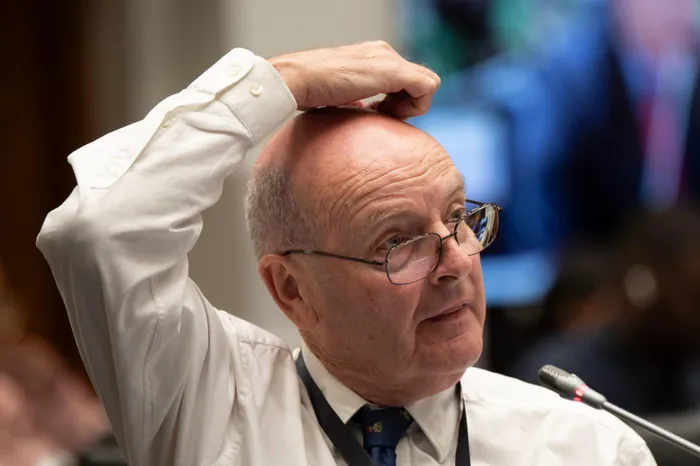
Forensic investigator Paul O’Sullivan told Parliament he moved his family overseas after realising that if he did not fight back against those he accused of corruption, he or his family could be killed.
Image: Armand Hough / Independent Newspapers
He said the situation had become difficult to separate.
“At the end of the day, you are also somebody’s father, someone’s brother, friend - perhaps even a grandfather. But when one speaks to others in the same harsh manner we have seen in some of your emails, it becomes difficult to separate the two.”
Klopper said O’Sullivan had, at different times, been on both sides of the conflict.
“You have dished out, Mr O’Sullivan, and now you have also received,” he said.
“I have no doubt that, like many people in this room who are passionate about removing corruption from our institutions, the goal is shared by many of us. But there are rules to be followed and standards of conduct that must be maintained.”
“Passion for justice cannot replace discipline in behaviour, in the language you choose to use and in how you approach people. That is the balance I struggle with when I look at your evidence before this committee.“
Klopper also questioned O’Sullivan’s admission that he had used his identity as a white man to gain access to certain areas.
“You said you used your front as a white man to access places such as Sable Hills. You took photographs of people’s houses and questioned individuals,” Klopper said.
“Unfortunately, that is something I struggle to reconcile.”
Despite his criticism, Klopper thanked O’Sullivan for returning to the committee.
“I thank you for coming back to this committee despite the issues and the medical problems you have faced. I thank you for your time.”
Meanwhile, in his response, O’Sullivan said confronting wrongdoing was not always straightforward.
“It’s not easy to judge evil,” he said.
“With the benefit of hindsight, it’s very easy to say things should have been done differently, but it’s not easy to change history.”
He said that when confronting dangerous individuals, he sometimes felt compelled to appear tougher than he was.
“When you’re fighting evil, sometimes you have to put on a cloak to make yourself look much tougher than you are - especially when you have people trying to murder you, falsely arrest you, or send someone to kill your family because they cannot get to you,” he said.
“So yes, some of the emails may appear rude or insulting. Sadly, they were intended to be.”
O’Sullivan said he wanted to demonstrate that he would not be intimidated.
“I wanted to bring the fight to them and show them I was not going to be a walkover,” he said.
He described incidents in which he claimed he was forcibly arrested and detained under harsh conditions.
“They dragged me off at 220 kilometres an hour with handcuffs so tight behind my back I could hardly move. They put me in a cell with raw sewage running across the floor,” he said.
“When food and comfort items were brought in, the other 17 people in the cell shared it among themselves.”
O’Sullivan said these experiences convinced him that failing to fight back would have serious consequences.
“It leaves you knowing that if you don’t fight hard, you’re going to lose,” he said.
“With the benefit of hindsight, I might have done some things slightly differently.”
However, he said the situation forced him to act.
“I realised that if I didn’t fight hard, I would be dead or my family would be dead,” O’Sullivan said.
“I had to move my family overseas for their own protection.” He reiterated his apology for the tone of his emails.
“I apologise for being rude and for taking the fight to them,” he said.
“But I realised that if I didn’t, they would have beaten me and gotten away with what they were doing. It was done to show them that I was not going to be walked over and that I was onto them.”
The committee continues.
IOL Politics