

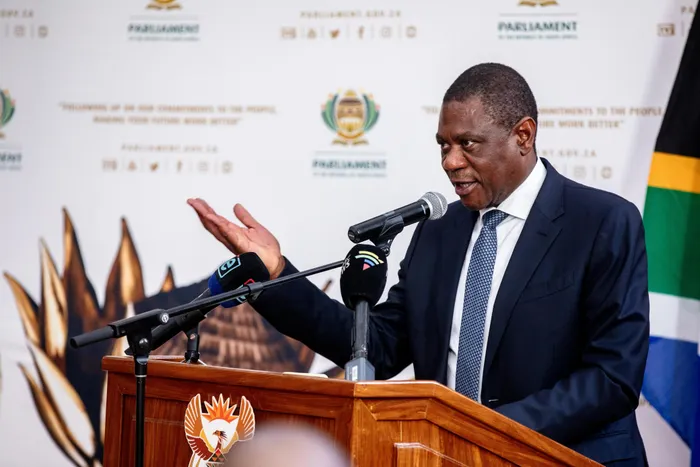
Deputy President Paul Mashatile says government is prioritising delayed water projects, emphasising the need for coordination and resources to address the escalating water crisis in key provinces.
Image: Parliament RSA
Deputy President Paul Mashatile has laughed off doubts about his competence in handling South Africa's water crisis, particularly in light of the creation of the National Water Crisis Committee led by President Cyril Ramaphosa.
The committee, which was announced in the President's recent State of the Nation address, has raised concerns among opposition members about the Deputy President’s role in tackling the country’s water challenges.
Mashatile, in a session of oral questions in the National Council of Provinces (NCOP) on Thursday, firmly rejected the idea that the creation of the new committee was a sign of a loss of confidence in his ability to handle the water crisis.
Responding to a question from The DA'S NCOP member, Frederik Badenhorst, who asked whether the President had placed a vote of no confidence in him, Mashatile clarified that the formation of the committee was not an indication of failure on his part.
He explained that it was a strategic move to bring together all necessary resources and departments under the President's leadership, particularly to address escalating water shortages in critical areas like Gauteng.
Mashatile emphasised that the Water Task Team, which he leads, will continue to monitor the situation at the provincial level and that his role would remain vital in overseeing the water challenges across the country.
“I will still be part of it because the Water Task Team will continue with its monitoring role, going to provinces. But we do need this structure that the President will assist to bring resources to bear in provinces and municipalities where there's a big crisis,” Mashatile said.
He added that the coordination between himself and the President on this issue remained strong, highlighting their collaboration in tackling water challenges at a national level.
The Deputy President also provided an update on government actions aimed at addressing the water crisis.
He confirmed that the Water Task Team had assessed the impact of abandoned and incomplete water infrastructure projects, identifying that delays have significantly weakened water availability and compromised environmental compliance in certain areas.
To address this, Mashatile highlighted that long-outstanding grant-funded projects had been prioritised for accelerated completion.
"Government has also taken steps to reprioritise funding to ensure delayed projects are finalized and water systems stabilised," he said.
On the issue of criminal syndicates, specifically water mafias, that have been sabotaging water infrastructure, Mashatile acknowledged the challenge and stated that the government was tightening policy reforms to address these issues.
He revealed that Operation Vulindlela, working with the Department of Water and Sanitation, was focused on reforms to prevent exploitation by such groups.
He also stressed that government-owned water tankers would be deployed to communities facing water shortages to prevent exploitation by private water tanker operators.
"The President indicated recently that where there are challenges of water, government itself must have its own water tankers," Mashatile said.
Turning to the provinces, the Deputy President outlined specific measures in place to combat water shortages.
In Gauteng, Mashatile shared that the government had approved increased water abstraction from the Integrated Vaal River System to support Rand Water in restoring reservoir levels. Further steps included the acceleration of leak reduction and infrastructure repairs.
Mashatile also visited the Carlswald reservoir construction site in Midrand, where a new 20 million-litre reservoir is expected to be completed by 2027, aimed at stabilising long-term water supply in the area
"Once it starts operating, it will give them a guaranteed supply for the next 20 years," Mashatile said of the project.
In the Eastern Cape, KwaZulu-Natal, and Western Cape, government efforts are focused on accelerating bulk water projects, reducing non-revenue water, and improving intergovernmental coordination to tackle the crisis.
Mashatile also responded to concerns about aging infrastructure, which has contributed to significant water losses in municipalities.
He acknowledged that many municipalities lacked long-term planning and faced financial constraints, which had hindered infrastructure maintenance.
"We are intervening to ensure those projects are completed...and that critical infrastructure is brought to completion," he said, emphasising the importance of municipalities planning for the long term.
In response to questions about the water crisis in Nelson Mandela Bay and Qheberha, Mashatile committed to investigating the issues further, acknowledging the ongoing challenges in the region.
He cited examples of intervention in the Eastern Cape, such as the use of boreholes in rural areas to supplement the water supply.
He also emphasised that rural areas, where infrastructure challenges are more pronounced, would be prioritised.
On the subject of the Giyani bulk water project in Limpopo, which has faced significant delays, Mashatile reiterated that government intervention was underway to complete the project.
"There was a lot of work done to get water to the areas, but the project did not complete the reticulation. That's what we are unlocking in Limpopo," he said.
Mashatile noted that, given the vastness of the province, alternative solutions, such as boreholes, were also being encouraged to ensure a reliable water supply.
IOL Politics