

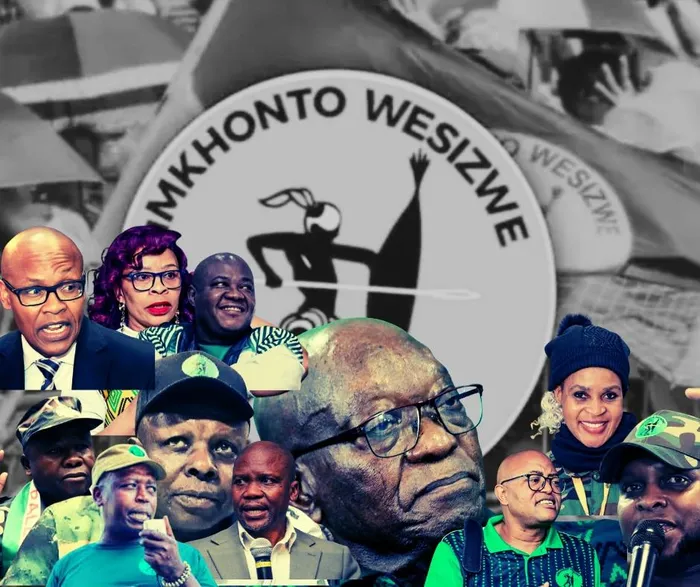
The MK Party has seen rapid changes in leadership since its formation, with top positions frequently reshuffled under the influence of founder Jacob Zuma.
Image: IOL Graphic / Lee Rondganger
The Umkhonto Wesizwe Party (MK Party) has seen rapid leadership changes since its formation two and a half years ago, with key positions frequently reshuffled.
Despite this instability, analysts say the party’s founder, former president Jacob Zuma, maintains strong support, particularly in KwaZulu-Natal, keeping its electoral prospects in the region largely intact.
Since its launch, the party has repeatedly reshuffled top officials, including the secretary-general, deputy secretary-general, treasurer-general, and the chief whip.
Around 18 Members of Parliament (MPs) have reportedly been removed, with some taking their cases to court.
These moves have sparked public concern about the party’s stability, but analysts say insiders remain largely unfazed.
IOL previously reported that Member of Parliament (MP) Sibonelo Nomvalo was appointed Secretary-General, replacing Dr Bongani Mncwango. Nomvalo becomes the party’s eighth Secretary-General in less than two years, highlighting the high turnover in the role.
MK Party chairperson Nathi Nhleko announced the changes at a media briefing in Umhlanga, Durban on Thursday, explaining that the reshuffles followed a meeting of the party’s National Officials to reconfigure operational and leadership functions.
“He is charged to serve as the centre of organisational management and ensure the smooth operation of the party’s initiatives while maintaining its structural integrity,” Nhleko said.
The reshuffle also affected KwaZulu-Natal, with Simphiwe Mpungose appointed Provincial Secretary and Gobizizwe Makhanya replacing Reggie Ngcobo as Provincial Organiser.
Tholakele Dlamini was named Head of Elections, taking over from Bongani Baloyi. Nhleko framed the changes as part of strategically aligning the party ahead of the 2026 local government elections.
UKZN political analyst Siyabonga Ntombela said the high turnover reflects Zuma’s leadership style.
“Zuma doesn't want people to feel comfortable and be popular to the point that they start thinking they're bigger than him and the party,” Ntombela said.
He added that the reshuffles are unlikely to destabilise the party itself. “Some will even justify such a reshuffle as part of Zuma's strategic moves. However, the public might sympathise with those who are losing a livelihood abruptly,” he said.
Ntombela also pointed to internal disputes that led to suspensions, including cases involving Dr Hlophe, Nhlamulo Ndhlela, and Colleen Makhubele.
“If Zuma suspended someone who lost his pension for him and the MKP did not make any noise about it, nothing else can shake its support in regions like KZN,” he said.
On women in leadership, Ntombela was blunt: “Not at all. The party has no elective conference to address these issues, so members would rather keep quiet and wait their turn at the trough.”
Professor Theo Neethling, research associate at the University of the Free State, described the turbulence as a symptom of the party’s personalised leadership and weak institutional foundations.
“The party is closely associated with its leader, Jacob Zuma, whose dominant role in decision-making, particularly regarding political appointments, means that authority is concentrated in one individual rather than in stable party structures,” Neethling said.
He explained that most leadership positions are appointed rather than elected. “Without the legitimacy that comes from formal party conferences or democratic internal processes, leadership roles can easily be contested. This fuels factional disputes and leads to high turnover of officials,” he said.
Neethling warned that unless the MK Party develops clearer rules and stable internal procedures, frequent reshuffles are likely to continue, which could threaten organisational cohesion and voter confidence.
Meanwhile, UKZN analyst Zakhele Ndlovu said the MK Party is “not a normal political party in the sense that Zuma still considers himself a member of the ANC.” He described it as a temporary vehicle designed to demonstrate Zuma’s influence.
“MKP was formed because he wanted to show the ANC that he commands significant support. It is a temporary party while Zuma is at odds with Ramaphosa's ANC.
''His agenda is not fully understood by many MKP supporters, who are being used as pawns. Zuma is still fighting to have his ANC membership reinstated,” he said.
Ndlovu added that while frequent reshuffles may hurt the party’s image among some supporters, loyalty to Zuma remains strong.
“The majority of the party's supporters are sycophants who are unbothered by the ongoing drama. The cult of Zuma's personality is enough to attract electoral support,” he said.
On long-term stability, Ndlovu cautioned: “As long as Zuma is around, retaining members is not an issue. The problem arises when Zuma is no longer here. The party will implode when the glue ceases to exist.”
Independent analyst Goodenough Mashego said the party’s unelected leadership explains the high turnover.
“The leadership of MK Party is not elected. So for every person in leadership, there are no numbers behind them.
''It becomes easy to move someone from secretary to deputy secretary, or from secretary to parliament, like chess pieces, because they are not elected. They don't carry a mandate and serve at the behest of the party leader,” Mashego said.
He added that the instability is deliberate. “I don't think MK Party is intended to be stable. Once people feel secure, they start growing independent. That’s when they get dismissed. You must always be on tenterhooks,” he said.
Mashego explained that internal tensions serve a divide-and-rule purpose. “As long as you prevent cohesion, it’s a divide-and-rule strategy,” he said. On public perception, he noted that the party is unconcerned.
“They know who's going to vote for them. I don't think MKP intends to grow beyond its current size, but it aims to influence the ANC leadership next year.”
IOL Politics