

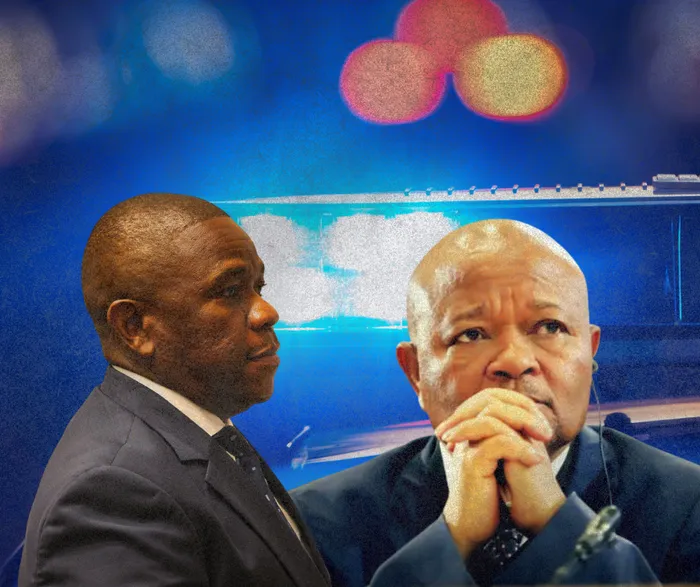
KwaZulu-Natal police commissioner Lieutenant General Nhlanhla Mkhwanazi has told Parliament that suspended police minister Senzo Mchunu is no longer fit to lead the department, pointing to evidence presented before two inquiry structures.
Image: IOL Graphics
Suspended under-fire police minister Senzo Mchunu is no longer fit to lead the police ministry - this is according to KwaZulu-Natal provincial police commissioner Lieutenant General Nhlanhla Mkhwanazi.
His remarks have sparked debate after he addressed a parliamentary Ad Hoc Committee during his final testimony on Wednesday.
His comments echo calls from political parties that have long demanded Mchunu’s removal following explosive allegations against him.
The no-nonsense top cop said his remarks were based on what he had seen and heard during proceedings linked to the Madlanga Commission of Inquiry and the committee.
“I am an official. For me to start talking about a decision the president must take might not be fair,” he said.
“Having seen what we have seen and having read and listened to what has been presented to these two structures (Madlanga Commission and the Ad Hoc Committee), it is clear that Minister Mchunu is no longer fit to run the department of police,” Mkhwanazi said.
Mkhwanazi was responding to allegations against both himself and the Political Killings Task Team (PKTT).
His testimony follows his explosive media briefing on July 6, 2025, which triggered the current parliamentary inquiry into alleged corruption, political interference and institutional capture within the South African Police Service (SAPS).
During that briefing, Mkhwanazi implicated several senior officials, including Mchunu, who is currently on special leave, and suspended deputy national commissioner for crime detection Lieutenant General Shadrack Sibiya.
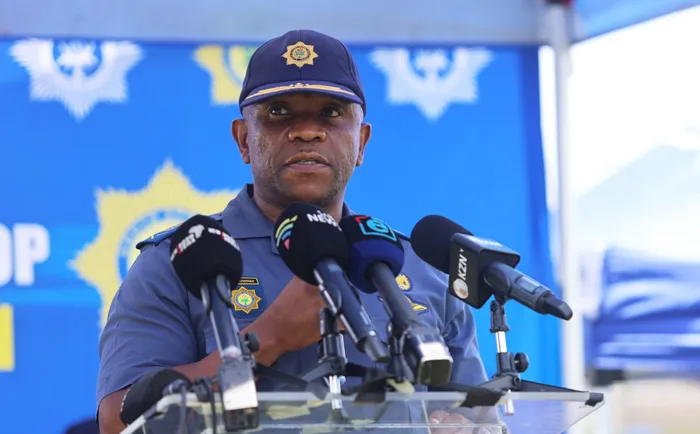
KZN Provincial Commissioner Nhlanhla Mkhwanazi KwaZulu-Natal police commissioner Lieutenant General Nhlanhla Mkhwanazi says suspended police minister Senzo Mchunu was “captured” into writing a disbandment letter of the PKTT.
Image: Tumi Pakkies Independent Newspapers
Mchunu was ‘captured’ into writing PTKK disbandment letter
Mkhwanazi maintained that Mchunu, who was new to the portfolio at the time, had been influenced to author the December 2024 letter that led to the disbandment of the PKTT.
“I believe the minister was captured to write that letter,” he said. “He does not accept that - he owns it.”
According to Mkhwanazi, forensic analysis shows that Mchunu drafted the letter on his iPad. Although the data was allegedly deleted, investigators were able to recover it.
“You delete, we retrieve,” he said. “We know he is the author.”
He outlined the document’s circulation process, stating that it was sent from the minister to his chief of staff, then to a personal assistant, where an electronic signature was added before distribution.
He also alleged that the document was sent to both official and private email addresses on the same day.
Mkhwanazi argued that the disbandment had serious operational consequences, including leaving SAPS without a head of crime intelligence for nearly a year and disrupting ongoing investigations.
He said arrests linked to the Crime Intelligence division, including that of Lieutenant General Dumisani Khumalo, brought key operations to a halt.
Officers involved were unable to work, access resources or receive payment due to funding constraints tied to intelligence structures.
He added that millions of rand from the secret services account were spent during this period and that these expenditures are now under audit scrutiny.
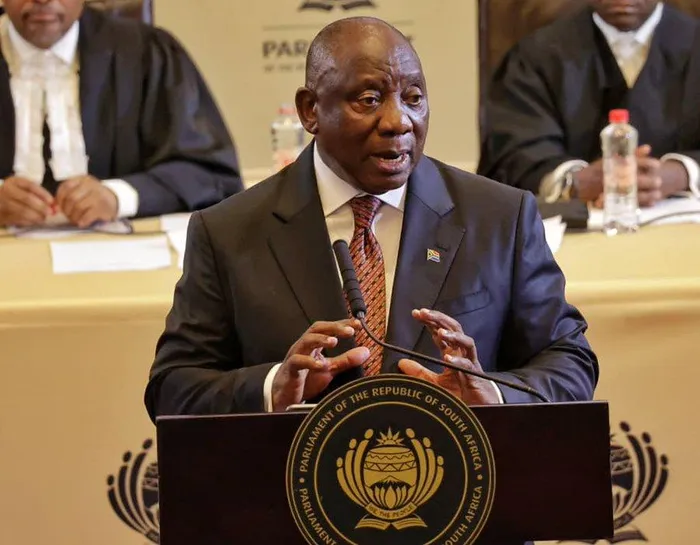
President Cyril Ramaphosa has criticised suspended police minister Senzo Mchunu for disbanding the Political Killings Task Team without consultation, saying the decision should have rested with the national police commissioner.
Image: GCIS
Ramaphosa: Mchunu did not consult me on PKTT disbandment
President Cyril Ramaphosa has said he did not approve the disbandment of the Political Killings Task Team and was dissatisfied that he had not been consulted beforehand.
Ramaphosa made the statement in written responses submitted to the committee on Tuesday.
He said the decision was taken by Mchunu and should have fallen under the authority of national police commissioner General Fannie Masemola.
Ramaphosa said he was informed of the move on or about February 1, 2025 by Masemola, who indicated that Mchunu had instructed that the unit be disbanded.
Masemola also made it clear that he disagreed with the decision, Ramaphosa said.
“He further assured me that, notwithstanding this instruction, a disbandment could not be effected immediately, as this would negatively affect pending investigations,” Ramaphosa said.
The president said he subsequently requested a meeting with Mchunu, which took place on or about February 13, 2025.
“At this meeting, the minister informed me that he had given the instruction to disband the task team and his reasons for doing so,” Ramaphosa said.
“I conveyed my dissatisfaction at not having been consulted prior to this decision being taken. I further indicated that, in my view, this was a decision for the national commissioner to make.”
Ramaphosa said he made it clear that he expected to be kept informed of any further decisions affecting investigations into political killings.
“It was my understanding that the steps to be taken fell within the purview of the national commissioner’s authority,” he said.
He added that he understood from Masemola that the PKTT would not be disbanded and that its work would continue despite the directive.
Ramaphosa’s responses follow calls from members of the parliamentary committee for him to appear in person and be held fully accountable.
Mchunu previously told the committee that he had not consulted Ramaphosa before issuing the disbandment directive.
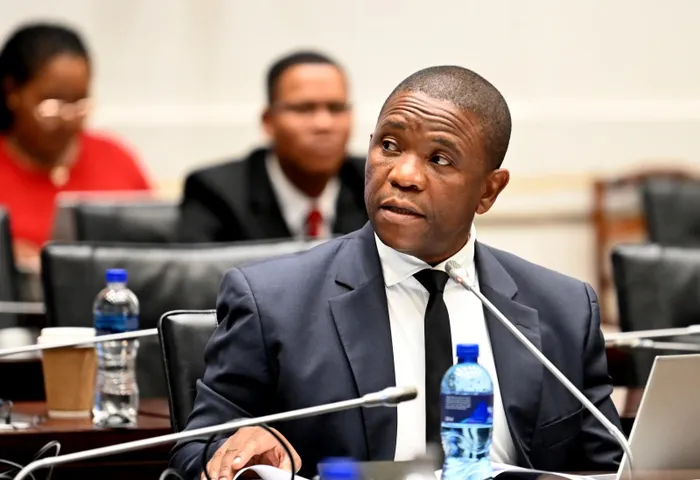
KwaZulu-Natal police commissioner Lieutenant General Nhlanhla Mkhwanazi delivers testimony before a parliamentary ad hoc committee, where he questioned Senzo Mchunu’s fitness to lead the police ministry.
Image: Ayanda Ndamane / Independent Newspapers
Mkhwanazi criticises SAPS vetting unit as ‘dirty’
Mkhwanazi, whose security clearance expired in 2018, said that if he had the authority he would dismiss the entire vetting unit, starting with its head, Major General Feroz Khan.
He described the office as “dirty”. He confirmed to the committee that he still does not have security clearance.
“The answer is no, I still do not have one,” he said.
His last top-secret clearance expired in 2018. He had applied for renewal in 2013 through the State Security Agency.
“In the vetting process, you have to disclose everything - where you were born, where you grew up, your schooling, friends, family, bank accounts, assets and more,” he said.
He claimed the process was completed, including a polygraph test, but clearance was not issued due to allegations raised by an Independent Police Investigative Directorate (IPID) official in KZN.
“I was told there was a case involving a so-called hit squad in 2013 in KwaZulu-Natal, in which I was implicated. At the time, I was working in Pretoria and had never worked in KwaZulu-Natal,” he said.
Mkhwanazi said he received no feedback on the matter, and a subsequent application to Crime Intelligence remained unresolved as of 2022.
He alleged that delays were caused by unverified claims, including media reports and cases he said he was never informed about.
“These allegations are used to justify not finalising my clearance. From what I know, I have no case. My name was simply included,” he said.
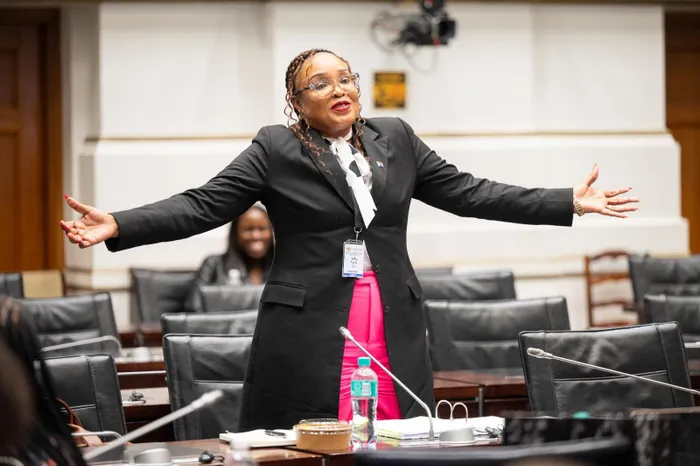
Lieutenant General Hilda Khosi Senthumule, Acting Deputy National Commissioner for Crime Detection and Divisional Commissioner for Detective in SAPS, testifying before the committee and showing off her Brazilian butt lift (BBL).
Image: Armand Hough/Independent Newspapers
Senthumule a “typical example”, says Mkhwanazi
Mkhwanazi criticised acting deputy national police for crime detection Lieutenant General Khosi Senthumule, describing her as a “typical example” of manipulative officers.
During testimony at the Madlanga Commission of Inquiry, Sibiya previously alleged that Senthumule had received money from controversial murder business tycoon Vusimuzi “Cat” Matlala to fund cosmetic surgery.
However, when she recently appeared before the committee, Senthumule stood to demonstrate to MPs and committee members that she had paid for her own Brazilian butt lift (BBL) in 2023.
She told the committee that she has documentation to prove it. She did, however, admit to attending a party at Sibiya’s home in 2024, where Matlala’s wife, Tsakani, was present.
In her testimony before both the commission and the committee, Senthumule criticised Mchunu’s decision to disband the Political Killings Task Team.
She recalled being informed by Khumalo that the minister wanted 121 dockets under investigation by the PKTT transferred to Detective Services. However, Mkhwanazi warned lawmakers not to believe everything they hear without questioning it.
“Honourable (Ashley of Patriotic Alliance) Sauls says even Mkhwanazi has holes. I agree. We all have our downfalls … Senthumule comes here with her own things, and when she leaves, she is more like a celebrity,” he said.
Mkhwanazi played a recording of a conversation between Senthumule and Sibiya in which she criticised Masemola, Khumalo and the work of the PKTT.
“I removed her when I was at Crime Intelligence, and nobody asked why. She is a person who acts to be doing good, but when she speaks to Sibiya, you can tell that she’s not a good person,” Mkhwanazi said.
He alleged that Senthumule was among those who had abused Crime Intelligence’s secret fund.
“It’s attending functions, parties, and using that money,” he said.
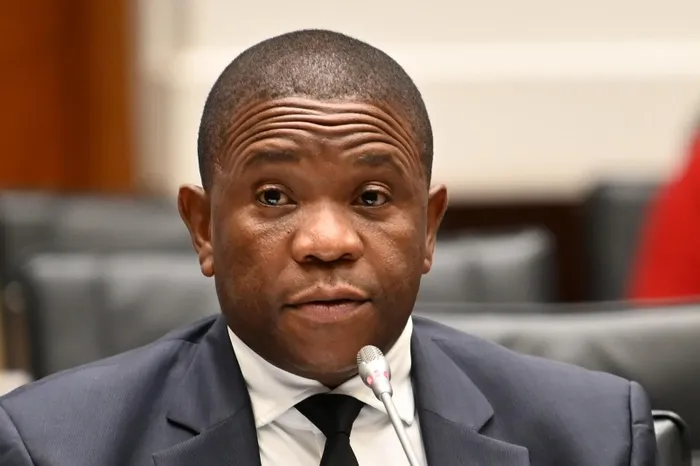
KwaZulu-Natal police commissioner Lieutenant General Nhlanhla Mkhwanazi told a parliamentary committee he is not afraid to die.
Image: Ayanda Ndamane / Independent Newspapers
“We shall all die,” says top cop
Mkhwanazi said he chose to speak out on July 6 despite the risks to his life and family.
“We all shall die. Nobody will live forever. It depends how you die as a person,” he said.
“I’m not necessarily worried about dying. If death gets me, it will get me.”
He acknowledged that his life has changed significantly since the briefing.
“I can’t easily walk around anymore with my children or sit in a restaurant and have a meal. People approach you everywhere,” he said.
He added that he values his freedom and does not enjoy constant security.
“That’s why I’ve said those who might be planning something must move with speed if it happens,” he said.
The committee will now compile its oversight report, and is expected to include a broad range of recommendations aimed at reform.
Once finalised, the report will be tabled before the National Assembly (NA) for adoption or rejection.
IOL Politics