

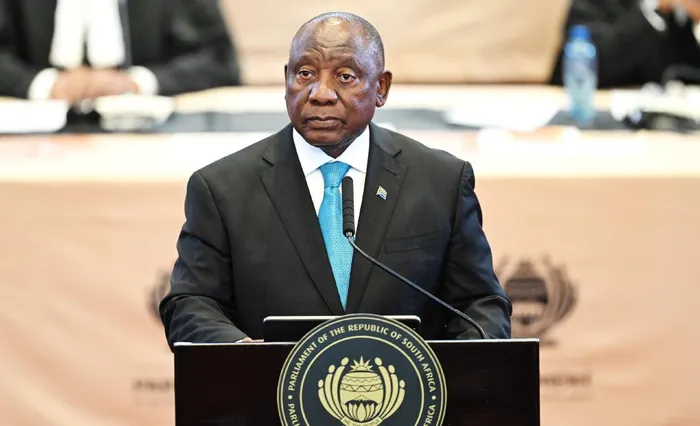
The Constitutional Court has ruled in favour of the EFF, paving the way for an impeachement of President Cyril Ramaphosa in connection with the Phala Phala case.
Image: Phando Jikelo / Parliament of SA
The Constitutional Court has ruled in favour of the Economic Freedom Fighters, finding that the National Assembly acted unlawfully when it voted in December 2022 to reject the Section 89 Independent Panel report into President Cyril Ramaphosa's Phala Phala scandal.
The judgment, delivered at 10h00 on Friday morning at Constitutional Hill in Braamfontein, marks one of the most consequential rulings against a sitting head of state in the country's democratic history. The court has ordered Parliament to properly process the Section 89 panel report, reopening the possibility of a full impeachment inquiry into the President.
The ruling came exactly 521 days after the matter was argued before the court, a delay that had itself become a national controversy.
At the heart of the ruling is Rule 129 of the National Assembly's impeachment procedures, which the EFF had argued was unconstitutional. The EFF argued that the discretion Rule 129 gave Parliament was unconstitutional, as it allowed Parliament to override the findings of an independent panel and frustrate the constitutional purpose of the impeachment process. The court agreed, finding that the National Assembly's 214-to-148 vote to reject the panel's findings was irrational and inconsistent with the Constitution.
ATM parliamentary leader Vuyo Zungula had argued that Parliament failed in its oversight role by refusing to allow a full impeachment inquiry to proceed. "The only rational thing to do would be to further scrutinise," Zungula said. The Constitutional Court has now validated that position.
The matter will be returned to Parliament, which must now reconsider the Section 89 panel report and determine whether to proceed to a full impeachment inquiry.
The ruling brings to a head a constitutional crisis that began on a winter night in February 2020, when thieves broke into Ramaphosa's Phala Phala game farm in Limpopo and stole a large sum of foreign currency, reportedly around $580,000, concealed in furniture at his private residence.
The President maintained that the money was a payment from a Sudanese businessman, Mustafa Mohamed Ibrahim Hazim, for the purchase of 20 buffalo. However, the Section 89 Independent Panel, chaired by former Chief Justice Sandile Ngcobo, found significant gaps in that explanation, including that the animals remained on the farm over two years later and that no official tax records existed for the transaction.
The panel, tasked with determining whether sufficient evidence existed to justify a full impeachment inquiry, made a series of damning findings. It found prima facie evidence that the President may have committed serious constitutional violations, including undisclosed foreign currency of doubtful origin, active involvement in a private business in potential breach of Section 96(2)(a) of the Constitution, failure to report the theft to the Directorate for Priority Crime Investigation as required by PRECCA, and abuse of office through a secret, unofficial investigation that included requesting assistance from the President of Namibia to apprehend a suspect.
The panel's conclusion was unambiguous: there was enough evidence to proceed to a full inquiry. Parliament, then still controlled by an ANC majority, disagreed.
On December 13, 2022, the National Assembly voted 214 to 148 against adopting the panel's findings. The motion failed. The ANC, which still held its parliamentary majority at the time, had resolved internally to oppose it, effectively using its numbers to shield the President from further scrutiny.
The Economic Freedom Fighters subsequently approached the Constitutional Court, challenging Parliament's decision not to adopt the Section 89 panel's findings. The EFF argued that Parliament had acted improperly in setting aside a report that suggested the President may have a case to answer.
The Constitutional Court ruling does not exist in isolation. Earlier this year, the declassified report of the Independent Police Investigative Directorate added fresh fuel to the accountability fire. IPID national head of investigations, Thuso Keefelakae, confirmed: "Our investigation found that there were some transgressions."
Chief among them: "Major General W.P. Rhoode failed to register or ensure that a case docket of housebreaking and theft was opened." Instead, Rhoode led an off-the-books internal operation to recover the stolen funds, using state resources, falsifying travel documentation, and invoking the President's name to avoid scrutiny. Astonishingly, Rhoode remains the head of the Presidential Protection Unit to this day.
Ramaphosa, confronted with the IPID findings, pushed back. "I had nothing to do with it," he said. "So that is a process, as I've always said, processes must play themselves out, and all these matters are being handled by the right institutions, and we must allow those institutions to handle those matters."
The political landscape in which this ruling lands is fundamentally different from the one that produced the 2022 vote. The ANC no longer has a majority in Parliament after the 2024 national election, which changes the landscape entirely. The party that once protected Ramaphosa with sheer numbers can no longer guarantee the same shelter.
The ANC, the DA, the EFF, MK, and every other party in the National Assembly must now decide how they will vote when the Section 89 report returns to the chamber, with the November 4 local government elections looming on the horizon, and every ward in the country watching.