
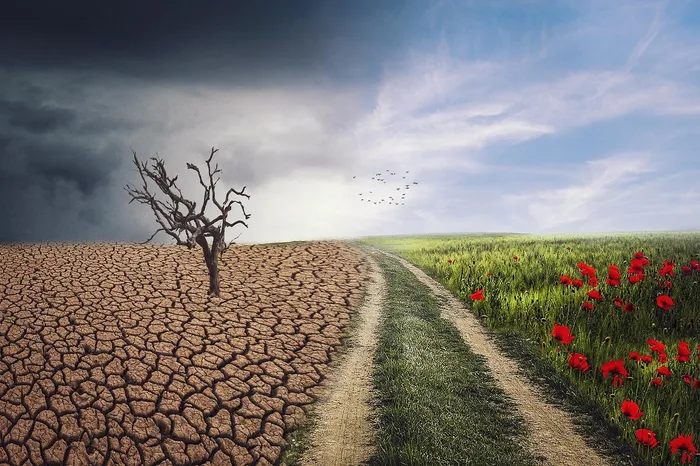
Experts say that marginalised people experience climate change far greater than people that are privileged.
Image: Pixabay
Indigenous people are at the receiving end of epistemic violence and climate calamities, and their knowledge is looked down upon, not regarded as scientific.
These are some of the concerns voiced by experts during a recent webinar titled ‘Decolonising Climate Risk Scholarship from the Global North to Africa’ hosted by the Human Sciences Research Council (HSRC) in collaboration with Midlands State University, University of Venda, and partners in Namibia.
Epistemic violence is described as systemic silencing, delegitimisation, or overwriting of particular knowledges, ways of knowing, or intellectual frameworks by dominant ones, often in colonial and power-imbalanced contexts.
Dr Mokhantšo Makoae, research director at HSRC, said that decolonising climate risk from the Global North to Africa is important considering how environments are consistently being disrupted by various factors.
She said the climate crisis coincides with wars taking place in different parts of the world, and also co-exists with declines in economic growth, and prosperity is under threat.
“We find that geopolitical polarity is affecting various ways in which communities and governments could collaborate to restore normality and certainty. But most worrying is that we see that where relationships take place, they are characterised by selective solidarity. This is a problem for humanity, particularly in the context of a human development programme that has been shaped by multilateralism and relationships across boundaries.
“And as the world is facing these challenges that we are talking about as recent as 2024, we find that the world fails to achieve one of its simplest goals: avoiding global average temperatures above 1.5 degrees centigrade and already this shows that we are living in a world where it is difficult to push the common agenda at the same rhythm and with the same form of effort,” Makoae said.
She added that it is challenging that solutions to reduce climate risk disasters have to be found, negotiated, and implemented by governments and communities that are ever facing multiple risks simultaneously.
“We know that it is a challenge, it requires multifaceted ways of addressing the problems, finding solutions, and also ensuring that there are sufficient investments to address these issues. While some of the risks that compound climate risk are more localised, many are globalised, and all have to be envisaged through policies and investments that ensure sustainability and inclusion.
“In addressing these challenges that we face, in relation to whose knowledge gets to be included, and whose knowledge gets to be excluded, we find that, as a result of these patterns of exclusion, it is a huge responsibility for governments but also for multilateral partnerships, such as the United Nations,” she said.
Makoae added that it is encouraging to see that social science and humanities have begun to question how knowledge and scholarship around climate risk reduction are being addressed.
What kind of policies are put in place, and they draw attention to the unequal contribution and domination of the institutions that are particularly influential when it comes to designing climate disaster risk policy, and that is policy for the entire world.
“We find that it is influenced by knowledge that is generated in only parts of the world, not the entire globe. The bias is real in that most of the knowledge systems that influence decisions about knowledge, about climate disaster risk, are epistemologies and methodologies that are informed by the Global North knowledge systems.
“But there is a problem, in the sense that they are characterised and informed by ethnocentric understandings. These understandings are based on othering. They are informed by ideas that drove colonialism and imperialism, they tend to be Western-centric and they harbour these values that put the West at the centre, while devaluing knowledge systems of other regions of the world, including Africa,” Makoae said.
She added that policy, planning, and governance around these matters have to be informed by a balanced scholarship.
Dr Wilfred Lunga, a senior research specialist with the HSRC’s Developmental, Capable and Ethical State research division, said the African continent contributes merely 4% of the global share of greenhouse emissions, and 35% of that 4% comes from South Africa, mainly from the emission of fossil fuels.
Dr Charles Musarurwa, a lecturer in Geography and Environmental Education in the Department of Science, Technology, and Design Education at Midlands State University in Zimbabwe, said indigenous, local, traditional, and Southern scholars are not placed on an equal footing with their Western counterparts.
“Knowledge from the North is regarded as science, while knowledge from the South is looked down upon. Climatic science is usually written in privileged languages; either you understand French or English, Portuguese or Spanish, and these are the main languages in which articles are written in most databases.
“Scientific models, such as convective, radiative, mathematical, and General Circulation Models and peer-reviewed papers, are regarded as objective and authentic as opposed to experiential, local/indigenous and practitioner knowledge,” Musarurwa said.
He added that even when you are a researcher, if you don’t include some of these models, your paper might be rejected when it is being peer reviewed.
“Most grants are awarded to the Global North, because most grant awarding institutions are in the North, and, they make sure that, they award grants to those people whom they can partner with, and when they partner, it is always us (global South researchers) playing the second feed rule, doing all the manual work, while they do the decision work. They want to make sure that whatever grant they give you, the money goes back to them in terms of paying for whatever they produce there.
“We really need to write in our own knowledge to ensure that all the systems, whether it’s political, economic, social, or planning, centre around recognising indigenous knowledges and their impact on our society. We also need scholars to rewrite the frameworks that are used for disaster risk and climate change, and factor in the African story, which relates to the unique nature of the various disadvantaged communities or local communities, and then put that into context,” Musarurwa said.
Fatima Peters, a lecturer in the Department of Psychology at the University of Venda, stated that epistemic violence, the non-physical form of violence invalidates the intellectual and cultural power of subjugated groups, causing them to lose their history, identity, and capacity to articulate their own realities by imposing foreign epistemic frameworks.
She added that people who are marginalised experience climate change far more than privileged people. All marginalised groups differ, and context matters; it is important to understand the people, context, and how the problems are being thought of and experienced.
Research is demonstrating that when forests are being destroyed, water is being removed, and when people are experiencing climate injustice, there’s a higher rate of anxiety and depression for indigenous people, because of the spiritual and cultural connection with land, Peters said.
“We need to think about participation, we need to think about inclusion, we need to think about empowerment, but most importantly, we need to think about how we facilitate emancipation of people who are marginalised. Being marginalised doesn’t just mean being excluded; it refers to the systemic ways individuals or communities are treated as less important, less powerful, less worthy within life, socially, politically, and economically.
“The problem is that people who have the money then come into the African context, South American context, Asian context, and they do interventions, that cost a lot of money, but have very little impact, because it thinks about us as people from the Global South as inferior, as incapable, and to blame for the problems that we are experiencing. And so epistemic violence and climate change and psychology literature really blame the person for experiencing the problem,” she said.
Peters added that water is at the heart of the problems experienced when it comes to climate justice.