

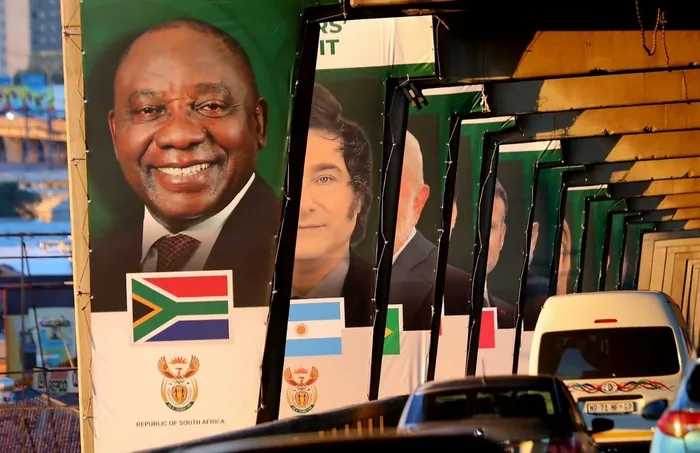
South Africa prepares to welcome global leaders for the G20 Summit G20 leaders have unanimously endorsed the South African expert panel's recommendations report for Global South development.
Image: Timothy Bernard / Independent Newspapers
The global leaders gathered at the G20 Leaders' Summit have unanimously endorsed the recommendations set forth by the Report of the South Africa G20 Africa Expert Panel.
This report, recently handed over to President Cyril Ramaphosa, demands a shift from old development paradigms, which viewed countries in the global South as mere export centres for raw materials.
It also called for bold multilateral action to transform Africa's development path. Further, it recognises the key role of the African Development Bank Group in realising productive investment across the continent, urging Africa to maintain high levels of economic growth.
Part of its plan is to restructure the continent's minerals through the beneficiation of its vast minerals and precisely calls for Africa to expand its transformation and expansion of its workforce to ensure global prosperity in a bid to reverse the inequalities that continue to enslave the continent and its economy with perpetual debt.
Various global leaders gathered on the first day of the summit have given this report the thumbs up, with Italy having already committed to halving the debt owed by African countries by 50%.
Speaking at the G20 Leaders' Summit in Johannesburg on Saturday, Italy’s Prime Minister Giorgia Meloni revealed that her country has committed itself to cutting the debt owed by low- and middle-income countries by half over the next decade.
This comes as reports have revealed that Africa faces growing financing pressures due to rising debt service costs, which severely constrain development. By the end of 2024, public debt had reached $1.815 trillion, while annual debt servicing climbed to $163 billion, leaving 57% of Africans living in countries where debt payments exceed health or education spending.
"Italy has also decided to reduce the debt of low-and middle-income countries by 50% over the next 10 years. It is our goal to convert the entire debt of the least developed countries into investment supply for young capitalists, which I consider a choice of justice and responsibility, and we hope others will follow," Meloni stated.
The G20 Summit leaders, through the declaration, have reaffirmed their commitment to support efforts addressing the economic obstacles and the unfair debt regime against the low- to middle-income countries.
"We recognise that a high level of debt is one of the obstacles to inclusive growth in many developing economies, which limits their ability to invest in infrastructure, disaster resilience, healthcare, education, and other development needs. While the risk of a systemic debt crisis appears to be broadly contained, many vulnerable low and middle-income countries face high financing costs, large external refinancing needs, and a significant outflow of private capital," the leaders declared.
Reacting to the work being done to champion a Global South-centred approach to the global economy, Dr Shadi Maganoe from the Wits School of Law commended South Africa for using the G20 Summit as an inclusive platform for change, particularly for the marginalised countries of the South.
She added that the report has marked a key milestone in South Africa’s G20 Presidency, which has sought to advance solutions for the issues that matter most to the African continent.
Dr Maganoe added that this year’s discussions, particularly following the recent Africa Expert Panel report handed to President Ramaphosa, are crucial in shaping the global conversation around growth, debt, and sustainable development.
"We welcome the declaration by G20 leaders. The summit’s success should, therefore, not be measured solely by whether a joint declaration is issued, but by whether it provides a platform for advancing the Global South’s priorities, fostering collaboration among member states, and bringing attention to the pressing economic challenges identified in the Africa Expert Panel report," she said.
The G20 agenda, as its standards are critical for Africa to achieve its economic sovereignty and self-reliance. The work on inclusive global economic growth, reform of international finance and tax, climate finance and green investment, development-based trade and investment are all critical for Africa to rise again," she added.
Speaking on the economic conditions set against low-income nations, John James Kirton, the co-director of the G20 Research Group, said more needs to be done to ensure Africa and other low-income countries can fend for themselves without being curtailed by debt.
"Africa has the opportunity now to drive its own development, and President Cyril Ramaphosa has done well to ensure that this G20 Summit reflects the aspiration of the rest of the African continent. There could never be sustainable economic development without allowing Africa to take charge of its minerals and the reduction of debt," he stated.