

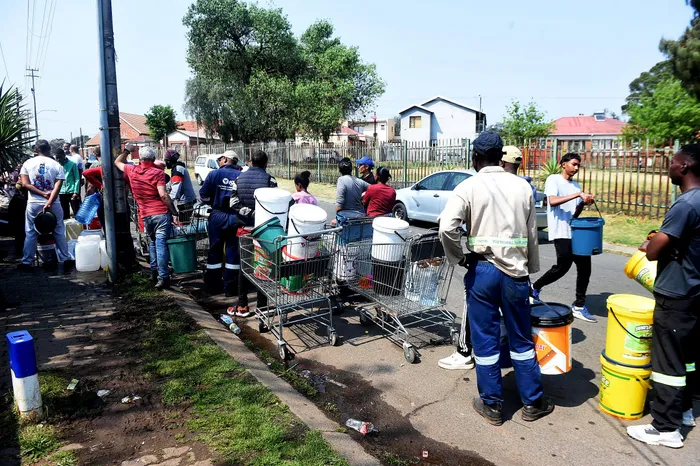
Governance experts say the water crisis in South Africa is likely to worsen despite President Cyril Ramaphosa establishing the National Water Crisis Committee.
Image: Itumeleng English / Independent Newspapers
Despite President Cyril Ramaphosa announcing the establishment of the National Water Crisis, the problem is likely to worsen in the coming years.
This is according to governance experts, who said the committee will not resolve the water crisis unless Ramaphosa gets rid of cadre deployment in water management.
South Africa is currently grappling with a severe national water crisis, which escalated around 2015, driven by severe droughts exacerbated by climate change and compounded by failing infrastructure, decades of neglected maintenance, and financial mismanagement.
The crisis has led to chronic water shortages in several major metropolitan areas and provinces, with Gauteng, Eastern Cape and KwaZulu-Natal being the most heavily affected.
Major parts of Johannesburg, including Midrand, Melville and Laudium, have faced prolonged outages (some exceeding 10 days), leading to widespread protests.
In KwaZulu-Natal, residents on the South Coast have experienced erratic or non-existent supply since mid-December due to power supply interruptions affecting extraction pumps.
In the Eastern Cape, Nelson Mandela Bay remains at high risk, with potable water levels in its five supply dams (Impofu, Churchill, Koega, Loeries, and Groendal) recently as low as 9.31%.
The situation in Gauteng and KwaZulu-Natal is a result of deteriorating infrastructure and major pipe bursts.
During his State of the Nation Address (SONA) on Thursday evening, Ramaphosa acknowledged that water outages are a symptom of a local government system that is not working.
He announced that he has tasked Minister of Water and Sanitation Pemmy Majodina and Minister of Cooperative Governance and Traditional Affairs (Cogta) Velenkosini Hlabisa to urgently address the water crisis in South Africa, particularly in Johannesburg.
He said criminal charges have already been laid against 56 municipalities for failing to deliver water. Ramaphosa also added that charges will now be extended to municipal managers in their personal capacity for violating the National Water Act.
Ramaphosa announced he will personally chair the National Water Crisis Committee (NWCC) to coordinate a national response, modeled after the National Energy Crisis Committee.
He said the committee will deploy technical experts and resources from the national government to municipalities facing water challenges, and ensure that action is taken swiftly and effectively to address the problem.
He also added that the government had committed more than R156 billion in public funding for water and sanitation infrastructure over the next three years.
Governance expert and political analyst Professor Andre Duvenhage said, despite this, the problem is likely to remain the same or worsen.
Duvenhage added that the problem with Ramaphosa and the ANC is the reliance on establishing committees instead of resolving problems.
He said this was not necessary at a local level.
“At the end of the day, you have layers of committees and commissions, as well as centralised decision-making. And the fact of the matter is that it is not worth it, especially when it comes to local government, where you need to create solutions,” he said.
Duvenhage said it was impossible to change the situation within the current framework, which he attributed to the 'lack of distance between what is political and what is administrative-technical'.
“You cannot appoint a cadre with the right connections and 20 years within the ANC in an appointment that is clearly a technical matter where you need engineers, technicians and people that are specialised,” Duvenhage said.
Asked to comment, Ramaphosa’s spokesperson, Vincent Magwenya, did not respond.
Water and Sanitation Ministerial spokesperson, Cornelius Monama, said the creation of the NWCC is far from being a “new promise” and that it is consistent with ongoing reforms in the water sector, reflecting the administrative logic that crises require stronger and centrally coordinated responses.
“Detractors are creating an environment in which timely action to serve citizens is mischaracterised as electioneering. The government cannot neglect its constitutional duty to serve the people until after elections. It must uphold that obligation every day, irrespective of the electoral cycle,” he said.
Meanwhile, another governance expert, Sandile Swana, said that while Ramaphosa is famous for creating parallel structures, the Constitution, the National Water Act and municipal law set out how water should be delivered in South Africa.
Swana said incompetence, non-performance and corruption are a problem in the water sector.
“In the political education of councillors, there is no effort to make sure that those in charge of water at any level are properly qualified and serious in delivering water.
“So the actual solution to the problem is not that we need Ramaphosa to oversee any delivery of water. Through the Public Service Commission instead, there should be assistance to remove the people who are a problem and appoint qualified candidates,” he said.