
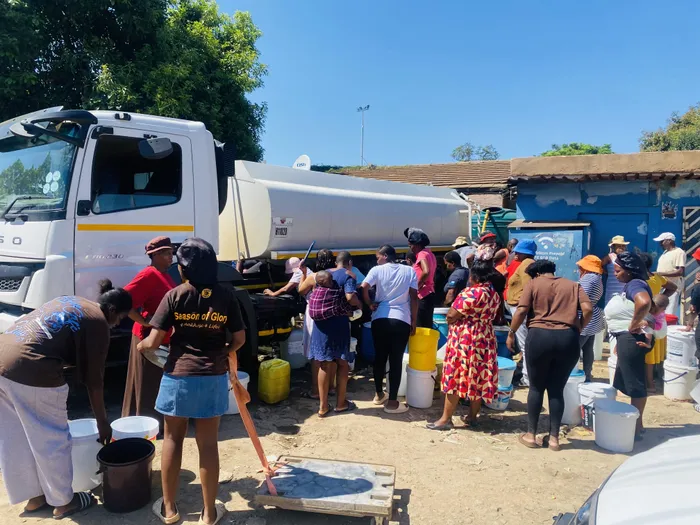
Residents of Zandspruit informal settlements queue with buckets and containers to collect water amid ongoing shortages in the area, as the City of Johannesburg reveals it spent millions of rand on emergency supplies.
Image: Simon Majadibodu / IOL
The City of Johannesburg spent R130.5 million on water tankers in the 2024/25 financial year in the midst of shortages due to infrastructure maintenance, the municipality’s council meeting heard on Thursday.
Details of the expenditure were revealed to ActionSA Councillor Khomo Mashala by Environment and Infrastructure Services MMC Jack Sekwaila.
Sekwaila said Johannesburg Water spent R130.5m on water tankers in 2024/25, which ended in June last year, and this includes both tanker provision for day-to-day water delivery to informal settlements, as well as emergency water tanker provision.
The cost related to the supply of water to informal settlements was R116.3m in 2024/25, and this service is provided to 198 informal settlements, comprising about 166,000 households.
In addition, the cost for emergency water provision relates to supply to residents during times of planned and unplanned maintenance, which results in water outages, and in 2024/25, the cost for emergency water provision was R14.2m.
Mashala asked for the plan now that Johannesburg is experiencing an escalating, severe water crisis, with many areas facing days or weeks without supply due to ageing infrastructure, high demand, and failing systems.
She said that currently, 56% of water is wasted, and storage capacity is under 12 hours, far below the required 48 hours.
“Key factors include critical infrastructure damage, leaks, and rising demand, which have left residents struggling with severe, ongoing shortages.
“Further to this, the city is increasingly relying on water tankers as a primary, rather than temporary, solution to chronic water outages caused by infrastructure failure and system instability, notably in regions like Midrand,” Mashala said.
According to Mashala, with about 75 trucks and hundreds of stationary tanks deployed, the city still faces significant logistical challenges and high costs, which call for a phased reduction in this dependency.
She demanded to know how much it cost Johannesburg Water to deploy water tankers to supply water to residents.
In response, Sekwaila said the statement that 56% of water is wasted or lost is not correct.
“The City of Johannesburg has an audited non-revenue water (NRW) figure of 44.8% for the 2024/25 financial year, with water losses of 32.9% (real or physical losses of 23.7% and apparent or commercial losses of 9.2%).
“The difference between non-revenue water (44.8%) and water losses (32.9%) is unbilled authorised consumption, which mainly refers to water consumed in deemed areas,” he explained.
Sekwaila insisted that the actual water loss figure for 2024/25 was 32.9%.
“The city has a combined storage capacity of 1,943 million litres, with an average daily demand of 1,726 million litres, which translates to approximately 27 hours of storage.
“Even though the overall storage is 27 hours, there are water districts where storage is below this,” he added.