
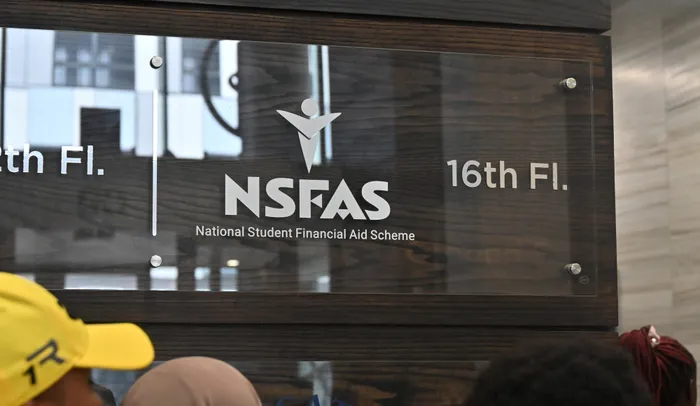
An OUTA investigation has revealed governance failures, systems weakness in the NSFAS student accommodation model.
Image: Ayanda Ndamane / Independent Newspapers
The Organisation Undoing Tax Abuse (OUTA) has released a report raising serious concerns about billions in public funds flowing through the National Student Financial Aid Scheme (NSFAS) student accommodation system.
The two-year investigation exposes corruption risks, governance failures, and issues with accommodation standards that affect thousands of students across South Africa.
OUTA's report builds on findings from its December 2023 investigation and incorporates new evidence from the Promotion of Access to Information Act (PAIA) and whistleblower disclosures.
The report highlights that recent structural changes to the NSFAS student accommodation model have introduced multiple intermediaries into the funding pipeline, complicating the system and increasing the potential for inefficiencies and abuse.
“There were already accommodation placement systems operating successfully at many universities,” said Stefanie Fick, OUTA’s Executive Director of Accountability.
“Instead of building on those systems, NSFAS introduced a new portal and outsourced critical functions to external service providers and accreditation agents.”
The investigation reveals significant weaknesses in the accreditation process, with some accreditation agents failing to properly inspect properties and certifying those that did not meet the required standards.
In one case, a property listed as accommodating 200 beds was found to be a typical three-bedroom house.
“If agents are certifying properties without proper inspections, the reliability of the entire accommodation system must be questioned,” said Rudie Heyneke, OUTA’s Senior Project Manager.
OUTA also raised concerns about the procurement process for companies managing the accommodation portal.
The NSFAS board appointed four solution providers, despite the evaluation committee recommending only two.
One of these companies, Training Young Minds, had been disqualified earlier but was later reinstated.
“If an evaluation committee recommends one outcome and a different one is implemented, there must be transparency and justification for that decision,” said Heyneke.
The financial arrangements within the system were also scrutinised. OUTA found that NSFAS deducts 5% from accommodation rental payments before distributing funds.
These service agreements introduce multiple financial interests into a system that should focus solely on students.
“Where public funds move through several intermediaries, strong transparency and oversight are essential,” Heyneke said.
Additionally, OUTA questioned the long-term accommodation lease agreements introduced during the tenure of former NSFAS CEO Andile Nongogo and former board chair Ernest Khosa.
It said NSFAS was unable to produce documentation supporting the development of these agreements, raising concerns about governance.
“If long-term leases were pursued without proper planning or oversight, that would be a serious governance failure,” Fick said.
Perhaps most concerning is a discrepancy in the number of accredited student accommodation beds. NSFAS data reveal that in several institutions, the number of accredited beds exceeds the number of beds funded, which raises questions about the allocation of resources.
“If sufficient accredited beds exist but are not funded, students are being destabilised unnecessarily,” said Heyneke. “Or is money being allocated to beds that only exist on paper?”
OUTA emphasised that while most accommodation providers comply with the Department of Higher Education and Training’s (DHET) minimum standards, the issue lies in the governance framework, which needs stronger oversight.
“A funded student should never start the academic year unsure where they will sleep,” said Fick. “Student accommodation funding must deliver beds and stability. If the system creates confusion and opportunities for abuse, it must be fixed.”
OUTA is calling for a full audit and physical inspection of the identified properties and has vowed to share the report with the NSFAS board, the Auditor-General of South Africa, and the Special Investigating Unit (SIU), which is already investigating NSFAS operations.
Meanwhile, NSFAS has acknowledged the OUTA report and said it will carefully review the findings and recommendations.
The Scheme emphasised that the report follows sustained engagement with OUTA, including the provision of substantial information through a Promotion of Access to Information Act (PAIA) request.
NSFAS stated that such collaborative efforts enhance transparency and provide valuable insights for improving student accommodation management.
"NSFAS is fully committed to continuous improvement," NSFAS said in a statement.
"Relevant recommendations from OUTA's report will be integrated into our broader strategy for student accommodation management."
NSFAS further affirmed that, following a comprehensive legal and forensic review of the student accommodation system, it has begun implementing reforms.
These reforms include transitioning to direct payments to accommodation providers, moving away from reliance on solution partners. The phased implementation of this system will continue throughout 2026.
The Scheme also confirmed that the SIU is investigating student accommodation under a Presidential Proclamation, with NSFAS fully cooperating with the inquiry. Additionally, NSFAS has initiated a national audit of student accommodation accreditation for 2026.
“We will continue to work with stakeholders to address both short-term and long-term structural challenges in the student accommodation sector.''
For the 2026 academic year, NSFAS has introduced new controls to strengthen the processes for student registration, placement in accredited accommodation, and timely disbursements to accommodation providers.
The Scheme reported that student placement for the 2026 academic year has been relatively smooth and stable.
NSFAS also stressed that any student, accommodation provider, or staff member found to have defrauded the Scheme would face appropriate consequence management.
“The consequences of instability within the accommodation system are felt most directly by students,” Fick added.
“Students deserve stability and safety. Taxpayers deserve accountability. The NSFAS student accommodation system requires urgent reform.”
IOL News