

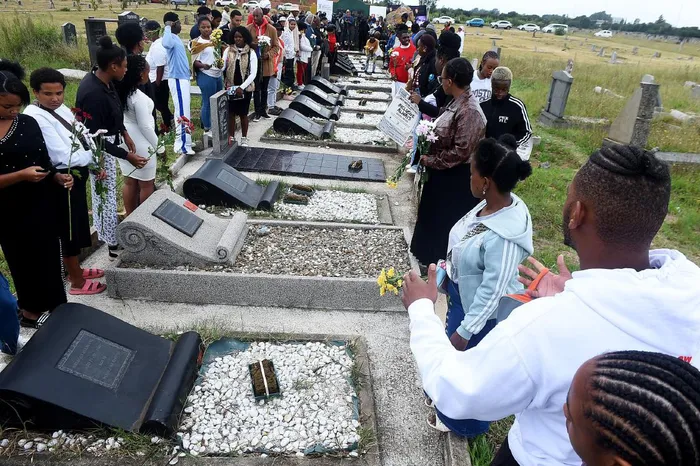
Families of the victims of the Sharpeville Massacre visit the Phelindaba Cemetery where the 69 victims of the tragedy are buried.
Image: Itumeleng English / Independent Newspapers
On the eve of Human Rights Day, two of IOL's young interns hit the streets of Cape Town to speak to young people about their perception of the public holiday commemorating the 1960 Sharpeville Massacre.
Some South Africans cherish the Bill of Rights as a cornerstone of democracy, but for many, these rights are not yet a “lived reality”, and Human Rights Day should be a day to stand up for what’s right and to push for a better future.
Sfiso Ndaba, 20, a student at the University of the Witwatersrand, said Human Rights Day should be remembered by treating people with humanity in diverse South Africa.
Ndaba said that inequality persisted and the day should encourage South Africans to find ways to combat it, saying that prolonged injustice made people focus more on rights than responsibilities, though they align.
”While the government has established a strong Constitution, crime and violence still affect rights,” he said.
The 1960s saw systematic anti-apartheid defiance. The Sharpeville community protested pass laws on March 21, 1960. Apartheid police killed 69 protesters in what became the Sharpeville Massacre. The democratic government declared March 21 as Human Rights Day to honour these sacrifices for liberation.
Reflecting on issues plaguing South Africans in 2026, Ndaba said gender-based violence (GBV) and femicide as serious issues, showing a "huge gap between laws and reality".
“The government should enforce laws equally, especially protecting women and children", Ndaba said, adding that believing officials often go easy on rights violators and may even perpetuate violence.
He concluded by stressing the importance of respect, non-discrimination, self-education on rights and responsibilities, and ensuring one's actions do not harm others.
Sibusiso Ndlovu, 23, a UWC student, defined Human Rights Day as a time to reflect on fairness and equality, stressing the need to protect rights to prevent abuse.
“I believe that rights and responsibilities are inseparable,” he said, using the right to freedom of expression versus the responsibility to avoid insults as an example.
Ndlovu acknowledged government progress, citing policies like Affirmative Action for disadvantaged individuals in education and employment.
“With this policy, more people are having access to equal opportunities regardless of their race and background,” he said.
However, he emphasised that more effort is needed to address poverty, crime, and GBV. Ultimately, Human Rights Day helps him appreciate his rights as a South African.
Student Ntombizodwa Ngcukana, 24, views Human Rights Day as a call for the South African government to improve its service to citizens.
She highlighted that three decades post-apartheid, human rights are not universally enjoyed, noting "exceptions" and criticising the government for failing to adequately uphold people's rights.”Where are we now free,” she said.
Ngcukana expressed a personal lack of safety as a young woman.
"There are a lot of GBV cases that have remained unsolved."
Her final appeal was an emphasis on the urgent need for the government to increase protection for women and children in the country.
Vuyo Douws, 70, offered a perspective on Human Rights Day, defining it as a time to commemorate the sacrifices that led to liberation.
Douws, however, expressed concern that today's youth misuse their rights. He specifically criticised how protests often result in the destruction of essential public infrastructure, such as clinics or supermarkets, which the community will ultimately need.
Douws suggested that people were more responsible during the apartheid era, feeling that the current scope of rights is excessive.
“Children need to learn to take responsibility for their actions so that tomorrow they do not become adults believing that nothing is ever their fault,” he said.
Douws highlighted a loss of authority.
"In this democratic era, I can not discipline a child otherwise I will be labelled as an abuser."
Ultimately, he feels young people do not appreciate or fully grasp the struggles of the past and should not take their rights for granted or abuse them.
A eight year old girl said she does not know about Human Rights Day but tried her best explaining to IOL.
“Human Rights Day is celebrated because that's when we are allowed to do anything we want, as long as it's not illegal but I don't know what happened for us to celebrate it.”
Cuma, in Grade 8, said: “No, I don't know what Human Rights Day is, but I really want to know. I think it has something to do with our freedom.”
Asking the older youth the same question did not change the case one bit. An older woman in 20s states that she can not recall the history of the day.
“I cant tell you the exact history. I won't be able to tell. Unfortunately I don't remember it.”
IOL