

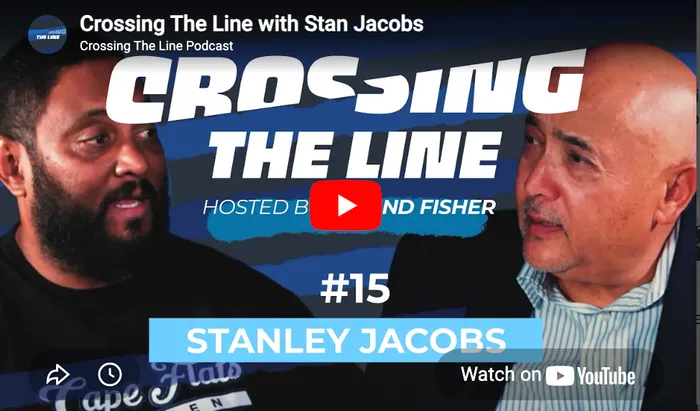
Stanley Jacobs, founder of Cape Flats Stories, features in the latest episode of Crossing the Line, hosted by veteran journalist Ryland Fisher, as part of IOL’s new weekly partnership with the podcast.
Image: YouTube
Stanley Jacobs, the founder of Cape Flats Stories, is the latest guest featured on Crossing the Line, a podcast series of interviews hosted by media veteran Ryland Fisher. IOL is proud to announce a partnership where we will feature one of the interviews every Thursday morning.
Jacobs, who works in IT and runs Cape Flats stories on a part-time basis with a group of trusted non-profit board members, spoke about growing up on the Cape Flats, including in Grassy Park, Parkwood and Ottery; about how his family’s roots in the church inspired him to help the community in which he grew up; his fight with epilepsy; his surprise at the growth of his non-profit initiative; his belief in cooperation and interaction of communities across the racial divide on the Cape Flats; the value of education and his love for cars.
The interview with Jacobs is the 15th in a series started by Fisher, former editor of the Cape Times, in the middle of last year.
Fisher has more than 45 years of experience in the media industry and works with several media companies locally and abroad. He is executive producer of The Arch, a documentary series about the late Archbishop Desmond Tutu.
He is also convener of the Vodacom Journalist of the Year competition.
Crossing the Line covers serious topics such as politics, human rights, social justice, international and African matters, business, technology, leadership, education, health, housing, transport, race and identity, and the economy.
These are interspersed with conversations about sport, arts and culture, music and entertainment, among others.
In the latest interview, Jacobs told Fisher that he grew up in a working-class family with six children. “We had a band and we jokingly called ourselves The Jacobs Six, which was a play on The Jackson Five. I played bass and was responsible for the sound.”
“My father had his own little church before we joined a bigger church, and my mother was a typical kerksister (church lady). She always believed in helping poor people, especially the homeless, and instilled that in me too.”
Jacobs said that his father’s and mother’s lack of formal education made him realise the importance of education. His father built a successful business, but Jacobs believed he could have done better if he had more formal education.
“I believe that education is the antidote to poverty, but it also depends on how we use it to empower ourselves,” he said.
Jacobs said he started Cape Flats Stories as a Facebook page eight years, not expecting it to have much traction. “It now reaches more than half a million people.”
Jacobs said he did not identify with the racial term of “coloured”. “I consider myself to be a Cape Flats citizen, which does not identify with race.”
He said Cape Flats Stories targeted everyone who had been removed under the Group Areas Act and resettled on the Cape Flats. “The Cape Flats is not just about Mitchells Plain, Manenberg or Hanover Park. It includes Langa, Gugulethu and Khayelitsha.”
He said the best way to uplift the people on the Cape Flats was to stand together. “We need to realise that there is power in numbers.”
Watch the full interview and others on the Crossing the Line channel on Youtube.
Follow Crossing the Line on social media:
Instagram: @crossingthelinepodcast.cpt
Facebook: Crossing The Line
IOL News