

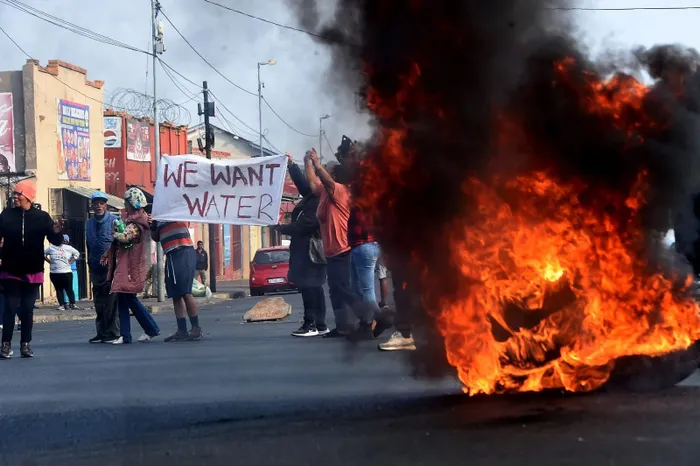
Service delivery in South Africa remains a big challenge for municipalities. This is largely due to municipalities not having the required resources to fulfil the delivery of basic services.
Image: Itumeleng English/Independent Newspapers
As South Africa enters its 32nd Freedom Day celebration, the country continues to face challenges in service delivery, which is spiraling into a critical crisis as municipalities struggle under the weight of inadequate resources needed to meet basic community needs.
Water outages, power cuts and deteriorating infrastructure have become a norm in some areas. This continuing failure has sparked widespread discontent among citizens, who are increasingly fed up with broken promises and the deterioration of essential services.
Delayed or lack of service delivery has oftentimes plunged communities into chaos, leading to violent protests as a last resort to get municipalities to act. Over the last years, there has been a marked rise in service delivery protests, serving as a potent indicator of the deep-seated dissatisfaction amongst South African communities.
The consequences of delayed service delivery, however, reach far beyond mere inconvenience. They signal a profound governance crisis; when basic needs go unmet, trust erodes, economic activity falters, and unrest follows. These protests are not merely expressions of anger—they are indicators of a deeper governance crisis.
Last year, public Works and Infrastructure Minister Dean Macpherson disclosed that 57 infrastructure projects experienced delays with total overruns to the tune of R444.7 million over the last three years.
Macpherson detailed the breakdown of the overruns, which included R110.8m in 2022/23, R64.3m in 2023/24 and R269.6m in 2024/25.
The minister further added 38 construction projects had been delayed or halted in the past five years.
Recently, the Minister of Human Settlements Thembi Simelane said 212 housing projects across the country have been identified as stalled, abandoned, or blocked, and her department is actively working to unblock them.
Simelane was responding to questions in the National Council of Provinces (NCOP), where ANC's Mxolisi Kaunda asked about the reasons behind these stalled projects, including issues related to contractual disputes, poor contractor performance, non-payment, and disruptions caused by extortionists.
In her response, Simelane detailed the efforts of her department to tackle these issues, citing a funding allocation of approximately R37 billion for the 2025/2026 financial year to address the backlog.
The Free State, according to the Minister, is the hardest-hit province, with 154 stalled projects.
The Minister further pointed out that challenges in the completion of projects were not limited to contractor issues but also extended to municipal delays, particularly with service installation in Gauteng.
To tackle these issues, Simelane said that her department is working with municipalities to provide necessary bulk infrastructure.
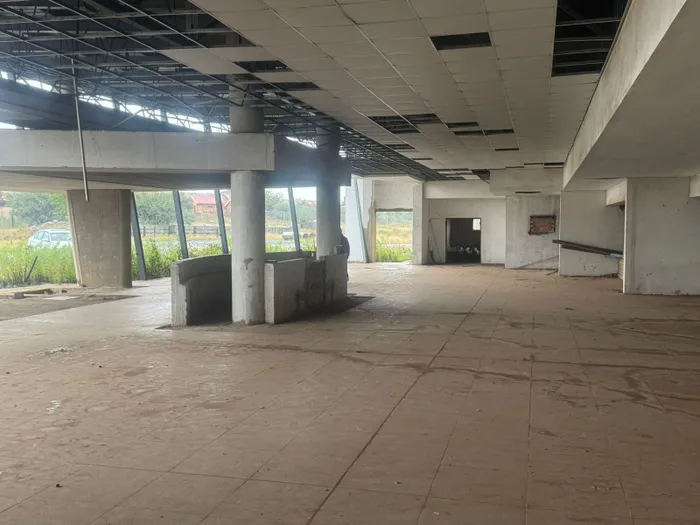
Inside the Sebokeng DLTC: a decaying interior with crumbling walls and broken doors.
Image: Masabata Mkwananzi/ Independent Newspapers
A decade later, the Sebokeng driving licence testing centre in the Emfuleni Local Municipality is still under construction. Recently, the Gauteng Department of Roads and Transport said work was continuing despite the delays.
The project was launched in 2015 with an initial estimated cost of R63 million. Over the years, however, costs have escalated sharply, with more than R80 million already spent. The Gauteng government is now planning additional funding that could push the total projected cost to well over R200 million.
The Star previously reported that the project had become a symbol of government failure, with more than R9.4 million spent on security alone since 2019, despite the site remaining vandalised, abandoned and unusable. Initially expected to open in 2021, the unfinished facility has forced residents to travel to neighbouring towns for services, prompting opposition parties to label the spending wasteful and unacceptable.
Gauteng MEC for Roads and Transport Kedibone Diale-Tlabela’s spokesperson, Lesiba Mpya, said the department continues to make progress on the project, describing it as a strategic infrastructure investment aimed at improving access to modern driver and vehicle testing services in Sedibeng.
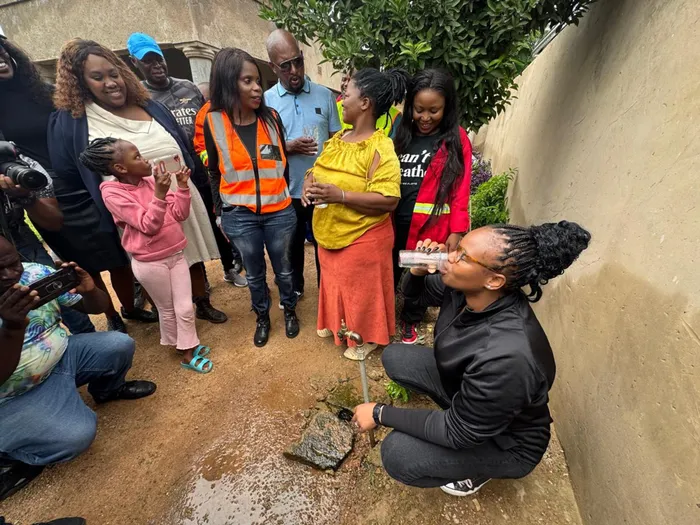
Tshwane Mayor Nasiphi Moya takes a sip of water from a household tap to demonstrate her confidence in the safety of water supplied to residents in Hammanskraal.
Image: Supplied
Hammanskraal residents have for years been forced to rely on water tankers and bottled water after repeated tests found the local supply to be contaminated.
In May 2023, the contaminated water contributed to a cholera outbreak which led to over 50 people hospitalised and 15 deaths. This exposed the human cost of neglected infrastructure and failed treatment systems.
Before the deaths, residents tirelessly fought the municipality through the high court and the South African Human Rights Commission for clean water.
Moreover, a report by an independent commission of inquiry into the water crisis in the area also found that the City of Tshwane had failed to provide clean and drinkable water to residents.
In January 2025, Tshwane Mayor Nasiphi Moya drank treated water from the Magalies Klipdrift Water Treatment Plant to prove to the residents that it was safe for consumption.
In January 2026, Moya told Hammanskraal and surrounding areas are closer to receiving reliable, clean drinking water after the main construction phase of the long-awaited Klipdrift Package Water Treatment Plant has been technically completed.
Before Moya, in September 2018, former Tshwane mayor Solly Msimanga also drank the water in front of residents who had gathered inside the hall demonstrating that the water was not contaminated.
Despite his demonstration, the matter remained unresolved.
On Monday, 13 April, residents were scheduled to meet with the Moya to discuss the persistent water issues; however, the mayor failed to attend meeting, leading residents to disrupt the gathering.
The session was intended to give residents a platform to engage with political and administrative leaders on persistent water supply issues.
Speaking to eNCA, a community activist said people were frustrated and were looking forward to being addressed by the mayor and not people from her office.
He said water was still an issue around the area despite the mayor promising it was resolved adding that, “those who get water receive it for a few hours and the water stops again."
Moya later apologised for her absence and promised to set another date.
"It was not out of disrespect at all. The traders’ meeting ran long, and I could not leave it without properly adjourning it,” she said.
Elizabeth Mtshweni,53, who has lived her whole life in Hammanskraal, said she has been buying water for over a decade now.
She only uses the tap water to do laundry and clean.
"We have been fighting for clean water for many years, I have made peace that we will never be taken serious, even if they say the water is safe to drink, I'll never believe them. I buy my drinking water because I can afford to spend R200 or more on water. But what about families who can't afford, their lives are at the mercy of the government," she said.
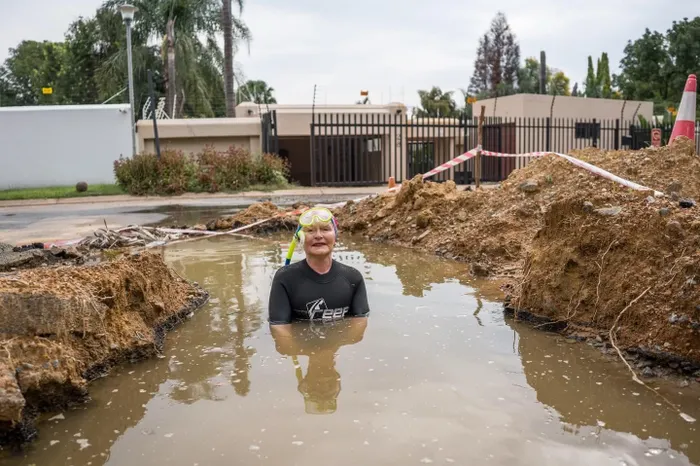
The Federal Council chairperson of the Democratic Alliance (DA), Helen Zille posted showing herself wading through murky water on Balder Road in Douglasdale.
Image: X/@DAGauteng
Road infrastructure tells years of under-maintenance, combined with financial instability and maladministration, which have left critical transport routes in disrepair.
Potholes, incomplete upgrades, and stalled road projects have become commonplace. To highlight the severity of the issue, Helen Zille, mayoral candidate for Johannesburg, recently went into a water-filled pothole in Douglasdage, Johannesburg and attempted a backstroke.
According to residents in the area, the gaping hole and a persistent water leak outside their homes had gone unresolved for more than three years despite repeated reports to municipal departments.
Following Zille's demonstration, road crews filled the cavity and sealed the damaged pipe.
“It shouldn’t take a spectacle for basic services to be delivered,” said one of the residents, "We’ve been raising this for years. Suddenly, it’s fixed overnight.”
According to the Organisation Undoing Tax Abuse (OUTA) the core of the problem poor service delivery is failed leadership, not inadequate law or policy.
“More than two decades since the adoption of the 1998 White Paper, South Africa continues to face systemic governance failures, financial mismanagement, political interference, and declining public trust in municipal institutions."
To witness changes, OUTA said it advocates for, among other solutions, the enforcement of fit-for-purpose leadership, active community engagement, lifestyle audits, and the protection of whistleblowers
“OUTA believes that unless these systemic issues are addressed with urgency and courage, any new policy framework will suffer the same fate as its predecessors. Reform must be rooted in ethical governance, professionalised administration, and a relentless focus on public accountability," said OUTA executive manager Julius Kleynhans.
The organisation said it has identified lack of political will, lack of ethical leadership, and lack of accountability as crucial challenges.
“There is a pervasive absence of political will to enforce accountability and implement reforms. Too often, leadership positions are filled based on political affiliation rather than competence. Oversight mechanisms exist but are underused or ineffective. Political interference, cadre deployment and manipulation of procurement are rife. Municipalities are in financial distress, often due to poor revenue collection, rising unproductive wage bills, debt and mismanagement," added Kleynhans.
IOL News
Get your news on the go, click here to join the IOL News WhatsApp channel.