

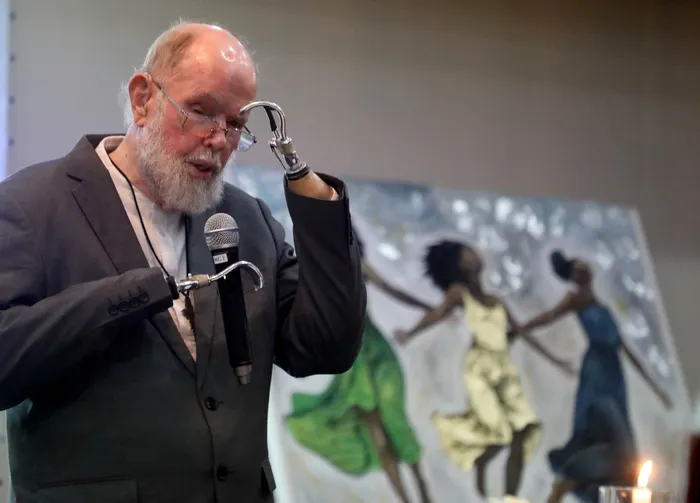
Father Michael Lapsley, SSM, who founded the Institute for Healing of Memories, speaking at the fundraising dinner held at the Royal Johannesburg on Thursday night.
Image: Timothy Bernard / Independent Newspapers
The Institute for Healing of Memories (IHOM) and Johannesburg Child Welfare held a successful fundraising dinner at the Royal Johannesburg in Linksfield North on Thursday night.
The evening’s primary goal was to raise funds through the auction of artworks, all dedicated to addressing the trauma and suffering experienced by many in the country.
Founded in 1998 by New Zealand priest Father Michael Lapsley, IHOM emphasises the power of forgiveness over bitterness. A prominent anti-apartheid activist, Father Lapsley, faced a life-altering moment in 1990 when he survived a letter bomb attack in Zimbabwe, which resulted in the loss of both of his hands and an eye.
Among the evening's highlights was a powerful testimony from self-taught photographer and fine artist Tshepo Mokoena, born in Limpopo and based in Gauteng.
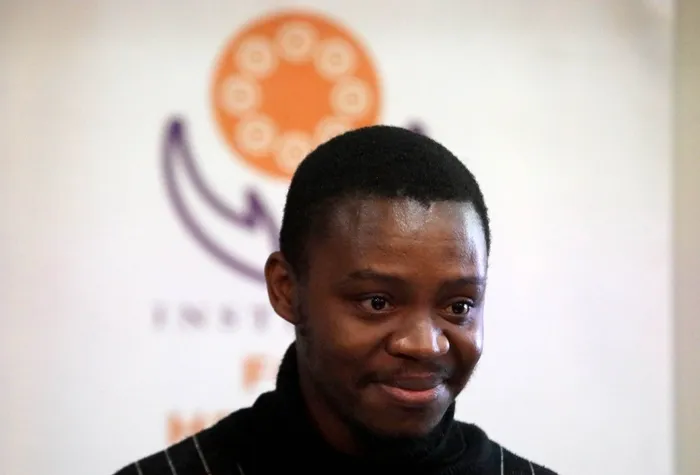
Self-taught artist Tshepo Mokoena, whose art was featured, shared how an epilepsy diagnosis in 2017 led to job loss and trauma.
Image: Timothy Bernard / Independent Newspapers
His unplanned journey into art was born from pain, silence, survival, and healing following a 2017 epilepsy diagnosis. Before this, he was a passionate construction site manager. However, multiple seizures led to job loss and dangerous accidents, totalling five of his six owned cars.
“This experience left scars that were not always visible. Every episode, I chose silence; I rarely spoke about the fear and frustrations and emotions, the weight that came with constantly rebuilding my life. With a passion for design, I had also enrolled to study architecture while still employed. Five years later, I had to deregister and was placed on high medication dosage. In 2024, only one module was outstanding; I missed two major tests, and I could not complete my degree in construction management.”
Through these struggles, nature provided solace. Escaping to the family farm, surrounded by trees, became a form of therapy. Hours spent staring at and trying to connect with trees evolved into the foundation of his art.
“I found a form of therapy that no medication could provide. I would spend hours simply staring at trees and trying to connect with them, almost hoping for a conversation. And in many ways, that conversation began. Those quiet moments became a foundation of my art.”
He began creating functional art pieces guided by instinct and emotion, using collected materials like tree logs, bark, sawdust, and burnt ashes. His process embraces the imperfections of the wood, resulting in pieces that tell stories of humanity, time, pain, healing, and connection with nature.
Through his storytelling and art, he inspires audiences to reconnect with and listen to the world, noting: “everything speaks. We sometimes just have to let the eyes listen.”
Internationally acclaimed artist, GreatJoy Ndlovu, whose painting was on auction, described it as more than just an artwork.
“It's a statement about the future, and it's also what we want to see in the art world, artists collaborating with organisations, and we want that interaction so we can literally impact so many lives.”
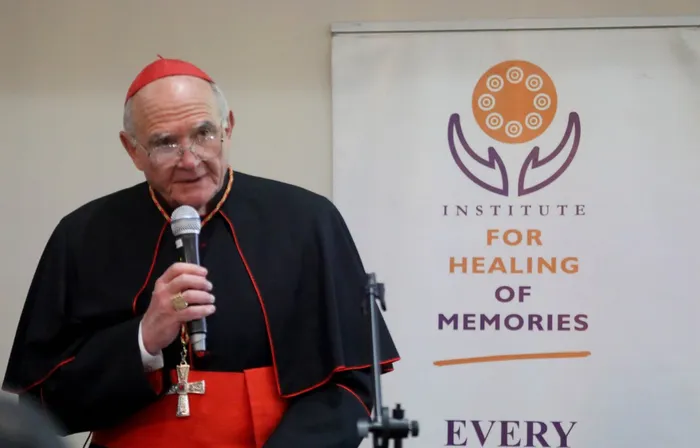
On the occasion of the fund raising for the Institute for Healing of Memories and the Johannesburg Child Welfare, Cardinal Stephen Brislin gave the keynote address.
Image: Timothy Bernard / Independent Newspapers
The evening’s keynote address was delivered by Cardinal Stephen Brislin, who praised Father Lapsley and the IHOM initiative for creating an essential space for truth and healing within a nation still burdened by its past.
He noted that the pain of the past must not imprison the future, stating: “Memory is alive — it shapes our present.”
Drawing parallels between Father Lapsley’s journey and the biblical figure of Joseph, the Cardinal highlighted the transformative power of reframing pain into hope for the future.
He asserted the need for “remembering forward”, echoing the philosophy of Viktor Frankl that suffering finds meaning through future possibilities.
Cardinal Brislin acknowledged the urgent need for transformed leadership in contemporary society, lamenting a global climate shaped by selfishness and corruption, where “truth is a rare commodity”.
He reiterated IHOM’s core principle of truth-telling as a prerequisite for healing, referencing Archbishop Desmond Tutu's declaration that “without truth, there can be no genuine healing”.
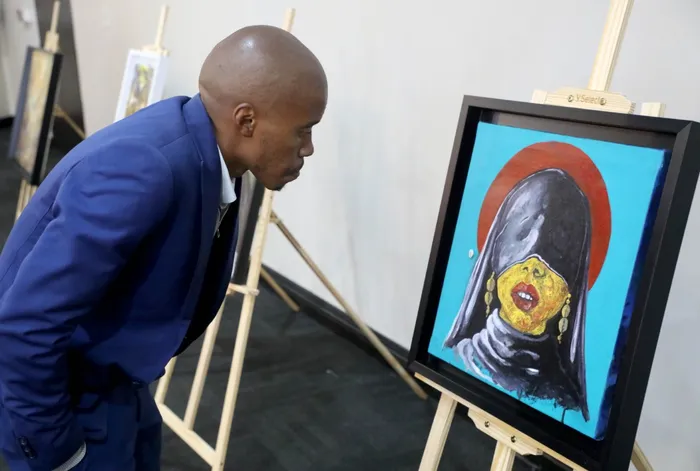
Paintings ranging between R5,000 to R150,000 were put on auction.
Image: Timothy Bernard / Independent Newspapers
Father Lapsley took a moment to express heartfelt gratitude to the attendees. He reflected on the profound impact of Mokoena’s testimony, reiterating that healing manifests in diverse forms.
After surviving his traumatic experience, Lapsley sought to escape the shadow of hatred and create a sanctuary for others to process their own pain.
“So I realised that if I was still filled with hatred and bitterness, I would be in prison forever. But when I came back to South Africa, I'd been away for 16 years, and I discovered a wounded nation, a nation wounded in our humanity, wounded by the things we had done, by what had been done to us, and by what we failed to do.
“But unlike me, for millions of South Africans, their stories had not been acknowledged in reverence and recognised in the way that mine was. And so I'd been a freedom fighter for the previous 16 years. I discovered a new calling, the calling of healing, to create spaces where people could no longer be prisoners in the past, where people could detoxify.”
He noted IHOM’s global relevance, serving individuals from 26 countries, with a particular focus on addressing gender-based violence and childhood trauma.
Emphasising the importance of collaboration with Johannesburg Child Welfare, Lapsley stressed the need to disrupt the cycle of intergenerational trauma.
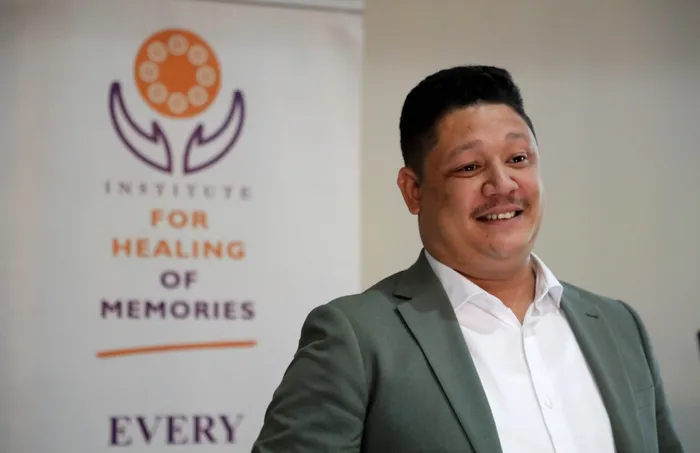
The CEO of Johannesburg Child Welfare, Abubakr Hattas.
Image: Timothy Bernard / Independent Newspapers
Abubakr Hattas, CEO of Johannesburg Child Welfare, spoke passionately about the pressing realities faced by children entering the social welfare system.
He highlighted that early experiences of trauma leave lasting marks that shape their futures.
Hattas stressed a paradigm shift in focus, advocating for a holistic approach to healing that encompasses family, school, and community — one that prioritises therapeutic care alongside protection.
“As we gather here tonight, we must remember that our world is not only about the children we see, it's about the millions of children across South Africa whose futures are still being shaped right now. Children who deserve safety, who deserve identity, children who deserve healing, and children who deserve hope.
“And whether we realise it or not, every one of us has a role to play in shaping that future. And ultimately, we have learned something really important in our world. Child protection cannot rest on the shoulders of the social workers alone. It takes all of us to get to need, to build the homes that can truly take you off their shoulders.”
The evening concluded with a lively auction of artworks, with proceeds to be shared equally between IHOM and Johannesburg Child Welfare