

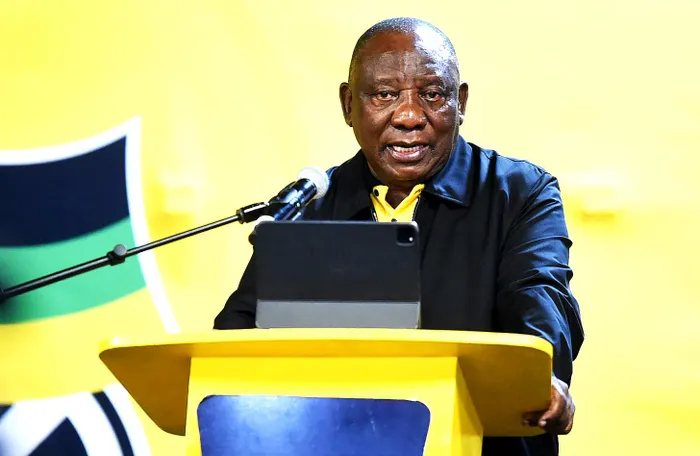
Some members of the ANC have called on President Cyril Ramaphosa to resign as unemployment and the state of the economy have been worsened under his leadership.
Image: Itumeleng English/ Independent Newspapers.
Some members of the ANC have called on President Cyril Ramaphosa to resign amid soaring unemployment figures under his leadership.
The members, who are in the anti-Ramaphosa faction in the party, said the unemployment rate has worsened since Ramaphosa took office in 2018.
This is after Statistics South Africa (Stats SA) last week confirmed that the unemployment rate increased to 32,7% in the first quarter, up from 31,4% in the previous quarter.
A source in the party said this was a concern to every member of the ANC.
“This has been discussed and it is a concern for everyone,” said the source, adding that Ramaphosa should resign.
When Ramaphosa took office in 2018, the national unemployment rate was around 26,7%. According to the latest figures from Stats SA, the unemployment rate now sits at 32,7%, representing 8,1 million jobless individuals.
The economy also experienced an extended period of stagnation and regression under Ramaphosa, largely characterised by elevated unemployment, structural crises in energy and logistics, and a sustained decline in gross domestic product (GDP) per capita relative to population growth.
The latest Stats SA poverty data also indicates that approximately 23, 2 million people, roughly 37,9% of the population, live below the lower-bound poverty line of R1,300 per month. Additionally, about 10,8 million people or 17,6% of the population survive below the food poverty line of R777 per month.
Another source said Ramaphosa must resign as the economy has been doing badly.
“The cost of living has reached unmanageable proportions, and that happened under his leadership. The economy is going down, the ANC is declining, and everything is deteriorating under his leadership,” said the source.
ANC spokesperson Mahlengi Bhengu-Motsiri said it was dishonest to discuss unemployment in South Africa 'without acknowledging the impact of state capture, the destruction of state institutions, the COVID-19 pandemic, global inflationary pressures, supply-chain disruptions, wars affecting oil and food prices, and a sluggish global economy which has negatively affected developing nations across the world'.
"Despite these realities, South Africa has seen important signs of economic stabilisation, including periods of consecutive GDP growth, improved energy availability, declining intensity of load shedding, increased investor confidence in key sectors, growth in renewable energy investment, and improved fiscal indicators, " she said, adding that the ANC will not apologise for interventions aimed at protecting millions of vulnerable South Africans from complete economic exclusion.
"Public employment programmes, youth employment initiatives and social interventions are not evidence of policy failure; they are evidence of a developmental state responding to social realities while long-term economic reforms take effect."
In a statement issued May 13, the ANC stated it is “deeply worried” by the data, noting that the numbers are not yet where they need to be to pull South Africa out of its chronic employment challenges.
The party reaffirmed its dedication to resolving the issue through the macroeconomic interventions embedded in the current Government of National Unity (GNU) policy framework.
In his address at the National Council of Provinces (NCOP), Ramaphosa said the government is working to tackle poverty and address the high cost of living that is putting strain on individuals and households, particularly the poor and vulnerable.
He said the government will be investing R1 trillion to build energy, water, transportation, logistics, IT and other essential infrastructure over the next three years.
Ramaphosa said this program will create jobs, support local businesses and supplier development, and develop new value chains.
“We are on a concerted drive to attract investment into our economy. These potential investors need to know that they are bringing their investments to places that have reliable basic services, are well-regulated and managed, and that are safe and secure,” he said.
Governance expert and political analyst Sandile Swana said Ramaphosa’s term was worse than those of former Presidents Thabo Mbeki and Jacob Zuma.
“He does not invest and do anything that is required. Our investment is half of what it should be. It is at 15% while it should be at 30% and above,” he said.
He said that while Zuma reduced the unemployment rate, Ramaphosa has worsened it, adding that he has also taken unemployment to record levels.
Political analyst Zakhele Ndlovu said that while Zuma left a mess behind, Ramaphosa failed to make the situation better.
“Ramaphosa's handling of foreign affairs has been disastrous and is harming the economy,” he said.