

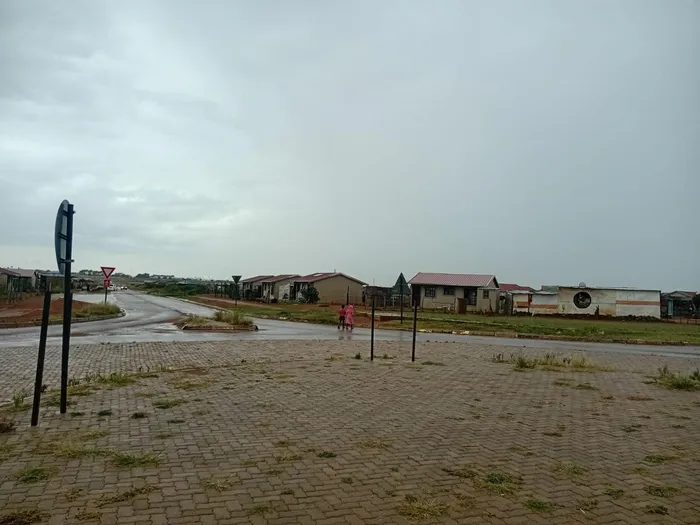
The Matlosana Catalytic Project in the North West is on the brink of collapse as the contractor and government are at loggerheads over payments and the cancellation of the contract.
Image: Supplied
The North West Department of Human Settlements is defending the stalled Matlosana N12 Catalytic Project, pushing back against mounting criticism while attempting to shift responsibility for the housing crisis onto contractors, municipal failures and national budget cuts.
The response follows widespread outrage after revelations that the ambitious R4.2 billion housing development in Ward 15, Matlosana, had descended into years of delays, incomplete structures and broken promises, leaving thousands of residents still waiting for homes promised as far back as 2023.
In a lengthy media statement issued on Thursday, the department said it wanted to “set the record straight” regarding claims surrounding the controversial project. But rather than accepting direct responsibility for the collapse in delivery, the statement repeatedly shifted blame to contractor MXN Development Construction, the Matlosana Local Municipality, and broader funding pressures within the national human settlements sector.
“The North West Department of Human Settlements has noted with concern the article published on IOL and wishes to set the record straight regarding the claims made therein,” the department said.
The Matlosana N12 Catalytic Project was initially positioned as a flagship integrated human settlements development aimed at addressing a housing backlog estimated at around 38,500 units within the Matlosana Local Municipality.
Beyond subsidised housing, the development was also expected to include schools, churches, creches, commercial developments, social housing and community facilities.
Instead, it has become a symbol of dysfunction, delays and growing public mistrust.
One of the most striking aspects of the department’s response is the extent to which it distances itself from the project’s troubled origins. According to the department, the municipality, not the province, appointed MXN Development Construction in 2014 to install underground infrastructure and build Breaking New Ground houses.
“In 2023, the department took over the implementation of the 1,667 BNG housing project… from the municipality, as the municipality was not accredited to implement housing projects,” the statement said.
The admission raises serious questions about how an unaccredited municipality was allowed to oversee a multi-billion-rand housing project for nearly a decade before provincial authorities intervened.
The department also confirmed that MXN Development Construction was expected to inject its own capital into the project.
“The contractor was expected to make a financial investment into the development; however, this has not materialised,” the statement said.
Despite this, nearly R1 billion in public money has already been spent. According to the department, “a total of R989 357 295.00 was disbursed and invested in the installation of engineering services.”
The government also appeared eager to narrow public focus away from the widely cited R4.2 billion project value.
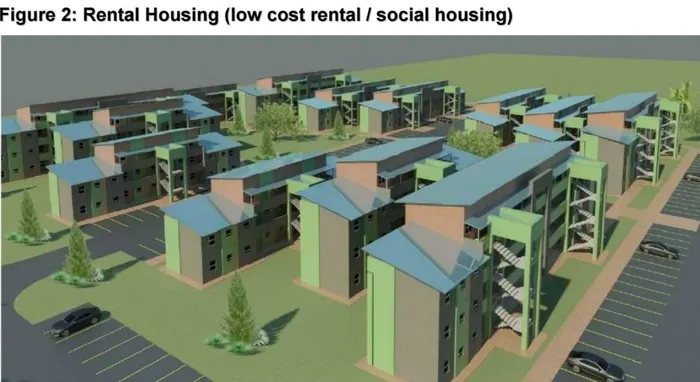
The Matlosana N12 Catalytic Project and how the low cost rentals were supposed to look like
Image: Supplied
“It should be clarified that the initial budget allocated for this specific intervention amounted to approximately R1 billion and not the broader R4.2 billion project value,” officials stated.
The department’s statement also contained a significant admission: the provincial government experienced major financial strain that directly affected project payments and timelines. Officials acknowledged “significant cash flow challenges from the 2023/2024 financial year to date due to budget reductions and broader funding constraints affecting the human settlements sector nationally.”
The department further admitted that limited cash flow forced it to prioritise certain obligations over others.
“As departmental cash flow allocations are linked to approved business plans and conditional grant transfers, the constrained funding environment adversely affected the department’s ability to process certain payments within contractual timelines,” the statement said.
Officials said the department had to “balance limited available cash flow against both financial obligations and the achievement of critical non-financial service delivery targets.”
The statement outlined a series of measures the department claimed were implemented to manage the crisis, including letters sent to contractors in January 2024 warning of financial difficulties and meetings aimed at explaining delays.
But while the department framed these issues as the consequence of national funding pressures, the statement simultaneously revealed a project bogged down by payment disputes, verification problems and administrative confusion.
Claim 46A, according to the department, was only paid four months after submission. Claims 47 and 48, submitted in December 2025, were only processed in January and February 2026, respectively.
Claim 49 remains unresolved.
The department said the dispute centred on “a short-payment dispute associated with roofing milestones and discrepancies on the Housing Subsidy System (HSS).”
Officials described the issue as part of an ongoing “administrative verification and correction” process.
Having acknowledged its own payment difficulties, the department then pivoted sharply to blame the contractor for inactivity on-site.
“We must further state as a department that constant monitoring of the project was done continuously, and the department’s Chief Building Inspector confirmed that the contractor was not active on site,” the statement said.
The department added that “departmental records reflected no project activity indicative of ongoing work on the ground.”
According to officials, the last requests for inspections submitted by the contractor were dated 7 October 2025 and 9 October 2025, which the department said demonstrated “no activity on the ground.”
This ultimately prompted the department to issue a notice of intention to terminate the contract on April 30, 2026, due to “material non-performance and breach of contractual obligations.”
However, in a contradiction that raises fresh questions about accountability and enforcement, the department also confirmed that no final termination notice has yet been issued.
“Following receipt of the notice, the contractor returned to the site and resumed certain construction activities,” officials said.
The result is a deeply conflicted narrative in which the contractor is simultaneously portrayed as responsible for abandoning the project while still being allowed to continue working on it.
One of the most politically sensitive aspects of the controversy involves allegations that funds linked to the project may have been redirected elsewhere. The department categorically denied this.
“The department categorically rejects allegations that funds intended for the development were redirected towards politically connected projects,” the statement said.
It further challenged journalists and critics to produce proof.
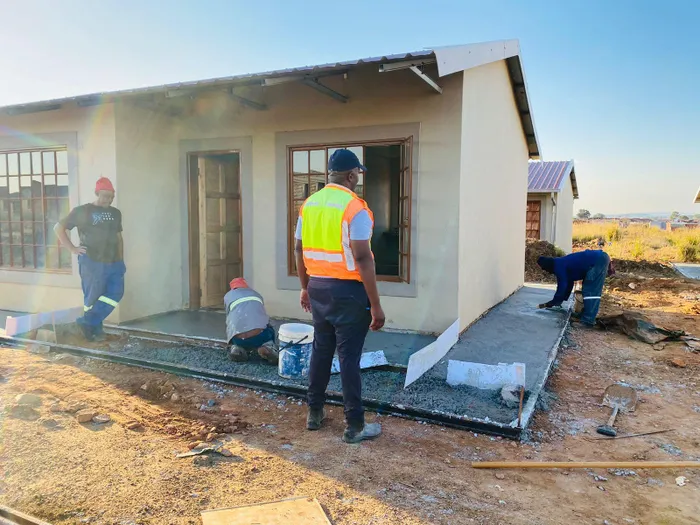
Work is being done on one of the finished houses on Wednesday afternoon.
Image: Supplied
“The department further challenges the journalist to provide credible evidence in support of these allegations, as such claims are serious, misleading and without factual basis.”
Yet while the department dismissed the allegations outright, it did not address the broader history of scrutiny surrounding the project.
Previous investigations and reports have already raised questions about procurement processes, oversight failures and the scale of payments linked to the development over the years.
Perhaps the most devastating reality emerging from the department’s own statement is how little tangible progress has been achieved relative to the scale of the promises made.
According to findings from a recent National Council of Provinces oversight visit, only 263 houses out of the planned 1 667 units were fully completed, with others remaining in varying stages of construction.
This is after more than ten years since the project’s inception.
Despite its defensive tone, the department ultimately acknowledged the growing anger among residents.
“The department acknowledges the frustrations, concerns and disappointment experienced by residents of Ward 15 regarding delays in the delivery of houses promised during 2023,” officials said.
“We fully appreciate that access to housing represents dignity, security, and stability for affected communities.”
But for many residents, the statement is unlikely to provide reassurance.
What emerges from the department’s own account is a picture of a project crippled by years of weak oversight, unresolved contractor disputes, funding shortfalls, administrative dysfunction and shifting accountability between multiple layers of government.
The department insists it acted in good faith throughout.
Yet after nearly a decade, hundreds of millions spent and thousands still waiting for homes, residents of Matlosana are left confronting a far more immediate reality: promises made, money spent and houses still unfinished.
IOL