

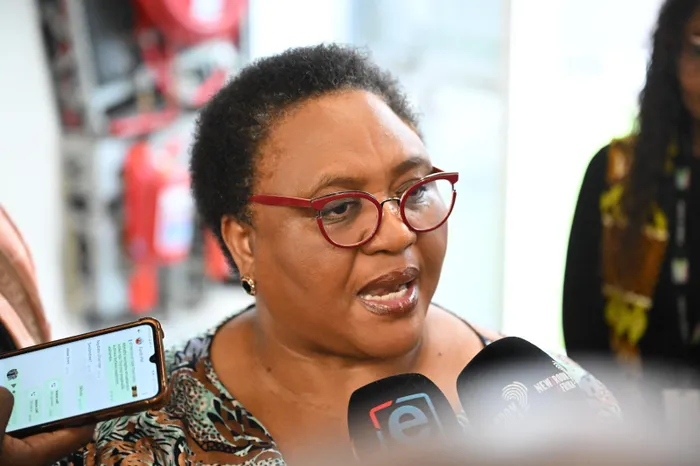
National Assembly Speaker Thoko Didiza speaking to journalists on the Constitutional Court judgment.
Image: Henk Kruger / Independent Media
African Transformation Movement’s (ATM) Vuyo Zungula has said that opposition parties want National Assembly Speaker Thoko Didiza to recuse herself from all matters related to the Impeachment Committee on the Section 89 Enquiry.
Zungula addressed the media before the first sitting of the committee. The committee was established after the Constitutional Court judgment directed Parliament to investigate whether there are valid grounds to recommend President Cyril Ramaphosa’s removal from office.
While it was ultimately Rise Mzansi Chief Whip, Makashule Gana, who was elected to be chairperson of the Impeachment Committee on the Section 89 Enquiry, there were several issues raised by Zungula before the meeting.
The parties, except for the ANC, had met to discuss their preferred candidate to chairperson and the possibility of asking Didiza to recuse herself from oversight-related matters, such as deciding on evidence leaders and the committee’s terms of reference.
Parties who had attended the meeting included MK Party, DA, UDM, ACDP, EFF, FF Plus, Rise Mzansi, BOSA, ActionSA, ATM and the United Africans Transformation (UAT).
The ATM parliamentary leader said that there were several principles and decisions taken, which included the sentiment that they did want the committee chaired by someone in the ANC “because we view the ANC as having already taken a posture and a decision to protect the president”.
“The other issue that we engaged on is that now that the president has litigated, all of the parties that were part of the meeting have agreed that the process must continue only until either an interdict or the report has been set aside by a court of law, which is what that Constitutional Court judgment says,” Zungula said.
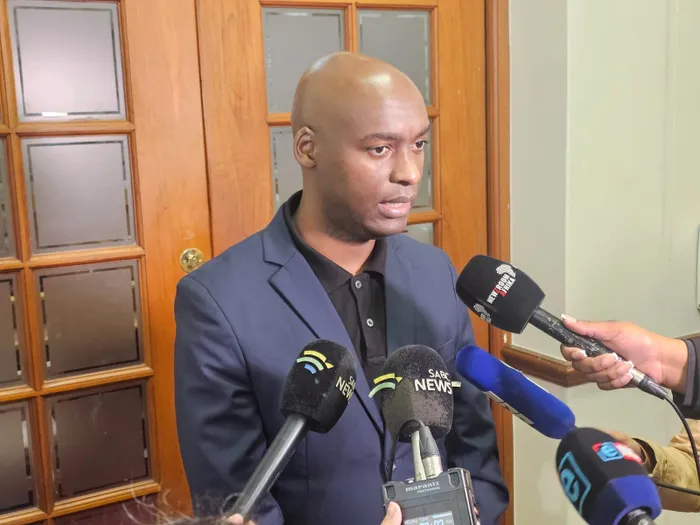
African Transformation Movement’s (ATM) Vuyo Zungula has said that opposition parties want National Assembly Speaker Thoko Didiza to recuse herself from all matters related to the Impeachment Committee on the Section 89 Enquiry.
Image: Theolin Tembo/Independent Newspapers
He said that the other issue they had was with the Speaker, who voted against the processing of the report in 2022, and then following the ConCourt judgment, the Speaker “met with the legal advisors, not only of the ANC, but also of other people, who we view were going to taint the process”.
“With that being said, we agreed that we are going to move for the recusal of the Speaker for this process; for this particular oversight of the impeachment committee. We are not calling for the Speaker to be removed as the Speaker. That was not what we decided on.
“We just moved that over to the process of the impeachment; the Speaker must not have oversight over that process,” Zungala said.
Spokesperson for the Office of the Speaker, Reggie Ngcobo, said the Speaker does not have any role to play in the impeachment process, and that the Speaker has never met with the president’s lawyers.
“The Speaker is the executive authority of parliament. She's the one who oversees processes in parliament, but thirdly, the speaker has no role to play in the impeachment committee.
“Maybe, (he) must go and read the rules of parliament, so that he understands how parliament works. It's also very disappointing that a person who's been in parliament for quite some time, still today, does not understand what, really, how parliament works,” Ngcobo said.
“That impeachment committee has a chairperson, and committees of parliament, they report to the Chair of Chairs. There's a person, Mr. (Cedric Thomas) Folick, who oversees the work of committees in Parliament.
“We still insist, the Speaker has never met with any of the lawyers of the president,” Ncgobo said.
“But let me emphasise that the Speaker has no role to play in the impeachment community, or in any other community of parliament.”
Didiza had previously said that she had complied with the court judgment.
“I don't think, therefore, there is anything that should make anybody worry about Parliament's responsibility in discharging its role,” she said. Didiza also said the court case was about Parliament and how it did not follow its processes in accordance with the rules.
The court found parliamentary Rule 129I to be unconstitutional and set it aside.
“It read into the rule, into the judgment, how this rule in its amendment must look like.”
She added that the Constitutional Court indicated Parliament should not have sent the panel’s report directly to the House, and ordered the process of taking it to the Impeachment Committee, which they were doing.