

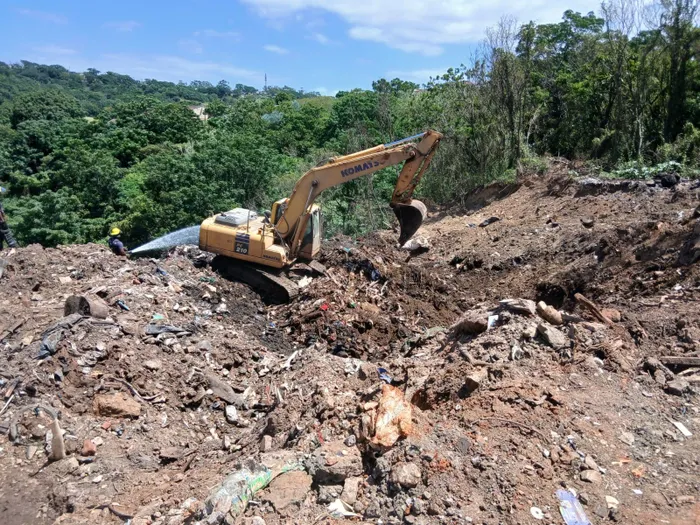
An illegal dumpsite near Chesterville. The Durban Fire and Emergency had to damp down on fires that caused air pollution.
Image: Supplied
The eThekwini municipality is intensifying inspections to protect the public from industrial hazards.
Fire Safety senior manager, Philani Mbanjwa, said the municipality was cracking down on hazardous operations. During an interview with eThekwini Matters, Mbanjwa said the municipality was strengthening compliance inspections to safeguard lives and communities.
Mbanjwa explained that the fire department not only responds to fires but also gets involved in preventing them. This was done, he said, during the planning process by property developers.
“Each directorate in the municipality provides its input on the project when building plans are submitted. We look at the plans and follow the health and safety regulations. Once we are satisfied with fire and safety we comment on the plan and either approve or reject it. If it's not in line with the standards we will give reasons why,” he said.
Mbanjwa said his department has a database that outlines the classification of a building in terms of its development and use. He said some buildings were classified as high or low risk guided by regulations. High risk is where there is a high density population and where there is likely to be an impact on the boundaries.
He said inspections were then carried out and information was added to the Service Delivery and Budget Implementation Plan (SDBIP).
Mbanjwa said that the department of Employment and Labour in South Africa, specifically through its Inspection and Enforcement Services (IES) branch, manages occupational health and safety measures, including inspections for workplace compliance, and monitors hazardous installations
In the city, the responsibility in terms of checking those premises and reports from authorised inspections which is accredited by the department of labour and the South African National Accreditation System (SANAS).
“They draft the report citing the level of the risk. As it comes to fire safety, we have a risk assessor. We will comment on this whether we approve or not and give reasons,” he said.
He said they also inspect Department of Correctional Services (DCS) facilities like prisons, hospitals, old age homes, special schools, shopping malls, stadiums and community halls either after six months or 12 months.
“It is important for the facility to fully comply and for the risk of fire breaking out to be eliminated or minimised. The building owners should be aware of the risk and have a plan in place on how to manage the risk,” he said.
Mbanjwa said the challenges they encounter in most facilities are poor maintenance and lack of conformity with safety processes. Others were that escape routes were locked or obstructed and would prevent people from escaping in an emergency.
“If people are rushing to an exit point and it is locked there could be a stampede and injuries. Sometimes, we find security seems to be taking precedence over safety,” he said.
Mbanjwa said the municipality gives out a warning and advisory to comply. He said penalties, fines and some transgressions thereafter go to court for non-compliance. Mbanjwa said they also worked closely with the environmental health department on pollution matters.