

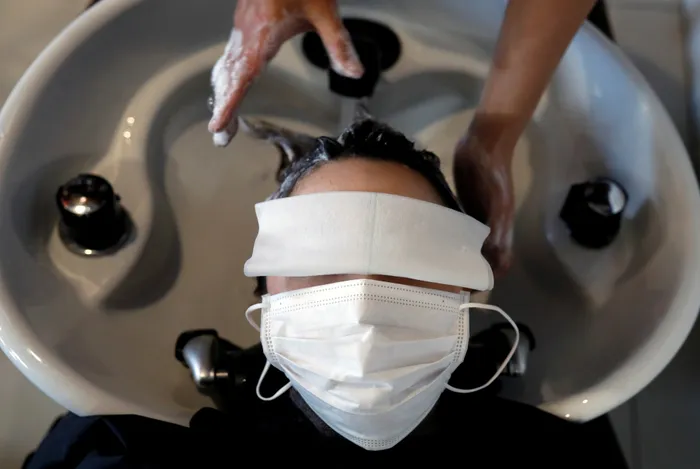
Natsuki Suda, wearing a protective mask to prevent Covid-19 infection, receives a hair treatment at a salon in Tokyo. File picture: Kim Kyung-Hoon/Reuters Natsuki Suda, wearing a protective mask to prevent Covid-19 infection, receives a hair treatment at a salon in Tokyo. File picture: Kim Kyung-Hoon/Reuters
Tokyo - Some 300 000 coronavirus masks
sent to pregnant women in Japan as part of a government handout
have been found to be faulty, media reported on Tuesday, the
latest in a string of complaints about how the government has
dealt with the epidemic.
The efforts of Prime Minister Shinzo Abe's government to
distribute protective cloth masks in the fight against the
coronavirus have been marred by complaints about mould, insects
and stains.
Just days after the government began supplying every
household with two washable masks at a total cost of $430
million, complaints emerged of soiled or defective products,
many of them from pregnant women.
By Tuesday, the number of defective masks distributed to
pregnant women had risen to 300,000 out of 500,000, public
broadcaster NHK reported.
The masks are being sent out in order of priority, with
pregnant women and care homes for the disabled at the top of the
list, though private households in Tokyo are also starting to
get theirs.
The Health Ministry was not immediately available for
comment, but the minister, Katsunobu Kato, told a news
conference the safety of all masks would be verified.
"It's a top priority to guarantee the quality of the masks
so pregnant women can use them," he said.
The government asked five companies to manufacture the
masks, and had originally said only three - Kowa Co Ltd
, Matsuoka Corp and trading house Itochu Corp
- were providing some for pregnant women.
Itochu said last week it was recalling some of its
undistributed face masks following reports of defects, as did
Kowa, which said it would tighten inspections at its plants.
A spokesman for Matsuoka Corp said it had received no
reports from the government of problems with its masks, though
it would work respond quickly and appropriately if issues turned
up.
On Monday, chief cabinet secretary Yoshihide Suga said the
government had verified that an additional company, Yusebio, had
also supplied masks which were sent to pregnant women.
According to Japanese media, the company, located in
northern Fukushima prefecture, normally imports wood chips for
use in biomass energy and has five employees.
In February, the company imported a large number of masks,
originally intending to sell them locally, but was subsequently
contacted by the Ministry of Economy, Trade and Industry about
purchasing them, the company's president was quoted by the Asahi
Shimbun daily as saying.
"There is no problem with the quality of our masks," the
company president was quoted by NHK as saying. The firm could
not immediately be reached for comment.
Asked about the procurement of the masks and how the firms
had been chosen, Suga told a news conference that everything had
been handled appropriately.
"There was an urgent need for the masks, so the government
asked around broadly," he said, without giving further details.
Masks remain a sought-after item in Japan.
Sharp Corp said in a statement on Tuesday that 4.7
million people applied for 40,000 boxes of face masks.
Last week, overwhelming demand crashed the Japanese
electronics firm's website soon after the company started taking
orders online. It then changed to sell the masks through a
lottery to avoid more crashes and said it was increasing
production.