

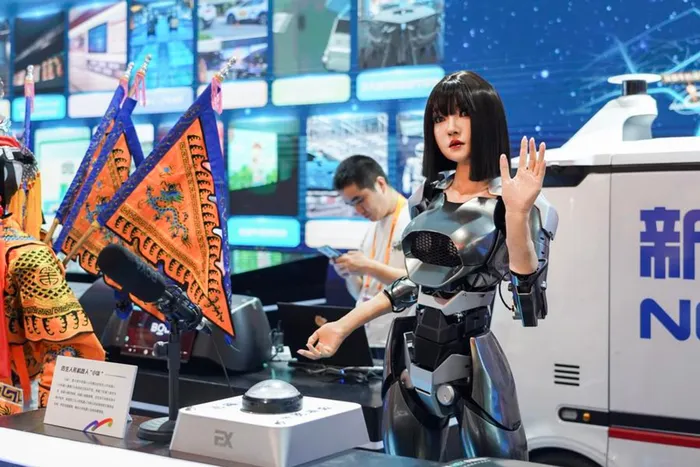
A humanoid robot on display, highlighting China’s rapid advancements in embodied artificial intelligence and next-generation robotics.
Image: Xinhua
Two 1.3m-tall humanoid robots in a storefront in Wuhan, capital city of central China’s Hubei Province, sprang to life, twisting and turning in perfect sync to a rhythmic beat. The conclusion of their dance coincided with the country’s first 7S humanoid robot store officially opening for its daily business.
Much like the automotive 4S shops, this novel concept aims to be a one-stop hub. But instead of cars, it focuses on humanoid robots. The 7S model builds on the traditional automobile 4S concept, namely sales, service, spare parts and surveys, by adding solution, show and school functions, thereby covering the entire industrial chain from components and whole machines to scenario-based applications.
Since opening in November last year, this store in Wuhan, run by Hubei Humanoid Robot Innovation Centre, has become a landmark of a shopping mall in the Wuhan East Lake High-Tech Development Zone, also known as the Optics Valley of China, a tech hub in Hubei.
China’s humanoid robot industry saw significant growth throughout 2025, backed by national and local government mid-to-long-term plans targeting it as a strategic sector. The 7S store represents a pioneering step in exploring viable commercial models and market acceptance for this transformative technology.
“In nearly two months, we’ve received approximately 18 000 visits, becoming a popular tech destination in Wuhan for both locals and tourists,” said store manager Hu Longdan.
“Cumulative revenue has reached almost 615 000 yuan (about R1.4 million). Humanoid robots are very popular for rentals, having served 10 plus commercial events, while experience projects featuring robot dogs and robot soccer have become major attractions for the youth,” Hu noted.
Inside the bustling store, robots of various sizes and shapes demonstrate their capabilities: some play soccer, others serve as retail assistants, while another group plays musical instruments.
“We have 17 different models of humanoid robots here, priced from 149 yuan to 700 000 yuan. They can be deployed in over 10 scenarios, including industrial manufacturing, cultural tourism guidance, elderly care and special operations,” said Hu.
China has intensified its efforts to foster future industries like embodied AI, as outlined in the proposals for the formulation of the country’s 15th Five-Year Plan (2026-2030). The goal is to cultivate new economic growth engines through technological innovation and market exploration.
The 7S store in Wuhan is part of a national wave of robot-themed retail experiments to promote real-life application of humanoid robots, a key phase for the development of the industry.
A think tank report forecasts that by 2045, China will have over 100 million humanoid robots deployed across industries, creating a total market value of approximately 10 trillion yuan.
In July last year, a robot 6S store, said to be the world’s first, opened in Shenzhen, a tech hub in south China. A month later, Beijing’s Robot Mall, a 4 000-square-metre robot 4S showroom, debuted during a robot consumption festival, featuring more than 50 products spanning medical, industrial and companion robotics.
The Wuhan store, notably, features a schooling function, addressing the “last mile” of skill development, thus standing out when compared to its peers.
This means the Wuhan store is not just a sales venue but also a “hands-on experience centre” offering interactive engagement and skills enhancement. Staff members highlight that the store provides robotics operator training, maintenance technician certification and introductory courses for teenagers.
In addition, corporate engineers can acquire practical skills in operating and maintaining humanoid robots on-site, while middle school students can learn programming and logic through hands-on activities.
“We’ve held 20 sessions, including eight instances of operator training, 12 youth courses and two teacher training events, involving over 1 000 participants,” said Hu.
About 65% of the trainees are youths, primarily students, building foundational skills. Professionals, like engineers and teachers, accounting for 35%, seek operational and maintenance expertise.
Over 50 professionals, meanwhile, have gained basic robot operation skills via the store programs, Hu revealed.
The store exemplifies the region’s integrated supply chain.
A key attraction near the store entrance is Yuan You, meaning Far Traveller in English, which is a wheel-footed robot standing 158cm tall and weighing 72kg.
“It can walk 1.5m per second,” Hu said.
“It’s a Hubei native and has been ‘working’ for nine months at a hospital in the city of Xianning in Hubei, providing guidance, explanations and even moxibustion therapy services.”
Xinhua