

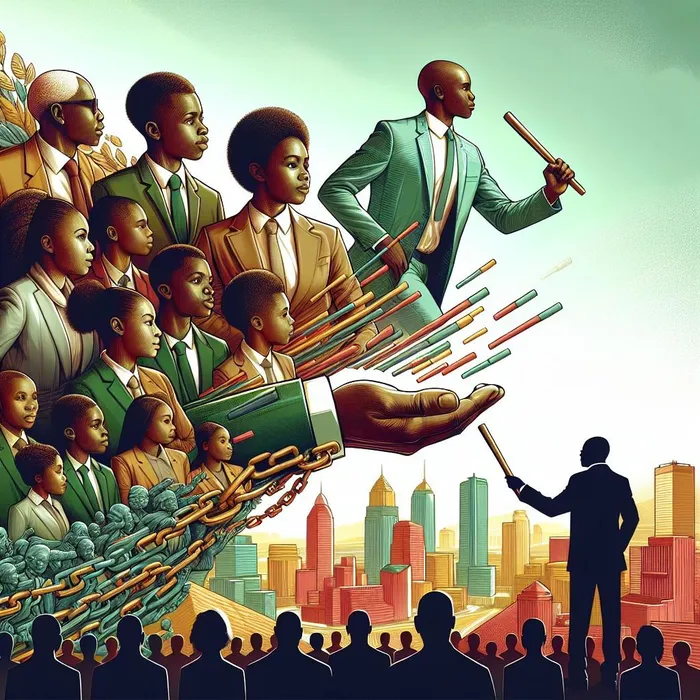
A generation disillusioned with the leaders who once fought for justice.
Image: RON AI
We grew up hearing stories of the struggle. Tales of courage, defiance, and sacrifice — of leaders who stood up to systems of oppression and injustice. For many of us in our 20s, these stories shaped our understanding of what leadership was supposed to look like: principled, selfless, and bold.
But today, as we look around, it’s hard not to feel like those very ideals are being betrayed. We’re caught between a rock and a hard place. On one side, a generation of leaders who were once celebrated revolutionaries, freedom fighters, and champions of justice. On the other, the suffocating reality that many of them have now become the gatekeepers of the very progress they once fought for. Let’s be honest: some joined the struggle out of deep conviction.
But many others were swept up in the tide of necessity — by circumstance, not conscience. Now that they’ve secured power, too many are clinging to it — not to continue the work of transformation, but to preserve their own interests. As they cling to power, the momentum for real change is slowing. In some places, it's even reversed. Our generation is watching hard-won gains be undone — not through direct oppression, but through neglect, arrogance, and resistance to evolution. Old slogans are used to silence new ideas. The language of revolution has been hollowed out and repurposed to defend outdated systems. Instead of passing the baton, the old guard tightens their grip, convinced that only it knows how to lead.
But here’s the truth: yesterday’s courage does not excuse today’s complacency. We are not ungrateful. We recognise the sacrifice it took to break the chains of colonialism, apartheid, dictatorship, whatever name oppression wore in different places. But revolution is not a final destination; it’s a process. One that must evolve with each generation. Holding onto power indefinitely doesn’t protect the legacy; it poisons it.
Our generation is not asking for shortcuts. We’re not expecting to lead without learning. But we are demanding space — to grow, to lead, to challenge, and to reshape what leadership looks like. We’re facing problems the old generation didn’t have to deal with: an unstable climate, digital inequality, stagnant economies, and mental health crises that are spiralling out of control. We’re living these issues every day — not reading about them in policy briefs, but navigating them in real time. So why is it so hard for those in power to listen to us? We don’t lack ideas. What we lack is access — access to decision-making spaces, platforms, and opportunities.
We are often told to “wait our turn.” But change does not operate on a waiting list. Our future is being decided *now*, and if we’re not part of shaping it, we will inherit a broken system we had no voice in designing. Let’s be clear: calling for generational renewal is not a call for disrespect. We honour the past, but we are not bound to it. The wisdom of the past should inform the future, not imprison it. Leadership must be a relay, not a throne.
To those in power: if your leadership was truly about the people, you should welcome the emergence of new voices. If the revolution mattered to you, you would recognise that it must continue, through us. To our peers — those in our 20s and 30s — we have work to do. Leadership isn’t just about replacing the old faces with younger ones. It’s about changing the values that drive our societies. We need to lead with integrity, not ego. With community in mind, not personal gain. With the courage to do what’s right, not just what’s popular. Our moment is coming, and for many of us, it’s already here. We can’t afford to wait for permission. The future depends on us stepping up-not because we want power, but because we know what’s at stake. Let the next chapter of leadership be driven by conscious purpose, not by nostalgia, entitlement, or fear.
Mayalo is an independent writer and analyst.
** The views expressed do not necessarily reflect the views of IOL, Independent Media or The African.