

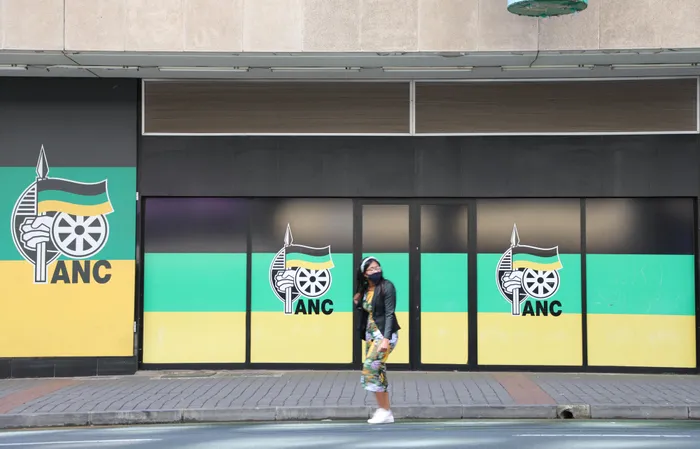
Inkosi Albert Luthuli House, the ANC headquarters in downtown Johannesburg.
Image: Timothy Bernard/Independent Newspapers
As South Africa grapples with a shifting political landscape, the thought of a future without the African National Congress (ANC) at the helm stirs in me a deep sense of uncertainty. For many, the ANC has become synonymous with corruption, complacency, and internal decay.
Yet for others, like myself, it remains the political home that carried the liberation struggle, gave us our democracy, and helped shape the constitutional framework that defines our democratic order today. This is not a blind allegiance to a party marred by scandal and misgovernance. I am not indifferent to the failures that have shaken the ANC’s credibility, failures that have cost lives, deepened inequality, and frayed the fragile trust between government and citizen. But despite this, I cannot easily discard the historical weight the ANC carries.
Nor can I ignore the vacuum it might leave behind. The end of ANC dominance may feel inevitable, even necessary, but I fear we have not sufficiently reckoned with what comes next. South Africans are angry, and rightfully so. Service delivery has stagnated, unemployment remains sky-high, and corruption has become a feature rather than a bug of our political life. But anger alone is a dangerous architect of political change.
What frightens me is not merely the ANC’s possible fall from power, but the increasingly likely scenario of a patchwork coalition of opportunistic parties, many of which lack a cohesive vision, national mandate, or ideological integrity, leading our country. In the 2024 general elections, the ANC dipped below 50% nationally for the first time since 1994. This marked a symbolic and material turning point. For the first time, we are staring down the barrel of a political future not defined by the ANC, but by a fragile web of coalitions.
And if our experience with municipal coalitions is anything to go by, especially in metros like Johannesburg and Tshwane, we should be concerned. Chaos, infighting, instability, and a lack of continuity have plagued these governance experiments, often to the detriment of the people they purport to serve. This is not to say the ANC has earned a permanent place in power - it hasn't. Accountability must prevail. But the euphoria with which some South Africans are celebrating its potential collapse often glosses over a fundamental question: what are we rushing into?
In many cases, the emerging alternatives appear less driven by a coherent policy agenda than by expedience and anti-ANC sentiment. Alliances of convenience — some backed by external or elite interests, others rooted in populist rhetoric — offer little assurance of stability or principled governance. It is one thing to want change; it is another to build a democratic consensus capable of sustaining it. We must reckon with the geopolitical undercurrents shaping our national discourse. In the absence of a strong, coherent government rooted in the interests of the people, we leave ourselves vulnerable to influences that are more imperialist than patriotic. The ANC, for all its flaws, still commands a sense of rootedness in South African history and the liberation narrative. In its absence, we risk opening the door to actors who have no allegiance to our democratic experiment—only to power.
This is not a romanticisation of the ANC. The party must confront its rot. Renewal cannot just be a slogan; it must be a lived reality—starting with decisive leadership, ethical governance, and a recommitment to the values of its founding. But while renewal is necessary, the alternative must be equally scrutinised. The question is: are we prepared for what comes after? Or are we letting our frustration drive us toward a political cliff, blind to the cracks in the supposed alternatives?I worry that we are more prepared to destroy than to rebuild. The culture of political accountability we seek will not come from dislodging the ANC alone; it must come from building new institutions, nurturing ethical leadership across the spectrum, and restoring faith in democratic processes—whether within or beyond the ANC.
The danger of a post-ANC South Africa is not just who takes over, but how they take over. Will it be through democratic consensus or through transactional politics where ideology is traded for short-term gain? Will it be a politics of inclusion or of fragmentation? Of continuity or chaos? For all its limitations, the ANC has provided a political centre — an imperfect one, but a centre nonetheless. In its absence, we must ask: who will hold the centre together? Because when the centre cannot hold, as history reminds us, things fall apart.
As citizens, our responsibility is not just to reject what has failed us, but to build what will serve us. We must demand more—not just from the ANC, but from every political formation seeking to shape our future. We cannot afford to gamble with our democracy in the hopes that “anything is better.” Such thinking gave rise to demagogues and instability elsewhere. We should not walk that path blindly. In the end, perhaps the most patriotic act is not just to remove the ANC, but to ensure that what replaces it is better, truly better, not just different. Otherwise, we risk trading one crisis for another, and history will not forgive us for it.
*Mayalo is an independent writer, and the views expressed are not necessarily those of IOL or Independent Media