

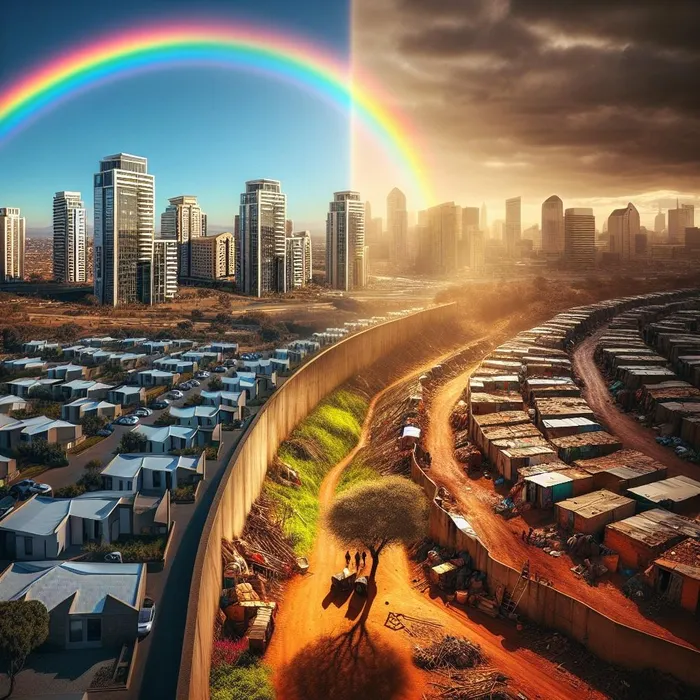
From the promise of a 'Rainbow Nation' to the harsh realities of inequality, the ongoing struggles faced by South Africans, particularly those in the Cape Flats, and calls for a renewed vision of true freedom and equality.
Image: RON AI
When South Africa emerged from the darkness of apartheid, we were told that we were entering a new era, one of hope, justice, and equality. The term "Rainbow Nation" captured that promise: a country where our differences would no longer divide us, but enrich us.
We were told we’d build a society rooted in dignity, where every South African — regardless of race, class, or background — could have a fair shot at life. But for those of us who grew up in the Cape Flats, that dream has always felt distant. The Cape Flats are often spoken about in the media only in terms of gang violence, poverty, and drugs. But behind the headlines are communities filled with resilience, families holding each other up, young people trying to survive —and yes, people still waiting for the basic promises of 1994 to be fulfilled. The streets I grew up on were filled with more struggle than opportunity. Our schools were under-resourced. Our clinics are overcrowded. Jobs were scarce, and crime often filled the vacuum left by the state.
It has become painfully clear to me that the Rainbow Nation project has failed—not just politically, but morally. It failed because too many of those who came into power were more focused on occupying office than transforming the lives of the people they claimed to represent. They traded one form of elitism for another. The apartheid-era divide was never dismantled; it was simply updated. Today, South Africa is a country where freedom is accessible to those with money, education, and connections—and where the majority remain locked out of opportunities. The wealthy enjoy secure homes, private healthcare, and elite education, while the rest of us still hustle just to meet our daily needs. There are still two South Africas. One lives in comfort and security. The other survives in the shadows—vulnerable, criminalised, and forgotten.
Yes, we have the right to vote, to speak, and to assemble. But what does that mean when you live in fear of being shot on your way home from school? When your child has to walk past a drug den to get to a classroom that hasn’t been painted in 15 years? When your cries for service delivery fall on deaf ears because your ward councillor only shows up around election time? This is not real freedom. It is symbolic freedomc— freedom in theory, not in practice. The dream of an equal society with equal opportunity has been steadily eroded. We were promised transformation, but what we got was substitution: one elite swapped out for another. Those who govern today speak the language of liberation but live lives far removed from the communities they once came from. What explains South Africa today is this betrayal. The institutions meant to serve the people have been captured not only by corruption but by apathy. And apathy kills hope. It tells people that nothing will change, so why bother trying? It tells the youth of the Cape Flats that their lives will always be defined by postcode, poverty, and police. But not all is lost.
Despite everything, I’ve seen people fight to keep their dignity alive—mothers who start feeding schemes, ex-gangsters who become mentors, teachers who show up every day in broken classrooms because they still believe in their students. These people, not the politicians, are the real custodians of our democracy. They are the ones holding the fragile promise of a better South Africa together.
We need to build a new vision. Not one based on slogans, but on justice. Not a Rainbow Nation, but a nation of equals—where freedom is measured not by what rights you have on paper, but by how you live your life. Where your future is not determined by where you were born, but by your potential. If we are to reclaim our country, we must do so from the ground up. From the Cape Flats to the townships, from the youth to the elders, we must demand more—and build more. Because until there is freedom for all, there is no freedom at all.
* Mmayalo is an independent analyst and writer