

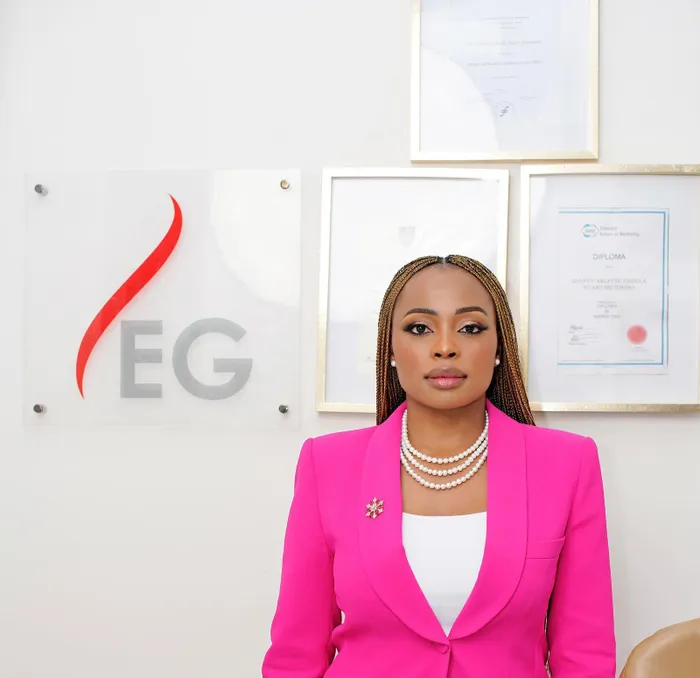
Shanty Tshiela Byart-Mutombo is the Chief Executive Officer of EG Group.
Image: Supplied
In the heart of the Democratic Republic of Congo (DRC), where the mining sector fuels much of the nation’s economy, Shanty Tshiela has emerged as a symbol of resilience, innovation, and visionary leadership.
CEO and founder of a leading mining supply chain company, she has carved a path few dared to tread, not only redefining what success looks like in a male-dominated industry but also challenging deep-seated stereotypes about what women can achieve in business.
Born in the DRC but raised in South Africa as a child, Tshiela’s journey has been marked by both courage and conviction. While many of her peers chose to seek opportunities abroad, she made the bold decision to return home, driven by a vision to build a company that would contribute to her country’s economic transformation.
“I saw opportunity where others saw instability,” she says. “The DRC is rich not only in minerals but in potential that needs people willing to invest in its future.”
Today, Tshiela stands among a new generation of African leaders rewriting the narrative of leadership one that is inclusive, compassionate, and grounded in purpose.
Redefining Leadership in a Changing World
Leadership, for Tshiela, is not about hierarchy or titles; it is about influence and impact. In an era when the global business landscape is undergoing profound transformation, she represents a new kind of leader — one who leads with empathy, vision, and authenticity.
Her philosophy centers on “transformational leadership”, a model that emphasises collaboration and empowerment rather than control and competition.
“The best leaders,” Tshiela reflects, “are those who create other leaders. My success is not measured by profit margins alone, but by how many women I’ve helped find their voice and confidence in spaces where they were once invisible.”
This approach is a deliberate departure from traditional notions of leadership — often associated with masculine traits such as dominance, authority, and aggression.
Tshiela challenges these stereotypes by embodying a leadership style that blends strength with emotional intelligence, decisiveness with compassion.
Her success invites a broader reflection: what does it mean to lead as a woman in industries that have historically excluded women?
And how can female leadership reshape the corporate and economic landscapes of developing nations like the DRC?
Success Against the Odds: A Woman in the Mining Supply Chain
The mining industry remains one of the most challenging sectors for women to enter — let alone lead. Characterised by its physical demands, entrenched male networks, and complex geopolitics, the field has long been seen as a man’s world.
When Tshiela founded her company in 2015, skepticism was rife. Many doubted that a young woman could navigate the rough terrain of supply contracts, logistics negotiations, and technical partnerships that underpin mining operations.
Yet, she persisted. Through vision, faith, resilience, strategic partnerships, innovative business models, and a commitment to transparency, Tshiela’s company has grown into a trusted player in the regional mining supply chain.
She attributes much of this success to her insistence on integrity and professionalism — two values that have helped her gain respect in an environment where female leadership is often scrutinised more harshly.
“I’ve learned that in this industry, credibility is your strongest currency,” she explains. “As a woman, you’re tested twice — once for your competence and again for your resilience. But when you show up consistently, deliver quality, and treat people with respect, even the toughest critics begin to see you differently.”
Her journey is not only a business triumph but also a symbolic one — proving that gender should never define one’s capacity to lead in technical, high-stakes sectors.
The Challenge of Stereotypes
Despite the progress made by women leaders across Africa, gender stereotypes remain pervasive. Society often expects women to lead in nurturing roles in education, healthcare, or social enterprises rather than in sectors like mining or finance.
Her reflection mirrors the experience of countless women leaders around the world who must navigate the double bind of leadership: being assertive without being labeled aggressive, ambitious without being dismissed as unfeminine.
But Tshiela has chosen to view these challenges not as barriers but as opportunities to change perceptions. “Every time a woman leads successfully in a space where she was not expected to, she redefines what leadership looks like for the next generation,” she says.
Championing Women and Girls
Beyond her business achievements, Tshiela is an outspoken advocate for women’s economic empowerment and girls’ education. Through mentorship programs and partnerships with local NGOs, she invests time and resources into initiatives that support young women in pursuing careers in science, technology, and business.
Her passion stems from personal experience.
“Education changed my life,” she says. “It gave me confidence, perspective, and the ability to dream bigger. That’s why I’m committed to ensuring that girls especially in rural areas have access to quality education and role models who show them what’s possible.”
She often emphasises that empowerment is not just about opportunity but also about mindset.
“We have to dismantle the mental barriers that tell girls they can’t because once they believe they can, they do extraordinary things.”
Through her leadership and advocacy, Tshiela has become a role model for aspiring women entrepreneurs across DRC, embodying the idea that success and service can coexist that business can be both profitable and purposeful.
A Trusted Voice in Global Forums
Tshiela’s credibility extends beyond her company’s boardroom. Her insights on leadership, sustainability, and inclusive growth have made her a trusted voice on global platforms such as the DRC Mining Week, Makutano Business Forum level up, Mining Indaba in South Africa, Annual Women and Leadership in Mining, and where she engages in dialogue about how Africa can leverage its natural resources to drive equitable development.
Tshiela has also featured in media platforms such as the BBC Africa, Newsroom Africa, Optimum a leading DRC business magazine and was nominated in the DRC ‘s Top 50 inspirational Women.
Her participation in these forums underscores a vital truth: women’s perspectives are essential to solving complex global challenges.
From climate resilience to supply chain transparency, female leaders bring holistic and community-centered approaches that complement traditional business strategies.
At the Mining Indaba, Tshiela has been vocal about the need to build ethical, sustainable, and inclusive supply chains — advocating for greater participation of women-owned enterprises and for policies that prioritise environmental stewardship and social impact.
Her voice carries authority not only because of her success but because of her integrity.
“Leadership,” she insists, “is not about being heard the loudest, but about speaking with purpose and authenticity.”
Reflections on the Future of Female Leadership
Tshiela’s story is a testament to what can happen when courage meets conviction. But it also invites a deeper reflection on how society can better support women in leadership roles.
For true gender equality to take root, structural change is necessary from access to financing for women-led businesses to inclusive workplace cultures that value diversity of thought. It requires shifting from tokenism to genuine representation, from celebration of a few exceptional women to the empowerment of many.
Tshiela believes that the next frontier of leadership will be defined by collaboration, empathy, and innovation.
“The world doesn’t need more leaders who command,” she says. “It needs leaders who connect who understand that progress is collective.”
Her message to young women is simple yet profound: “Don’t wait for permission to lead. Leadership begins the moment you decide to take responsibility for the change you want to see.”
In a sector often defined by extraction and competition, Shanty Tshiela has built a legacy of creation and collaboration. Her story is not just about breaking barriers in mining; it is about redefining what leadership looks like in the 21st century leadership that uplifts others, that challenges stereotypes, and that sees opportunity where others see impossibility.
Through her courage, vision, and compassion, Tshiela continues to prove that leadership is not gendered it is grounded in purpose. And in doing so, she lights the path for the next generation of women who will not just follow in her footsteps, but walk confidently in their own.
* Shanty Tshiela Byart-Mutombo is the Chief Executive Officer of EG Group. She has written this self-profile to highlight the challenges faced by women in business on the continent.
** The views expressed do not necessarily reflect the views of IOL or Independent Media.