

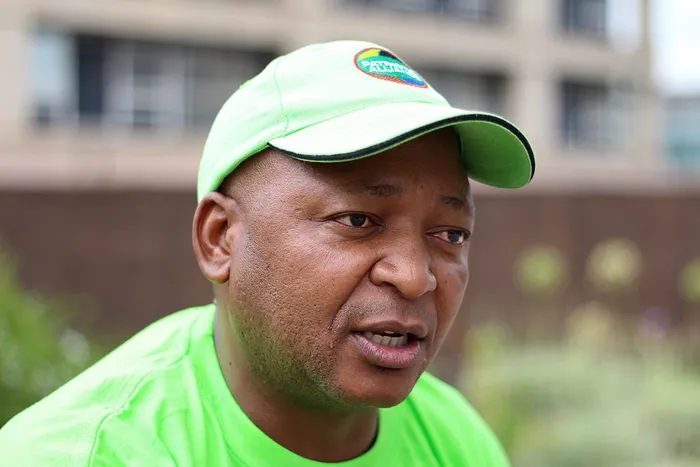
PA deputy president Kenny Kunene
Image: Sharon Seretlo / Independent Newspapers
In South African politics, coalitions have become the new normal, but with them has come a new kind of instability — one driven not by ideology or governance, but by spectacle, pressure tactics, and political strong-arming. Nowhere has this been more evident than in the City of Johannesburg, where the Patriotic Alliance (PA) recently pulled off a political stunt that exposed the ANC’s fragility, unsettled an already shaky coalition, and once again placed Kenny Kunene squarely in the public eye.
Let’s revisit the sequence. Kunene, then a Member of the Mayoral Committee (MMC) for Transport and Deputy President of the PA, was caught up in controversy after being spotted at the home of Katiso “KT” Molefe — an individual implicated in the high-profile murder of DJ Sumbody. Kunene claimed his presence there was journalistic, part of an effort to facilitate an interview. Nonetheless, the PA suspended him pending investigation. He soon resigned from both the MMC position and as a councillor in Johannesburg.
For most parties, that would be the end of the story. But the PA, under the theatrically strategic leadership of Gayton McKenzie, was just getting started. The party appointed Liam Jacobs — a fresh DA defector — to Kunene’s vacant seat, signalling a calculated move to maintain control of the portfolio. Then, in September, after an independent investigation by law firm Cliffe Dekker Hofmeyr cleared Kunene of wrongdoing, the PA turned up the heat. In a statement that was equal parts ultimatum and power flex, McKenzie demanded the immediate reinstatement of Kunene as MMC.
The terms were clear: if the ANC failed to comply within seven days, the PA would withdraw from all coalitions it was part of — local, provincial, or national. This wasn’t a polite request. It was a line drawn in bold, uncompromising ink. And what did the ANC do? They blinked. Kunene was swiftly reinstated as a councillor, and the political machinery moved to restore his position. What does this all mean? First, it lays bare the precarious nature of coalition politics in cities like Johannesburg. The ANC, once a dominant force, now finds itself relying on parties like the PA to govern. And those parties know it. The PA leveraged its relatively small share of seats to wield enormous influence — not by building consensus, but by threatening collapse. It's power politics at its most raw, and it worked. Second, this episode reveals how personalities increasingly drive political outcomes. Kunene’s return wasn’t based on a broader policy vision or community demand. It was driven by internal loyalty and public image management. McKenzie and the PA knew that backing down would be seen as weakness. By doubling down, they solidified their image as a party that stands by its own — right or wrong — and isn’t afraid to confront the ANC head-on.
But more than that, it raises uncomfortable questions about the ANC’s internal coherence. If the ruling party — even at the local government level — can be forced into cornered compliance by smaller partners, what message does that send about its capacity to lead? This isn’t about one metro; it’s a symbol of national slippage. A party that can be publicly strong-armed into appointments is one that is rapidly losing its grip. The broader risk is that governance becomes transactional. Votes are traded for positions, loyalty is traded for survival, and service delivery — the core responsibility of municipal government — becomes an afterthought.
Johannesburg, a city beset by potholes, power failures, water issues, and crumbling infrastructure, deserves better than to be the stage for ego-fuelled political brinkmanship. And yet, the PA isn’t necessarily losing support. Quite the opposite. By projecting strength, decisiveness, and defiance, it’s carving a brand for itself that resonates with a segment of voters tired of indecision and compromise. Whether or not Kunene is the best person for the job is beside the point. What matters, politically, is that the PA won — and did so publicly. As we head toward the 2026 local elections, the Johannesburg stunt may prove to be a defining moment. It showed the PA can punch far above its weight.
It showed the ANC is increasingly vulnerable in local structures. And it reminded us all that in the absence of political stability and maturity, coalition governance in South Africa is a ticking clock — waiting for the next showdown, the next resignation, the next ultimatum. What Johannesburg just experienced may be dismissed as a stunt, but in reality, it was a statement. One that said: power doesn’t belong to the biggest party anymore. It belongs to the one most willing to demand it.
*Mayalo is an independent writer and the views expressed here are not necessarily those of IOL or Independent Media