

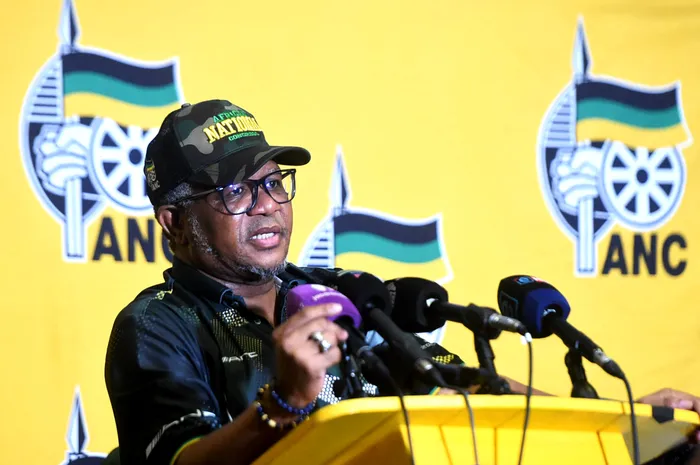
ANC Secretary-General Fikile Mbalula discussed President Cyril Ramaphosa's political future within the African National Congress in a speech to the Mpumalanga Provincial General Council that many experts recognize as strategically significant, says the writer.
Image: Itumeleng English / Independent Newspapers
In what appears to be a carefully orchestrated political manoeuvre, ANC Secretary-General Fikile Mbalula has opened a new chapter in the party's succession debate.
Speaking at the Mpumalanga Provincial General Council, Mbalula made what seasoned observers recognise as a strategically significant statement regarding President Cyril Ramaphosa's political future within the African National Congress.
Addressing delegates in isiXhosa, Mbalula acknowledged that Ramaphosa's second term as ANC President is approaching its conclusion. But rather than treating this as a natural transition point, he pointedly noted that "there is nothing that is prohibiting him to serve for the third term as the ANC President." This seemingly casual observation carries profound implications for the party's internal power dynamics.
The statement is remarkable for three reasons. First, it explicitly frames Ramaphosa's tenure as nearing a transition moment, establishing temporal urgency. Second, it introduces the prospect of continuity rather than change, suggesting momentum exists to retain Ramaphosa at the party's helm. Third, and most crucially, it invokes the absence of constitutional prohibition—a legal argument that effectively legitimizes what might otherwise be viewed as an unprecedented consolidation of power.
Understanding Mbalula's gambit requires distinguishing between two distinct offices: the presidency of the Republic and the presidency of the ANC. South Africa's Constitution is unambiguous—Section 88(2) limits any individual to two terms as head of state. Ramaphosa cannot legally serve a third term as President of the Republic.
However, the ANC's internal constitutional framework presents a more ambiguous landscape. Unlike the national Constitution, the party's founding documents contain no explicit two-term limit for the position of ANC President. This regulatory gap creates political space that Mbalula is now exploiting, suggesting that Ramaphosa could legitimately seek another term as party leader even while constitutionally barred from extending his state presidency.
This distinction between party and state leadership is not merely technical—it represents the foundation upon which Mbalula is constructing a continuity narrative that could reshape the ANC's leadership trajectory through 2027 and beyond.
Mbalula's intervention serves multiple strategic purposes within the complex chess game of ANC internal politics.
Establishing the succession framework: By raising the third-term possibility now, more than two years before the 2027 national elective conference, Mbalula is setting the parameters of debate. Rather than allowing an open contest to develop organically, he is framing the discussion around continuity versus disruption, with Ramaphosa positioned as the incumbent deserving renewal.
Complicating challenger positioning: Potential rivals now face a more difficult political calculus. Any challenge to Ramaphosa must be framed as opposing an incumbent seeking continuity rather than competing in an open field. This shifts the burden of proof, requiring challengers to justify why the party should break with its current leadership rather than simply presenting alternative visions.
Provincial mobilization: The choice of venue—Mpumalanga's Provincial General Council—is hardly coincidental. Mpumalanga represents a significant delegate bloc with substantial influence at national conferences. By planting these ideas in this provincial forum, Mbalula signals that the groundwork for 2027 is already being laid at the grassroots level where conference outcomes are determined.
The potential succession landscape reveals why the continuity camp may be moving preemptively.
Senzo Mchunu, once considered a formidable candidate after narrowly losing the secretary-general position to Ace Magashule by a mere 24 votes in 2017, now faces reputational challenges stemming from his involvement in the Madlanga Commission proceedings. His candidacy, while still viable, carries liabilities that the continuity camp can exploit.
Paul Mashatile, elevated to Deputy President of the ANC in 2022 with substantial delegate support, represents the most obvious successor within the current leadership structure.
However, ongoing media scrutiny regarding corruption allegations complicates his positioning as a reform-minded alternative.

Anda Mbikwana is a PhD candidate and a municipal finance and leadership in governance expert, writing in his personal capacity.
Image: Supplied
Gwede Mantashe, despite his influence, has stated his preference for wielding power rather than holding the top position—effectively removing himself from direct competition while maintaining his role as a critical power broker.
Mbalula himself occupies an interesting position. As Secretary-General, he controls party machinery and access but lacks the national stature and provincial base required for a successful presidential bid. His remarks may reflect recognition that his own path to the presidency requires maintaining the current configuration rather than disrupting it.
While the ANC has made notable progress in female representation—the 2022 Top Seven included three women—the prospect of South Africa's first female ANC president remains conspicuously absent from serious succession discussions. The more likely scenario involves elevating a woman to deputy president, fulfilling symbolic gender transformation commitments while maintaining male dominance at the apex of power.
This approach allows the party to demonstrate progressive credentials without fundamentally altering existing power structures—a pattern that risks being exposed as performative rather than substantive.
Examining the previous two national conferences illuminates current dynamics. In 2017, Ramaphosa defeated Nkosazana Dlamini-Zuma by a narrow margin of 2,440 votes to 2,261—a contest that reflected deep factional divisions within the party. The Secretary-General race that year was even tighter, with Ace Magashule edging Senzo Mchunu by just 24 votes.
By 2022, the landscape had shifted significantly. Ramaphosa secured renomination with overwhelming branch support—2,037 branches compared to Zweli Mkhize's 916—suggesting consolidation rather than contestation. While other positions remained competitive, the pattern indicated a more controlled internal environment with fewer genuine surprises.
This trajectory from contested succession to managed continuity provides the context for understanding Mbalula's current intervention. The 2027 conference is being positioned not as an open competition but as a ratification of existing arrangements.
Despite the apparent strength of the continuity strategy, significant vulnerabilities remain.
The party's public commitment to "renewal" sits uneasily alongside elite continuity. If Ramaphosa pursues a third term, critics will justifiably question whether the ANC is genuinely transforming or merely entrenching existing networks. This tension becomes more acute given the party's declining electoral performance and growing voter skepticism.
Corruption remains the most potent threat to continuity narratives. With key figures facing various degrees of scrutiny—from Mashatile's media challenges to Mchunu's Madlanga complications—the moral authority required to justify continuity may prove elusive. Ramaphosa himself, while currently shielded, is not immune to accountability pressures.
The spectre of unresolved political deaths and factional violence haunts the succession debate. While full details remain contested, these incidents feed perceptions that internal ANC competition involves not merely policy disagreements but existential struggles with occasionally fatal consequences.
For a party advocating stability and continuity, these ghosts in the room present serious reputational risks.
Finally, there is the challenge of managing expectations across various levels of the organization. While national leadership may align around continuity, provincial structures, branch networks, and particularly youth formations may demand more substantive change. If the gap between elite preferences and grassroots aspirations widens, the carefully constructed continuity narrative could fracture.
With approximately two years remaining before the next national elective conference, Mbalula's remarks represent an opening salvo in what promises to be an extended campaign.
The continuity camp must now execute a complex strategy: mobilize branch-level support, secure provincial nominations, manage financial resources, contain potential challengers, and maintain policy credibility—all while projecting an image of renewal to increasingly sceptical voters.
Whether this strategy succeeds depends on two critical factors.
First, can the continuity camp maintain internal discipline and organizational momentum through 2027? Second, can potential challengers present credible alternatives with sufficient moral authority and provincial support to overcome the incumbent advantage?
Mbalula's Mpumalanga remarks are far more than routine political commentary. They represent a strategic effort to shape the succession narrative, establish continuity as the default position, and manage what might otherwise become a destabilizing leadership contest.
By invoking constitutional flexibility and emphasizing Ramaphosa's eligibility for a third-party term, Mbalula is effectively launching an early campaign to transform the 2027 conference from a competition into a coronation.
The ultimate question facing the ANC is whether this approach serves the party's long-term interests. South African voters, increasingly disenchanted with elite continuity and unmet promises of transformation, may distinguish between rhetorical renewal and substantive change.
The party that once led the nation's democratic transition now faces its own transition dilemma: can it renew itself while maintaining elite continuity, or will the contradiction between these imperatives eventually prove unsustainable?
As the succession drama unfolds over the coming months, one thing is clear: Mbalula has planted his seed. Whether it takes root or withers will determine not only who leads the ANC into its next chapter, but what kind of organization the party becomes in the process.
Anda Mbikwana is a PhD candidate and a municipal finance and leadership in governance expert, writing in his personal capacity.