

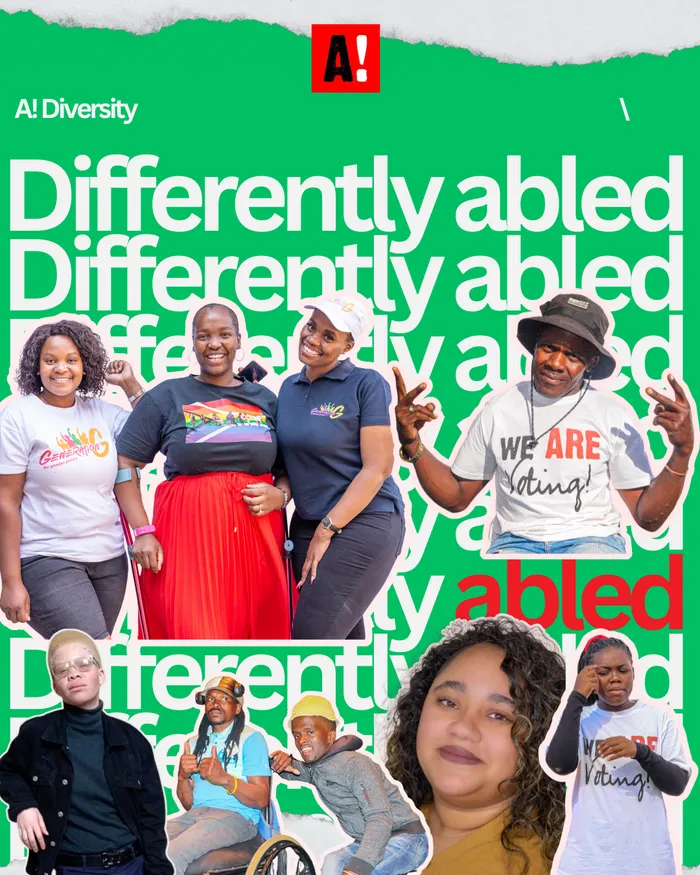
ACTIVATE! Change Drivers has decided to start this discussion early with its A! Diversity campaign.
Image: Supplied
October marks a significant moment of reflection and responsibility in South Africa’s journey towards greater inclusion.
While South Africa officially observes National Disability Rights Awareness Month from 3 November to 3 December, ACTIVATE! Change Drivers has chosen to begin this conversation early through its A! Diversity campaign.
The campaign dedicates October to deepening awareness, challenging stereotypes, and placing people living with disabilities at the centre of social participation. The campaign arrives at a time when inclusion cannot remain an abstract value.
According to Statistics South Africa’s 2024 report, approximately six percent of the national population lives with a form of disability. Behind that figure are individuals whose daily experiences are reshaped by physical and social barriers.
These barriers limit not only access to buildings or education. They limit dignity, opportunity, and full citizenship.
The Constitution of the Republic of South Africa enshrines human dignity, equality, and freedom from discrimination as foundational principles. Section 9 of the Constitution recognizes disability as a ground on which unfair discrimination may not take place. Section 10 goes further and affirms the inherent dignity of every person.
These are not abstract legal ideals. They form the moral framework of the nation’s social contract. In addition to these, Chapter 9 of the Constitution established, among other institutions, the South African Human Rights Commission (SAHRC), which is mandated to protect and promote human rights. The Commission continues to highlight the gap between policy and lived reality for persons with disabilities.
The SAHRC’s 2017 Research Brief on Disability and Equality underscored that the denial of access, whether to education, healthcare, or employment, constitutes a form of systemic discrimination.
The Commission has since urged all sectors to adopt the principle of ‘universal design,’ ensuring that physical and informational spaces are usable by everyone, regardless of ability. By doing so, the SAHRC reminds South Africa that equality is not achieved by accommodation after exclusion. It is achieved by inclusion from the outset.
To support employers and institutions in this task, the SAHRC has developed practical resources such as the ‘Disability Toolkit for Employers’ and the booklet on Human Rights and Persons with Disabilities. These tools offer guidance on workplace inclusion, accessibility standards, and the legal obligation of employers under the Employment Equity Act and other frameworks.
These resources are freely available on the SAHRC website and serve as valuable references for organisations committed to creating equitable environments. The South African government reinforced this constitutional commitment in 2015 through the White Paper on the Rights of Persons with Disabilities.
The White Paper provides a policy roadmap for removing barriers and creating inclusive communities. It calls for reasonable accommodation in public institutions, accessible infrastructure, and the representation of persons with disabilities in all decision-making spaces. Importantly, it affirms that inclusion is not an act of charity. It is a matter of justice and equality before the law.
South Africa’s domestic commitments are also shaped by its international obligations. As a signatory to the United Nations Convention on the Rights of Persons with Disabilities (CRPD), the country has joined the global movement to ensure the equal treatment of people living with disabilities.
The obligations remind governments, businesses, and civil society alike that disability rights are human rights.
Disability Rights awareness is not merely about empathy. Raising awareness, therefore, must go beyond annual observances. It involves re-examining everyday practices: the design of public buildings, the accessibility of information, the representation in media, and the attitude with which people engage difference. It also requires honest dialogue between policymakers and young South Africans who are demanding a more inclusive nation.
Young people are calling for a nation where ability is not measured by physical capacity but by contribution and character.
As South Africa moves from October’s awareness efforts into the official Disability Rights Awareness Month in November and December, the message remains the same: inclusion is not seasonal. It is a constitutional promise, a global mandate, and a moral necessity.
Sihle Siphosethu is a member of ACTIVATE! Change Drivers, a multisectoral youth development programme.