

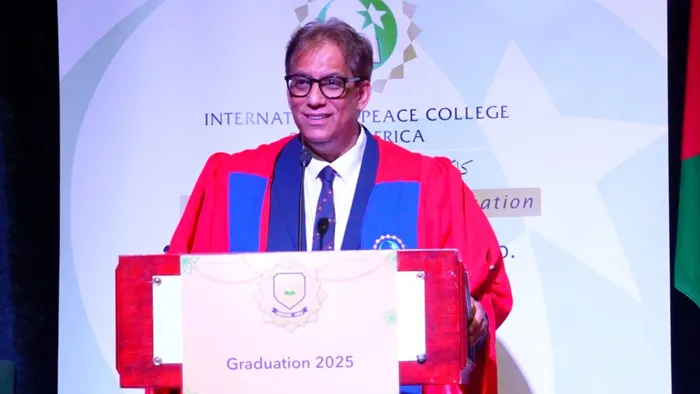
Dr. Surve’s message was both a challenge and an invitation: to shape an era where intelligence is guided by humanity and where progress prioritises people first.
Image: Supplied
Dr Iqbal Survé, Patron and Founder of the Surve Family Office and Chairperson of the Sekunjalo Group, received the IPSA Business Achievement and Philanthropy Award 2025 at the International Peace College South Africa (IPSA) graduation ceremony in Cape Town.
The award recognised his outstanding contribution to business, education, and social development.
The recognition reflected Dr Survé’s lifelong commitment to using enterprise as a force for good, building inclusive economies, expanding access to education, and championing ethical leadership in the modern world. As founder and chairman of Sekunjalo Investment Holdings, his career has been defined by transformation, innovation, and philanthropy.
Through Survé Philanthropies and several educational foundations, he has empowered thousands of young South Africans to study, innovate, and lead. On the global stage, his work through the World Economic Forum, BRICS Business Council, and other international bodies has positioned him as a voice for the Global South, a leader who connects technology with humanity and business with purpose.
Dr Survé delivered the keynote address titled “Artificial Intelligence and the New Human Renaissance.”
In a speech that blended intellect and conviction, he urged graduates to pair knowledge with conscience and to lead the coming age of technology with empathy, ethics, and courage.
Dr Survé reminded graduates that while Artificial Intelligence (AI) continues to reshape economies and industries, its true purpose must remain human-centred.
“Technology can process data, but it cannot care. It can diagnose, but it cannot comfort the sick,” he said. He described AI not only as a technological revolution but as a human one — a test of whether society can balance innovation with integrity.
“If we program it with greed, it divides. If we program it with empathy, it heals. Every generation must decide: will we use technology for profit or for people?” He urged young professionals to learn to work with technology, not for it.
“Let it enhance your curiosity, not replace your creativity. Let it guide your efficiency, not remove your humanity.”
Reflecting on his own path from medicine to entrepreneurship, media, and technology, Dr Survé said each chapter of his career reinforced one principle—knowledge without conscience is incomplete.
“As a young doctor, I watched computers enter hospitals and thought them miraculous. But I soon learned that while a machine can detect illness, it cannot comfort the sick. It can calculate, but it cannot care.”
He explained that this insight shaped his lifelong approach to leadership. “The difference between intelligence and wisdom is compassion. Machines can learn, but they cannot love.”
Dr Survé told graduates that while the world is obsessed with automation, the humanities remain the moral compass of progress. “When machines start to think, philosophers must ask what thought really means. When algorithms define truth, we need journalists to defend it. When AI paints, we need artists to interpret beauty.”
He described the humanities as the moral operating system of the modern world, insisting that ethical awareness must evolve alongside technological capability.
“Progress without ethics is not advancement; it is acceleration without direction.”
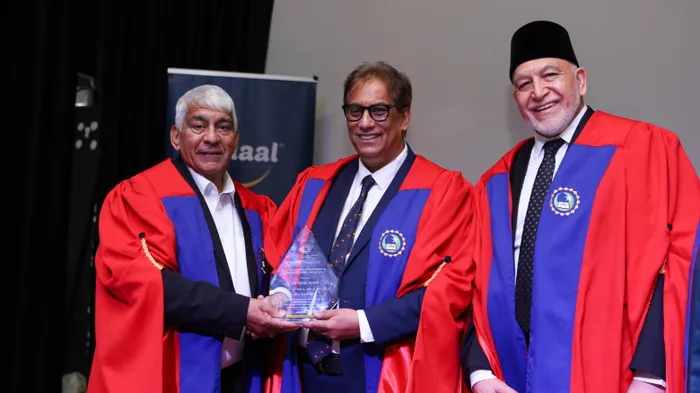
Dr Survé delivered the keynote address titled “Artificial Intelligence and the New Human Renaissance.”
Image: Supplied
He urged the graduates to let integrity guide every decision. Drawing on his medical background, he reminded them of the timeless principle "do no harm" and extended it beyond medicine.
“Whatever field you enter — business, education, media, or public service — do what isright, even when it is not easy. Treat people with dignity. Lead with honesty and humility,” he said.
For Dr Survé, ethics are not abstract ideals but daily disciplines. “Our shared humanity depends on integrity, choosing fairness over advantage, and compassion over indifference. Because true intelligence, in any form, is not measured by knowledge but by conscience.”
Throughout his career, Dr Survé has maintained that success carries a moral responsibility. “The world does not need more wealth; it needs more wisdom,” he said. “Education, when used for humanity, is the most powerful form of philanthropy.”
He encouraged graduates to redefine success as service. “Wherever you go, do it with purpose. Learn and share what you have learned. Grow and help others grow with you.” Philanthropy, he explained, is not about money but about mindset, a way of living that recognises the power of contribution and compassion.
Dr Survé reminded graduates that their degrees are not an end but a foundation. “Education is not a chapter that ends with a certificate; it is a lifelong dialogue with the world,” he said.
He urged them to continue learning with humility and curiosity. “The future will belong to those who keep questioning, exploring, and adapting,” he said. “When you educate one person, you transform a community. When you educate with conscience, you transform a nation.” A call for a new human renaissance.
Closing his address, Dr Survé called for what he termed a New Human Renaissance—an era that redefines progress through empathy and ethical intelligence. “Be humble in success, curious in failure, and generous in wisdom,” he told the graduates.
“Work hard, but work with heart. Dream, but dream for others, not just for yourself.” He warned that the greatest threat of the digital era is not that machines will become too intelligent, but that humans may become too complacent.
“Artificial intelligence can give us knowledge,” he said, “but only you can turn that knowledge into wisdom.”
As applause filled the hall, his words left a lasting impression — a reminder that the future will not be determined by technology alone, but by those who lead with conscience.
Dr. Surve’s message was both a challenge and an invitation: to shape an age where intelligence is guided by humanity and where progress serves people first.