

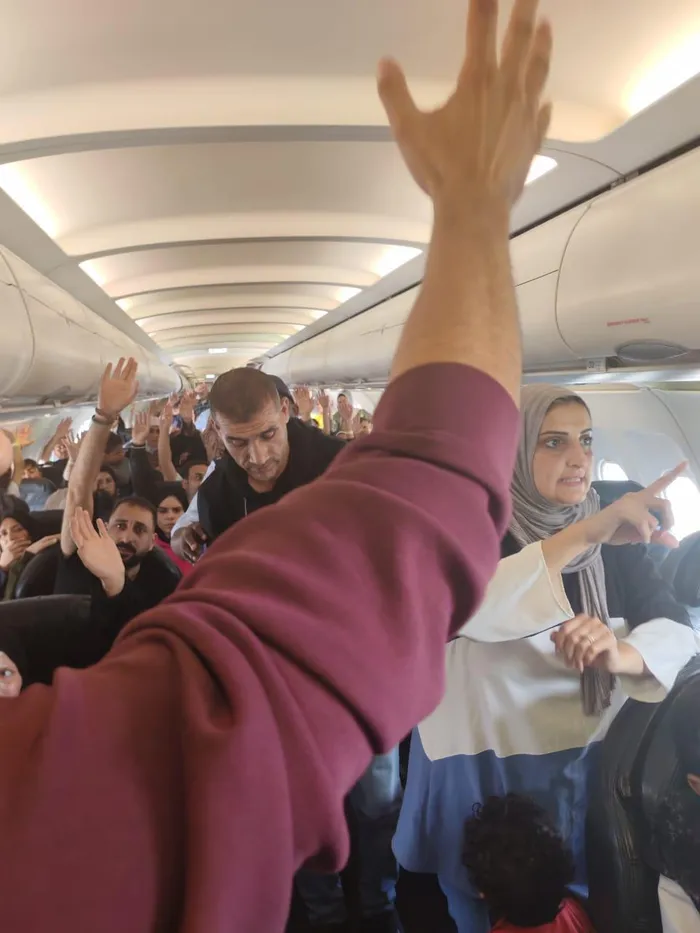
Aid organisation Gift of Givers has welcomed the Palestinian refugees who arrived in South Africa on Thursday.
Image: Supplied
It has become increasingly clear, particularly in the handling of the recent flight carrying the so-called ‘153 Palestinian refugees,’ that Gift of the Givers has effectively assumed control over the functions of the Department of International Relations and Cooperation (DIRCO).
It was deeply embarrassing for the government to remain completely uninformed about the details of the flight, while Gift of the Givers appeared to possess full knowledge of every aspect of the journey—information with significant foreign-policy implications for South Africa. This is especially troubling at a time when the country is already at odds with the United States and its allies.
It is increasingly reasonable to conclude that Gift of the Givers has effectively infiltrated and taken control of South Africa’s foreign policy, which has drifted far from its traditional focus on economic prosperity, peace, African unity, regional stability, and multilateral cooperation. Under the tenure of Dr. Naledi Pandor, foreign policy has increasingly centred on confronting the United States and its allies—particularly Israel—apparently as a strategy to curry favour with China, Iran, and Russia.
Dr Imtiaz Sooliman has positioned himself close to influential power centres within DIRCO, to the point where he appears to exert substantial influence over key decisions. He played a notable role in South Africa’s move to take Israel to the International Court of Justice (ICJ)—a decision that not only cost the state millions of rands but also provoked serious backlash from the US and its partners.
As South Africa hosts the G20 summit without the presence of the world’s largest economy, the United States — and with Mexico and Argentina also absent—the message should be unmistakable. While the summit will proceed, South Africa must urgently reflect on how its international posture is eroding its global standing and take steps to repair its international image.
Many South Africans — including politicians, analysts, and ordinary citizens — have long expressed concern that the government has failed to manage the country’s borders effectively. It has now become even more evident that the state is struggling, and failing dismally, to address the complex and sensitive issue of immigration.
Worse still, the authorities appear to be enabling and abetting unlawful immigration, a practice that poses serious security risks to everyone living in South Africa. By allowing people to enter the country without proper screening or due diligence, we are exposing ourselves to avoidable threats.
According to SAPS crime statistics, 26,232 people were murdered between January and December 2024.
What is most troubling is that the majority of perpetrators are never apprehended. This alone demonstrates that South Africa faces a profound internal security crisis—one that demands urgent attention to ensure the safety and security of all residents. Instead of tightening internal security, the government is permitting the entry of additional groups of people without adequate vetting.
Government officials who are making the dangerous decision to admit the so-called ‘Palestinian refugees’ should revisit the historical record of the Palestinian Liberation Organisation (PLO). After being expelled from Jordan in the early 1970s, the PLO relocated to Lebanon, entering the country as refugees.
Over time, the refugee camps were transformed into heavily armed military bases that overshadowed the Lebanese national army and effectively created a state within a state. Their growing power contributed to the instability that culminated in the Lebanese Civil War of 1975, in which the PLO became a major participant. They ceased to function as mere refugees.
The removal of the PLO in 1982 to Tunisia left the establishment of the Iranian-backed Hezbollah, which continued to cause chaos in that country by attacking Israel from the North. The country that used to pride itself as one of the few hubs of Christians now has below 50% of Christians, with weaker security and instability due to the infiltration of Hezbollah, which has created a state within the state in Lebanon.
There are numerous economically capable Arab states in both the Middle East and North Africa that should be at the forefront of championing the Palestinian cause. South Africa, by contrast, is grappling with a quadruple burden—poverty, inequality, unemployment, and weak economic growth — which continues to devastate the lives of its citizens. Having only recently emerged from the brutality of apartheid, South Africans still carry the deep scars of that system, and their government’s primary obligation should be to prioritise their well-being and socio-economic upliftment.
What, then, elevates the Palestinian struggle above the genocide unfolding in Sudan, where Africans are being killed in large numbers with minimal global outrage? Why does the ANC government remain conspicuously silent on the humanitarian crises in Zimbabwe, the Democratic Republic of Congo (DRC), Mozambique, the Central African Republic (CAR), Niger, Mali, Burkina Faso, Gabon, Cameroon, Burundi, and many other African nations? These countries are battling terrorism, widespread hunger, entrenched unemployment, collapsed governance systems, and various socio-political crises, yet they do not receive the same level of vocal solidarity and diplomatic energy.
South Africa cannot afford to ignore the lessons of history. The security of the nation and its people must come first.
Kgwadi is a research fellow at the Middle East Africa Research Institute (MEARI)