

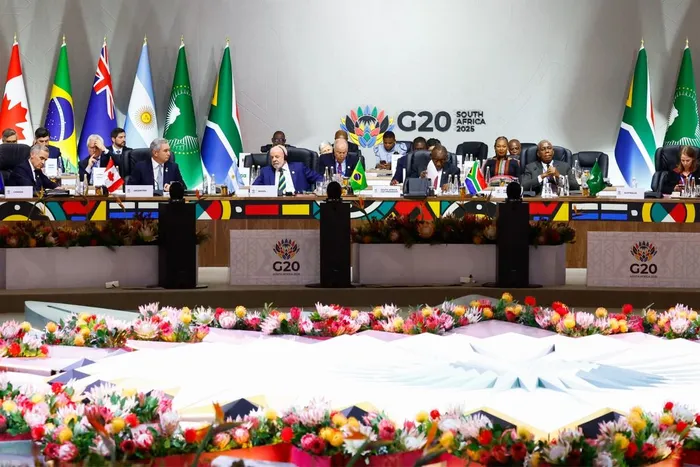
Not only has the Trump administration not participated in the proceedings, but Secretary of State Marco Rubio called South Africa's "Solidarity, Equality, Sustainability" theme "anti-American"—a label that turns policy disagreement into existential hostility, says the writer.
Image: Thomas Mukoya / POOL / AFP
The diplomatic cables crackling between Washington and Pretoria this week carry more than routine diplomatic correspondence.
The United States has explicitly warned South Africa that it opposes any G20 summit outcome document framed as consensus, threatening that any declaration would be viewed solely as a chair's statement without American agreement.
This confrontation, playing out as President Donald Trump boycotts the Johannesburg summit alongside ally Javier Milei of Argentina, represents far more than scheduling conflicts or procedural disagreements. It is a crystallizing moment that could fundamentally reshape the contours of US-South Africa relations and signal profound shifts in the architecture of global governance itself.
What makes this moment particularly significant is its unprecedented nature. This would mark the first G20 summit since 2008 not to issue a consensus leaders' declaration, a technical detail that masks a substantive fracture.
The Trump administration has not merely absented itself from the proceedings—Secretary of State Marco Rubio branded South Africa's theme of "Solidarity, Equality, Sustainability" as "anti-American", a characterization that transforms policy disagreement into existential opposition.
Consider what South Africa's presidency has proposed: debt relief mechanisms for developing nations, climate financing for disaster adaptation, and an International Inequalities Panel modelled after the IPCC. Between 2021 and 2023, Africa spent $70 per capita on debt interest payments, exceeding expenditures on education or health. These are empirical realities, not ideological provocations.
Yet Washington's response treats South Africa's developmental agenda as a threat to American interests rather than a legitimate attempt to address structural imbalances in the global economy.
The Trump administration has imposed 30% tariffs on South African exports—the highest on the African continent, a punitive measure that operates simultaneously as economic pressure and a symbolic message. For South Africa, which has positioned itself as a gateway to African markets and a stable emerging economy, this creates immediate commercial pain.
South African exporters—from platinum miners to automotive parts manufacturers—face margin compression that could render them uncompetitive in American markets.
But the more profound concern extends beyond tariff schedules. What happens when the world's largest economy treats a middle power's pursuit of developmental multilateralism as grounds for economic punishment? South Africa faces a potential cascade: reduced foreign direct investment as American firms recalculate political risk, credit rating agencies viewing US-South Africa tensions as sovereign risk factors, and domestic business constituencies pressuring Pretoria to moderate its international positions to preserve market access.
The historical parallel that comes to mind is Cold War-era pressure on non-aligned nations, though the dynamics differ. During the Cold War, superpowers competed for allegiance; in this emerging configuration, Washington appears less interested in winning South Africa over than in demonstrating the costs of charting an independent course.
This shift from competitive engagement to punitive disengagement may prove more destabilizing for smaller economies that lack the geopolitical leverage to absorb such pressure.
In the absence of the United States, China's Premier Li Qiang is expected to advocate for multilateralism, a positioning that illustrates how American absence creates strategic opportunities for competitors. Beijing does not need to actively undermine Washington's position when Washington vacates the field. Chinese diplomacy gains credibility not through aggressive action but through steady presence—showing up, engaging constructively, and presenting itself as a dependable partner committed to the institutional architecture that Washington now treats with disdain.
For South Africa specifically, this creates both opportunity and danger. China could offer financing mechanisms, trade relationships, and diplomatic support that offset American pressure.
The Belt and Road Initiative, whatever its complications elsewhere, becomes more attractive when the alternative is economic isolation enforced by Washington.
But deeper Chinese engagement brings its own dependencies, debt sustainability questions, and domestic political controversies in a South African context already debating foreign influence and economic sovereignty.
The truly destabilizing scenario emerges if this pattern replicates across multiple middle powers. If countries from Brazil to Indonesia to Turkey observe that defying American preferences on global governance issues triggers swift economic retaliation, the lesson learned may be either submission or accelerated diversification away from dollar-denominated trade and American-centric financial systems.
Either outcome diminishes American influence—the first through resentment that undermines soft power, the second through the gradual construction of parallel systems.
President Cyril Ramaphosa walks a treacherous domestic political path. His response—calling the US absence "their loss"—projects confidence but cannot obscure real vulnerabilities. South Africa's governing ANC faces electoral pressure from both left and right, with the Economic Freedom Fighters positioning themselves as anti-imperialist champions and the Democratic Alliance emphasizing pragmatic Western alignment.
If US economic pressure translates into job losses in export-dependent sectors—automotive manufacturing in the Eastern Cape, fruit farming in the Western Cape, mining operations in the Platinum Belt—Ramaphosa will face accusations of sacrificing workers' livelihoods for symbolic G20 positioning.
Opposition parties will argue that principled multilateralism is a luxury South Africa cannot afford with unemployment above 30%.
Conversely, if Ramaphosa moderates South Africa's international positions to appease Washington, he risks alienating his party's left wing, civil society organizations that view the G20 agenda as long-overdue justice, and South Africa's carefully cultivated reputation as a voice for the Global South.
The domestic political calculation becomes: is it better to absorb economic pain while maintaining moral authority, or to preserve economic relationships while appearing to capitulate to superpower pressure?
This dilemma extends beyond one leader's political survival. It speaks to fundamental questions about what kind of international actor South Africa can be—whether middle powers retain meaningful agency in shaping global rules, or whether the post-Cold War moment of relative multipolarity is closing into a new era of hierarchical ordering where smaller states must choose sides and accept subordinate positions within hierarchical blocs.
The G20 emerged after the 2008 financial crisis as recognition that major global challenges required inclusive problem-solving beyond the G7. South Africa's presidency marks the end of a cycle of Global South G20 presidencies following Indonesia, India, and Brazil. The US position argues that this forum only functions legitimately when it advances American priorities—a stance that retroactively undermines the G20's foundational premise.
If major powers can boycott summits and threaten to delegitimize any outcomes they dislike, what remains of institutional multilateralism? The precedent extends beyond this summit. Climate negotiations, trade agreements, UN specialized agencies—all rely on the principle that participation obligates engagement even when outcomes are displeasing. Washington's approach suggests that American exceptionalism now includes exemption from this basic diplomatic norm.
If the G20 cannot produce consensus documents, its utility as a coordinating mechanism diminishes. If middle powers conclude that investing diplomatic capital in global forums produces only great power vetoes and retaliation, they may disengage from institution-building entirely. The result would be a world of ad hoc arrangements, bilateral deals cutting across multilateral commitments, and the gradual hollowing out of the rules-based international order that American strategists spent decades constructing.
Defiant Consensus: Pretoria could rally other G20 members to issue a declaration despite US opposition, framing it as defending multilateral principles. This preserves South Africa's international standing but invites sustained American pressure and potential economic retaliation beyond current tariffs. The gamble is that other nations—particularly European democracies—will support South Africa diplomatically and economically, offsetting US pressure.
Strategic Accommodation: South Africa could retreat to a chair's statement as Washington demands, avoiding direct confrontation. This preserves the bilateral relationship and protects economic interests but undermines South Africa's presidency and signals that American pressure works. Future host nations learn the lesson: ambitious agendas invite punishment.
Forum Diversification: South Africa could pivot attention to alternative forums—BRICS+, African Union structures, South-South cooperation mechanisms—positioning them as more legitimate venues for developmental agenda-setting. This acknowledges G20 limitations while building alternative institutional infrastructure, though these forums lack the G20's inclusion of major economies.
Each path involves trade-offs between principle and pragmatism, immediate economic interest, and long-term strategic positioning. What South Africa cannot do is ignore the fundamental reality this confrontation exposes: the gap between formal multilateralism and actual power distribution in international politics.
The Johannesburg G20 confrontation poses a question that extends far beyond South African American relations: Is this a temporary aberration reflecting one administration's unilateralist tendencies, or does it signal a more permanent restructuring of international order where middle powers must choose between alignment with great powers or accepting marginalization?
For South Africa specifically, the stakes are existential to its post-apartheid international identity. The Rainbow Nation positioned itself as a bridge—between developed and developing worlds, between Western and non-Western powers, as a voice for justice grounded in its own transition from oppression.
American demands that South Africa choose sides—that it abandons developmental multilateralism in favour of economic bilateralism—fundamentally challenge this bridging role.
The irony is profound: Washington's pressure may precisely accelerate the outcomes American strategists wish to avoid.
Economic coercion pushes South Africa toward deeper engagement with China and other powers offering alternative partnerships. Dismissing legitimate developmental concerns as "anti-American" alienates not just South Africa but the broader Global South watching this confrontation. Boycotting multilateral institutions to protest their agendas undermines the very institutional frameworks that have historically amplified American influence.
The deepest question this confrontation raises is about power itself—not just who it has, but how it can be legitimately exercised in an interconnected world.
Can superpowers still dictate terms to middle powers through economic pressure, or has interdependence created mutual vulnerabilities that limit effective coercion? Does moral authority still matter in international relations, or has the global order devolved entirely into transactional calculations of material interest?
South Africa's G20 weekend will not definitively answer these questions. But how this confrontation resolves—whether through South African accommodation, American recalibration, or an extended standoff—will signal which future we're moving toward: one where multilateral institutions retain legitimacy and middle powers retain agency, or one where raw power reasserts hierarchical ordering and developmental concerns get sacrificed to great power competition.
The world will be watching Johannesburg this weekend. Not just for what gets declared or does not, but for what this confrontation reveals about the international order we are living in, as distinct from the one we rhetorically claim to uphold.