

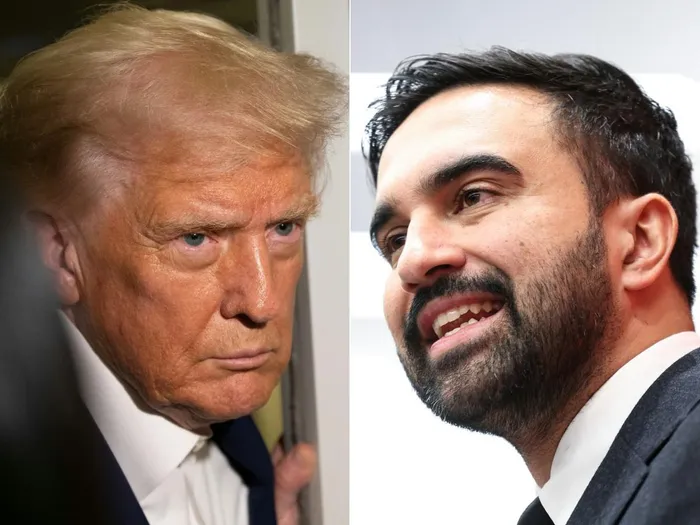
NYC mayor Zohran Mamdani and President Donald Trump
Image: AFP
What happened in New York is more than just a political victory. It is a revolution in how power is won and who it belongs to.
Andrew Cuomo had everything money could buy: millions in campaign funds, endorsements from political heavyweights, and even the surprising cross-party support of Donald Trump. The establishment closed ranks around him, confident that politics would follow its usual script — that influence and wealth would carry the day.
And yet, the people of New York tore that script apart. Zohran Mamdani’s campaign began with no corporate donors, no billionaire patrons, and no glossy television ads. What he had instead was conviction, clarity, and courage. He spoke to what New Yorkers needed most — dignity, fairness, affordable housing, justice, and opportunity. He did not treat politics as performance, but as service. He listened to those whom others dismissed. He knocked on doors where few politicians had ever gone. And in doing so, he gave voice to those who had long been ignored.
The Mamdani campaign became a movement powered not by money but by belief. Over seventy thousand volunteers joined him — students, workers, retirees, immigrants, and lifelong New Yorkers. They moved borough to borough, block to block, propelled not by the promise of power but by hope. Each conversation, each flyer, each doorstep became a small act of resistance against the cynicism that has long haunted American democracy.
People gave what they could — time, energy, conviction — because they believed change was not just necessary, but possible. And against all odds, belief won. The son of Ugandan and Indian immigrants, raised on the stories of struggle and solidarity, is now the mayor of the largest city in the United States. It is a victory that transcends geography or ideology. It is a statement that the people, when united, are stronger than the most entrenched political machine. Mamdani’s rise shatters the myth that politics belongs to the powerful.
For too long, elections have been treated as transactions — campaigns as commodities to be purchased by the wealthy and sold to the public. But this moment shows that politics, at its best, is not about money. It is about meaning. When people reclaim ownership of their democracy, they can rewrite what is possible. There is something profoundly human about what New York just witnessed. In a city defined by its contradictions — immense wealth beside deep poverty, ambition shadowed by inequality — a campaign built on compassion triumphed over one built on calculation.
It wasn’t just a contest between two men, but between two visions of power: one rooted in privilege, the other in participation. The lesson is simple but transformative. Change does not require billions of dollars; it requires belief. It does not need permission from the elite; it needs courage from the ordinary. When people are organised, disciplined, and hopeful, even the most fortified systems can be moved.
From the crowded streets of New York to the bustling townships of Cape Town, from Kampala to Nairobi, the message resonates. Politics need not be the playground of the rich. It can be reclaimed by the people — by teachers, nurses, students, workers — by those who have been told too often that their voices do not matter. What happened in New York is not an American story alone; it is a universal one. The world today faces a crisis of faith — not in religion, but in democracy itself. Many have stopped believing that politics can deliver justice or dignity. Mamdani’s victory reignites that faith.
It reminds us that politics, when done with purpose and humility, can still be a force for good. As dawn breaks over New York, the city’s skyline gleams with a new kind of light — the light of possibility. For every person who has ever felt powerless before a system too vast to challenge, this moment says otherwise. Change begins when belief becomes action, when courage replaces fear, and when people decide to claim what has always been theirs: their voice, their city, their future. If it can happen in New York, it can happen anywhere. Change does not need billions. It needs belief. It needs willpower, discipline, courage — and above all, faith. From Uganda to Cape Town to New York, the message is clear: politics belongs not to the powerful, but to the people.