

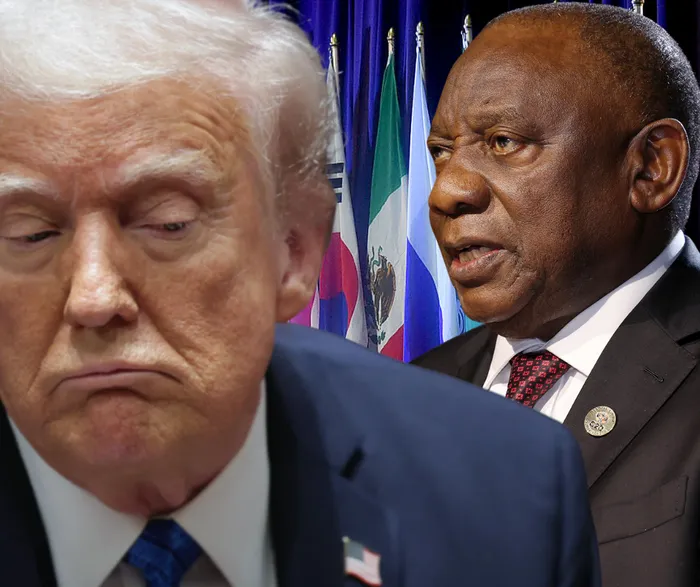
Analysts and experts believe Donald Trump's decision to prohibit South Africa from the G20 summit next year, as well as stopping subsidies, aims to prove the US's power and dominance.
Image: IOL Graphics
The recent statements made by President Donald Trump regarding South Africa mark a disconcerting turn in bilateral relations between the two countries. While disagreements between sovereign states are not uncommon, the nature and intent behind Trump’s rhetoric point to motives that extend well beyond simple policy divergence.
They reveal a willingness to distort facts, apply targeted political pressure, and undermine diplomatic norms in pursuit of narrow geopolitical objectives. U.S. intelligence agencies are fully informed about South Africa’s domestic realities. They receive detailed analyses, independent assessments, and security briefings that clearly reflect the consensus among scholars, civil society, police data, and international observers: there is no factual basis for the narrative of a so-called “white genocide” in South Africa. It is a fringe conspiracy theory that has been repeatedly debunked. Trump is not misinformed. He is choosing to repeat a falsehood.
This points to political intent rather than ignorance. Throughout his political career, Trump has demonstrated a pattern of weaponising misinformation when it suits his goals. In the South African context, the revival of this discredited narrative provides a convenient mechanism for demonising a government that has openly challenged the Trump administration’s ideology and foreign policy on several key fronts. South Africa’s firm position on the Israel–Palestine conflict before the International Court of Justice, its non-aligned stance on the Russia–Ukraine war, and its continued solidarity with Cuba have all clashed with Trump’s worldview. Moreover, South Africa’s strategic partnership with China and its active role within BRICS are fundamentally at odds with Trump’s desire to reassert U.S. dominance in the global balance of power. For an administration that sees sovereignty through the lens of compliance, South Africa’s independent foreign policy is treated as defiance.
In addition to ideological friction, there are clear economic incentives behind Trump’s antagonism. South Africa holds 15 of the world’s 25 most critical and scarce mineral resources—minerals central to the technological, energy, and security needs of the United States. As global competition over these resources intensifies, particularly between the United States and China, Washington has strong strategic interests in securing preferential access. A weakened ruling party in South Africa and the emergence of a more U.S.-aligned government could conveniently achieve that aim. Trump’s suggestion that South Africa should be excluded from the G20 is therefore more than a diplomatic insult-it is an act of deliberate destabilisation.
The G20 is built on multilateral cooperation, shared responsibility, and collective economic governance. It is not structured to allow unilateral expulsions driven by personal political agendas. Attempts to marginalise South Africa threaten not only our position but the integrity of the entire global economic forum. President Cyril Ramaphosa’s measured and principled response to Trump’s remarks has been appropriate and consistent with internationally accepted diplomatic conduct. His reaffirmation of South Africa’s sovereignty and his commitment to engaging the United States through formal channels demonstrate maturity and strategic clarity.
South Africa cannot afford to mirror Trump’s inflammatory posture. Instead, it must remain firm in its principles while maintaining open lines of communication. Equally important is the need to continue engaging American society beyond the White House. The United States is not monolithic. It is a complex polity with diverse voices-business leaders, civil society organisations, academic institutions, state governments, and diplomatic professionals, many of whom value stable, respectful relations with South Africa.
These constituencies will outlast the Trump presidency. They remain essential partners in rebuilding and strengthening the relationship after this period of turbulence. It is therefore crucial that South Africa takes a long-term view. Trump’s presidency, like all administrations, is temporary. The foundations of U.S. foreign policy extend beyond the personality occupying the Oval Office. The U.S. State Department, the diplomatic corps, and institutional actors within the American political system broadly support principled, stable, and mutually respectful partnerships. South Africa must preserve these relationships and avoid allowing Trump’s short-term political theatrics to dictate the future trajectory of bilateral relations.
South Africa’s commitment to an independent, principled foreign policy remains central to its role in an evolving global order. That independence has drawn criticism from some quarters, but it also commands respect internationally. As pressures mount—from Washington or elsewhere-South Africa must hold firm to the values that have shaped its international identity: multilateralism, sovereignty, equality among nations, and the pursuit of global justice.Trump’s rhetoric will pass. The strategic importance of South Africa, its principles, and its relationships will endure.