

While China has been South Africa’s largest trading partner for 16 consecutive years, the report reveals that economic dominance has not yet translated into seamless social integration.
Image: Ian Landsberg
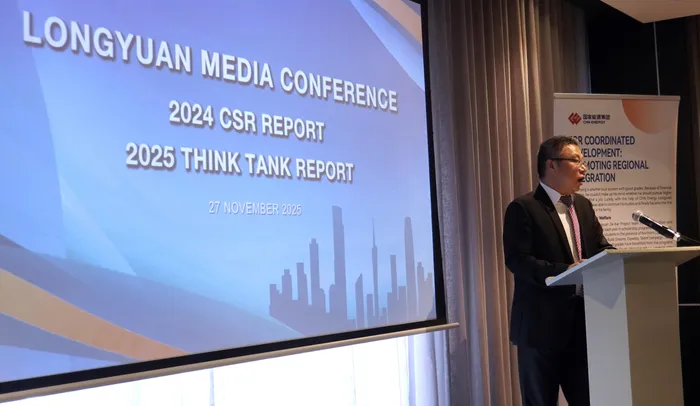
As South Africa and China elevate their diplomatic ties to an "all-round strategic cooperative partnership," a groundbreaking new Think Tank report released alongside Longyuan South Africa Renewables’ latest Social Responsibility Report, the academic study—titled “Chinese Corporations and South African Culture”—was prepared by the University of Johannesburg’s Centre for Africa–China Studies (CACS) in partnership with People’s Daily Online and Longyuan SA at the Century City Conference Centre and argues that the next frontier for Chinese investment is not just infrastructure but deep cultural integration.
While China has been South Africa’s largest trading partner for 16 consecutive years, the report reveals that economic dominance has not yet translated into seamless social integration. The study serves as a "scoping exercise" to map how Chinese enterprises are navigating South Africa’s complex labour, social, and regulatory landscape.
The report, drafted by a team including Professor David Monyae and Dr. Emmanuel Matambo, tackles the "liability of foreignness" faced by Chinese firms. It highlights a stark contrast between large multinationals and smaller entities.
While state-owned enterprises (SOEs) and large tech firms like Hisense and Huawei have successfully localised operations—creating domestic value chains and "Made in South Africa" exports—smaller traders and "China shops" often remain socially isolated, practising only "partial embedding" within local communities.
"The expansion of Chinese corporations... has encountered great barriers caused by cultural differences like difficulty of communication [and] operating methods," the report notes, citing frictions in labour relations and management styles rooted in different value systems.
From a local perspective, the report addresses the persistent myth that Chinese companies rely solely on imported labour. Data cited in the study indicates that across over 400 projects, workforce localisation stands at over 85%. However, a "glass ceiling" remains, where senior management roles are frequently reserved for Chinese nationals, limiting deep skills transfer.
Furthermore, the report acknowledges the clash between the Confucian work ethic (prioritising discipline and collective sacrifice) and South Africa’s highly unionised, rights-based labour culture. The study urges Chinese entities to adapt to local labour laws to avoid disputes that have historically marred perceptions of Chinese investment.
A key recommendation of the report is the adoption of Ubuntu—the South African philosophy of interconnectedness—as a corporate strategy.
"Helping the less fortunate is a key part of Ubuntu," the report states, noting that Chinese enterprises spent approximately R2 billion on corporate social responsibility (CSR) initiatives between 2019 and 2024.
Speaking at the launch event, Longyuan South Africa Renewables CEO Wang Tianbao echoed these sentiments, noting that sustainability must go beyond megawatts. "We have always followed the concept of openness, shared growth, and green development locally... We hope green energy can reach more families and help deepen the cooperation and friendship between China and South Africa," Tianbao said.
The event highlighted Longyuan’s De Aar wind power project as a "gold standard" of this integration. Beyond contributing over 783 million kilowatt-hours to the grid in 2024, the company’s mobile clinics have served over 50,000 residents, and its training initiatives have helped local youth secure employment in the green economy.
The think tank report concludes with actionable advice for Chinese firms wishing to succeed in the local market:
As South Africa continues its Just Energy Transition, this report underscores that financial capital must be matched by social capital. The ultimate test for the China-South Africa partnership will be whether these investments can shed the image of extraction and truly become part of the local family.