
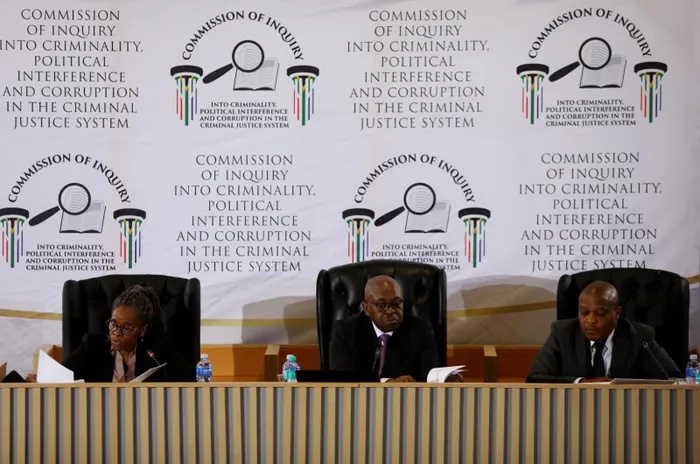
President Cyril Ramaphosa appointed a Judicial Commission of Inquiry to probe criminality, political interference and corruption in the criminal justice system. Members of the Commission (from left) Adv. Sesi Baloyi, SC, Justice Mbuyiseli Madlanga (Chair) and Adv. Sandile Khumalo, SC.
Image: Oupa Mokoena / Independent Newspapers
There’s an old saying, “Once the rain is over, the umbrella becomes a burden.” In the storm, an umbrella is precious, shared, defended, and trusted. But when the clouds clear, it suddenly feels heavy, unnecessary, and awkward to explain.
Loyalty often ends when the benefit stops. This old truth hits uncomfortably close to home as South Africans learn that the preliminary report of the Madlanga-led commission will not be made public. The storm seemed to have passed; the groundwork was done. The country waited for sunlight for truth, only to find the umbrella remained closed.
Who Holds the Umbrella? The question is simple: if the rain has stopped, why are we still being asked to carry the umbrella? Or more pointedly, who is allowed to hold it? Justice Madlanga has long reminded us that democracy thrives on transparency.
The rule of law does not fear exposure; it depends on it. Power must operate openly because secrecy breeds loyalty to people, not principles.
Politics, however, has a familiar rhythm: loyalty that flourishes in crisis but disappears when accountability approaches. During the downpour, cooperation abounds. Once the clouds lift, silence and selective memory return. This is no accident; it is an incentive.
When preliminary findings are withheld, those incentives linger. The umbrella may no longer shield anyone from the rain, but it casts a shadow. Some are spared scrutiny, while the rest of us are asked to be patient, to trust, and to keep walking under someone else’s protection. A preliminary report is not a verdict.
The law demands fairness, and those implicated deserve a chance to respond. But there is a vital difference between procedural care and prolonged opacity. One protects justice; the other protects comfort. South Africans understand due process.
What unsettles us is not delay but ambiguity. When we are not told why the umbrella remains open, or for how long, suspicion grows that the rain has stopped only for some. If the storm continues, say so plainly. If the skies have cleared, let sunlight follow. Anything less transforms the umbrella from a tool of protection into a symbol of exclusion.
Withholding even preliminary truth reshapes loyalty. Those inside the tent know the forecast; those outside are told to keep faith “just in case.” That is managed frustration, controlled, withheld, and not constitutional accountability. Madlanga’s record reminds us that in a constitutional democracy, loyalty must run upward to the law, not sideways to networks or personalities.
When information is hidden, loyalty drifts toward proximity to who knows whom and who is protected until further notice. We have seen this before.
When umbrellas are carried long after the rain stops, institutions weaken, cynicism grows, and accountability becomes a seasonal ritual rather than a permanent ethic. This is larger than one report. It asks whether we still believe that sunlight strengthens democracy or threatens it.
Whether truth can be shared or must be managed. If the umbrella must remain open, let us see it. Tell us why. Tell us when it will close.
Anything less only deepens the fear that loyalty did not end when the rain stopped; it merely retreated from view. In a country still learning to trust its institutions, that is perhaps the heaviest burden of all.
Nyaniso Qwesha is Master of Business Administration graduate