

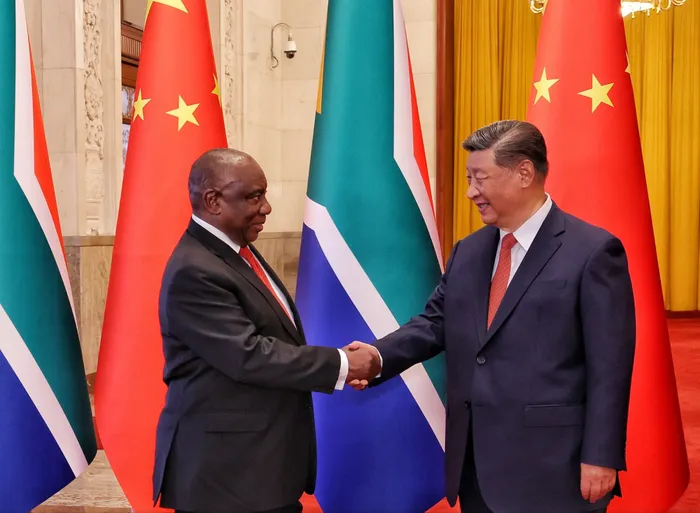
President Cyril Ramaphosa and Chinese President Xi Jinping have strong economic ties. Chinese firms and African governments have already piloted AI systems for urban management, fintech solutions, and hydropower operations, and there are joint efforts to apply technology for green energy and food. security, says the writer.
Image: GCIS
Emerging technologies, such as the internet of things (IoT), big data analytics and Artificialintelligence are rapidly evolving, with the potential to transform society and the economy.Africa stands a unique opportunity to reboot its development by leveraging new technologiesand reliable tech- partnerships for mutually beneficial socio-economic transformation.
AI and emerging technologies are projected to contribute around $1.5 trillion to Africa’s GDPby 2030 through rapid tech adoption, accelerated sustainable growth and development.Advances in renewable energy, broadband infrastructure, and digital public services arestrengthening resilience and fostering more inclusive tech adoption for development.
The African Union (AU)’s Agenda 2063 and the African Continental Free Trade Area(AfCFTA) provide crucial frameworks which could benefit from the growing adoption ofnew technologies and supportive tech-partnerships to leapfrog the continent intomodernization.
The African Union's Digital Transformation Strategy (2020–2030) guidescontinental efforts by prioritising broadband expansion, digital skills development, e-governance, data governance, and support for emerging technologies such as AI and fintech.
Regional blocs such as the Economic Community of West African States (ECOWAS), theEast African Community (EAC) and the Southern African Development Community (SADC)have embraced tech-innovation seeking to harmonize ICT and cybersecurity frameworks,promote cross-border digital services, regional data protection standards, digital tradefacilitation, and e-commerce integration.
These policies, although at various levels ofinitiation and implementation demonstrates continental willingness to widely embrace tech-driven national and continental socio-economic development.As the African continent increases and broadens inclusive access and adoption of newtechnologies, there is need to foster mutually beneficial tech- partnerships to accelerate techdriven modernization.
Evolving China Africa tech-partnerships involving governments,major telecommunications and mobile companies demonstrates that reliable partnershipscould effectively bridge the digital divide, allowing for inclusive economic participation andgrowth.China is the biggest trading and development partner with the African continent.
Beijing isalso a major power championing the development of the Global South through initiatives likethe Global Development Initiative (GDI), Global Security Initiative (GSI), GlobalCivilization Initiative (GCI), the Global Governance Initiative (GGI), the Belt and RoadInitiative (BRI) and the Forum for Africa China Cooperation (FOCAC).
These initiatives focus on shared development, security, cultural exchange, and fairer globalgovernance to promote equal multilateralism and inclusive decision-making including in therole and governance of new technologies to achieve shared development that benefits allhumanity.
The Chinese government and companies have become critical catalytic partners inAfrica’s tech-driven modernization providing Information and Communication Technologies(ICTS) driving economic growth and service delivery such as e-government, health andeducation.
In September 2025, African Union Commission (AUC) and the Ministry of Science andTechnology of China signed a new framework agreement to enhance cooperation in scienceand technology across the continent.
The memorandum of understanding gives newmomentum to deeper and broader collaboration across research, innovation, and technologytransfer through the establishment of joint laboratories, research centres, exchange andtraining programmes for scientists and entrepreneurs.
The 2025 China-Africa Internet Development and Cooperation Forum held in Xiamen reinforces digital cooperation with new initiatives covering e-governance, telemedicine,online education, smart cities, and joint training programs for digital-economy talent.
The push for deeper cooperation comes as part of a broader effort under the Forum on China-Africa Cooperation (FOCAC) and the digital-economy focused ''Community with a Shared Future in Cyberspace'' plan, which aim to support Africa's digital transformation as a catalystfor African modernisation.
The plan provides that China will continue to support the build-out of communicationinfrastructure, promoting 5G and broadband deployment, facilitating data-network links, andencouraging Chinese internet companies to invest in Africa.
China-Africa cooperation hasbroadened beyond infrastructure and connectivity into high-tech domains such as artificialintelligence (AI), smart-city tech, renewable energy, and sustainable agriculture.
Chinese firms and African governments have already piloted AI systems for urban management, fintech solutions, and hydropower operations, and there are joint efforts to apply technologyfor green energy and food security.
Beyond infrastructure and networks, China-Africa cooperation has evolved to focus on muchneeded capacity building, sustainability, and innovation. Joint programs under the China-Africa Science and Technology Partnership Program 2.0 envisage co-development ofresearch centres, technology transfer, science parks, sustainable-development projects, andcollaborative work on agriculture, environment, disaster mitigation, and public health.
The shift signals a deepening of long-term, mutually beneficial development positioningtechnology cooperation as a pillar of broader China-Africa socio-economic and diplomaticcooperation, and shared socio-economic modernization.
China has invested heavily in Africa's digital infrastructure and ecosystem. According toofficial data, Chinese firms have helped build massive backbone networks of up to 150,000km of communications networks, tens of thousands of kilometres of power and data-transmission infrastructure, and laid over 200,000 km of optical fibre.
These projects havebrought broadband internet, mobile connectivity, and cloud-computing services to millions ofAfricans helping to narrow the digital divide.
Chinese companies have leveraged robust Africa-China relations to play important roles indriving economic development in sectors such as telecommunications, cloud computing andfintech focusing on infrastructure development, online platforms, and services helping integrate Africa more deeply into the global digital economy, catalyzing job creation, skillsdevelopment, and long-term economic growth.
Cooperation between African regional telecom giants and Chinese corporates such as Huaweiand China Telecom have ushered a new era in mutually beneficial relations amongstcorporates. In 2025 a collaboration between MTN, Huawei and China Telecom deployed a5G private network at a large mining operation in South Africa.
The ground-breaking initiative which uses ultra-reliable, high-speed connectivity for automation, tracking, unmanned trucks, and other smart-mining functions is described as Africa's largest 5G-enabled ''smart mine''.
China Mobile International (CMI) worked with global and regional partners to build the 2Africa Submarine cable which spans 45,000 km from the East to West Africa connecting Africa with Europe, Asia and beyond.
Such connectivity catalyses Africa’s socioeconomictransformation by providing high-capacity, low-latency connectivity and cloud computing to support digital economies, education, and healthcare amongst other services. Huawei and ZTE have been instrumental in expanding 3G/4G/5G networks, telecom equipment, and mobile broadband across Africa enabling expanded faster and efficient mobile access and inclusive economic participation.
Huawei is estimated to have constructedaround 70 % of Africa's 4G networks, in addition to the bulk of earlier 3G infrastructure.China–Africa infrastructure and telecom cooperation has expanded into e-commerce, digital payments, smart logistics and trade platforms aiding African SMEs and producers to accessbroader markets, including in China and other countries.
Chinese companies are playingcatalytic roles in providing data-services and operating cloud, data-centres, and Internet-of-Things (IoT) solutions, enabling enterprises and governments in Africa to access moreadvanced ICT and new technological services important to the digital economy.China has supported African universities and vocational education, contributed scholarships,and specialized ''technology-talent'' programmes.
The parties have set up joint research andinnovation structures including labs and research centers deepening cooperation in scienceand technology to facilitate long-term mutual tech development on the continent. ChinaAfrica cooperation has also expanded into the domains of artificial intelligence (AI), cloud computing, big data and new-generation ICT as part of efforts to modernize Africaneconomies and public services.
Africa-China cooperation has played a catalytic role in bridging the digital divide in Africa.Going forward, China and African countries should consolidate tech cooperation as one ofthe main frontier of sustainable socio-economic transformation and modernization.
Dr Gideon Chitanga is a Political Science and International Relations Expert