
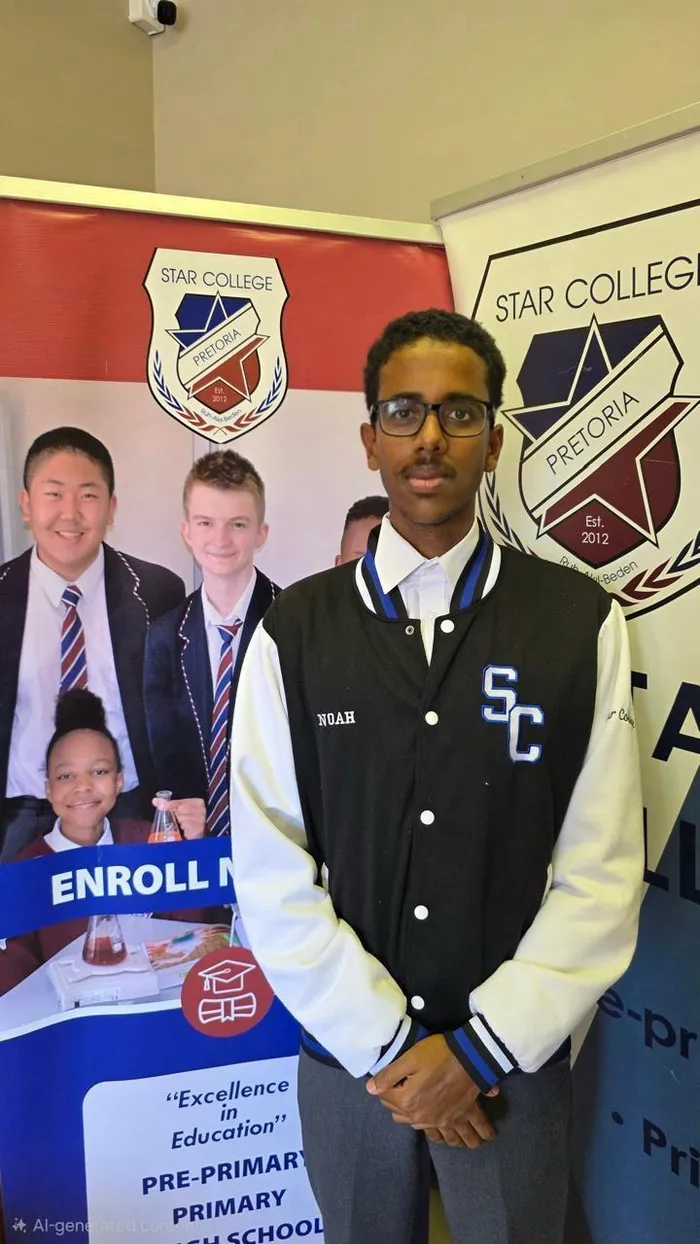
Noah Abraham Tesfay, a top achiever at Pretoria Star College, earned an outstanding eight distinctions, reflecting academic excellence and dedication.
Image: Supplied
South Africa's 2025 matric results once again ranked Horizon and Star Colleges, both run by the Horizon Foundation, as among the country's top educational institutions.
Headlines highlight distinctions, provincial top achievers, and impressive pass rates. However, these results did not begin in an examination hall.
They didn't start in Durban, Johannesburg, or Cape Town. They began decades ago, as part of an education-centered service movement that began in Turkey and later spread around the world — a movement founded on a simple but demanding belief: that serving humanity through education is one of the most important callings.
That early vision grew into an understanding that schools are not businesses, but places where character is formed, and that teachers are more than just employees; they are carriers of responsibility across generations.
Horizon and Star Colleges' current success reflects a long, mostly unseen history of sacrifice, displacement, endurance, and quiet perseverance. This isn't primarily the story of top students.
It tells the story of those who stood behind them. It tells the story of teachers who graduated from some of the best universities in their countries. Many of their classmates went on to become executives, directors, and corporate leaders, accumulating wealth and living comfortably.
They made a different choice. They selected classrooms over boardrooms. Communities on the outskirts outnumber corporate centers. Concerns about personal security. They did this without creating financial plans, calculating future comfort, or providing guarantees.
What they chose was simpler—and heavier: children, students, and service. In KwaZulu-Natal, some served in schools near KwaDabeka and Clermont, which are close to Pinetown. Others worked in Cape Town's informal settlements, such as Khayelitsha and Philippi, where poverty and opportunity coexist.
They did not come to collect their salaries. Nearly 20% of students in these schools receive full bursaries — they pay nothing. Many are from extremely disadvantaged backgrounds. Some people are orphaned. Some people do not have a stable home environment.
Most people started their lives far behind. Horizon and Star institutions are non-profit organizations. After paying staff costs, there is often little left over. There are no shareholders, dividends, or surplus to be distributed. All that remains is the responsibility to continue. They came with the intention of teaching. They stayed to raise other people's children.
For many, this was not even a free choice. Political realities made their lives more akin to exile than migration. Some people were unable to return home. Many people experienced extended periods of separation from their parents, siblings, and children.
And one of the most painful wounds was that these dedicated teachers, who were later turned into scapegoats, received no assistance from official diplomatic missions. There was no documentation. There was no assistance. There was no protection. There were several years of legal uncertainty.
Financial stress. Emotionally exhausted. However, they did not leave. Over time, the ground beneath their feet became home. The schoolyard took on a sense of belonging. The students bonded and became family. And it is here that the definition of success evolves.
A certificate of success does not exist. Success is a teacher who goes to a student's house after the final bell instead of going home. Success is defined as not knowing what weekends are. Success is defined as extra lessons provided without compensation or expectation.
Success entails carrying the emotional weight of a young life and gradually transforming it into confidence and optimism. As a result, Horizon and Star Colleges' 2025 outcomes are more than just academic. These are human outcomes.
They represent thousands of unseen decisions: to stay instead of return, to give rather than accumulate, and to prioritize character over career. The students who received distinctions this year are carrying something heavier than paper. They are carrying on the work of teachers who dedicated their best years not to titles, but to people.
The question, "What is the most beautiful feeling in this mortal world?" may hold the key to the entire narrative. Perhaps it's this: Someone says, "He was my physics teacher," after you have passed away. My math instructor.
My social sciences teacher. And he was a good human being.” That is success.
"This article is dedicated to teachers across the world — from the deserts of Africa to the steppes of Asia — who walk into the hardest places carrying nothing but knowledge, conscience, and hope for the next generation.