How South Africa can tackle its water crisis: Insights from Ramaphosa's address
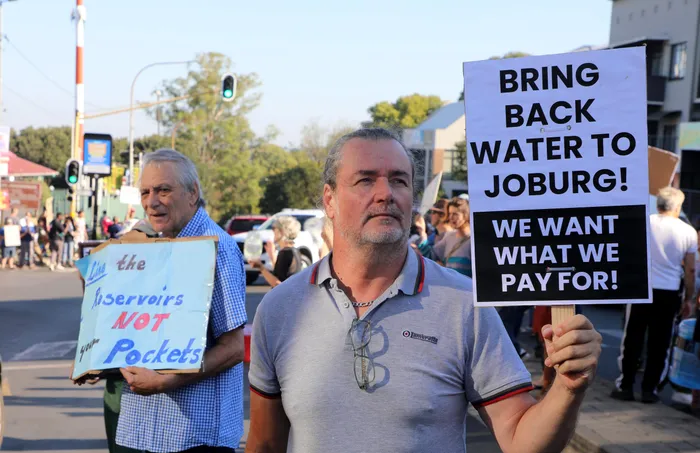
Joburg residents took to the streets recently to protest over continued water challenges.
Image: Timothy Bernard/Independent Newspapers
In his State of the Nation Address, President Cyril Ramaphosa articulated a national response to the water crisis anchored firmly in constitutional obligation and strategic foresight. His articulation moved beyond immediate symptoms to affirmation that water security is inseparable from human dignity and the long-term stability and development of our society.
As the Association of Water and Sanitation Institutions of South Africa (AWSISA), we welcome both the clarity of his analysis and the resolve embedded in his response. The President has reframed the water challenge as a collective national undertaking that demands disciplined coordination, sustained investment and shared responsibility across the state, industry and society. It is a call not simply to repair infrastructure, but to restore confidence in the very architecture of governance that safeguards every drop.
His remarks demonstrate a deep understanding of the institutional framework that defines water governance in South Africa, the causes of systemic failure at multiple levels of the water value chain and the long-term imperatives for reform that must drive the sector’s collective response.
Ramaphosa confronted the roots of the crisis with candour and precision. He identified systemic weaknesses in municipal planning, maintenance and infrastructure management as central drivers of recurring water disruptions, pointing to years of under-investment and operational neglect.
The President made it clear that the government will invoke powers under the Constitution and the Water Services Act of 1997 to intervene in municipalities whenever the need arises. He added that the government has already laid criminal charges against 56 municipalities for failing to meet their obligations and will now proceed to lay charges against municipal managers in their personal capacity for violating the National Water Act of 1998. We welcome these statements because they affirm that accountability within the legal and regulatory framework is non-negotiable.
The constitutional and legislative context within which these commitments sit is well established. The President’s framing demonstrated a firm grasp of this dual architecture of water resource management and water services provision.
Perhaps even more significant was the President’s decision to approach the water emergency through the same lens that guided the country’s response to the electricity crisis. By recalling how a dedicated national coordinating structure, anchored at the highest level of the executive, helped stabilise the energy system through a clear plan and disciplined implementation, he signalled that water will now receive comparable strategic focus.
The establishment of a National Water Crisis Committee under his direct leadership conveys an unequivocal message that this issue is no longer a peripheral municipal matter but a national priority requiring central coordination and sustained executive oversight. Such an approach reflects a mature understanding that the complexity of the water challenge demands whole-of-government alignment, measurable targets and accountability at the apex of the state.
The President further signalled a decisive shift toward long-term systemic resilience by outlining an ambitious infrastructure renewal programme that includes the construction of new dams, the rehabilitation of existing schemes and significant upgrades to ageing water and sanitation assets. Central to this commitment is a substantial multi-year public funding allocation exceeding R150 billion dedicated specifically to water and sanitation infrastructure over the medium term. The magnitude of this investment reflects a clear understanding that deferred maintenance and postponed capital expansion carry steep economic and social costs.
Without sustained infrastructure renewal, municipal balance sheets weaken, industrial output is constrained and public confidence erodes. By prioritising capital expenditure at this scale, the Presidency has acknowledged that water security is a prerequisite for economic stability and long-term growth.
The water crisis is also about governance fragility across the entire value chain from resource protection and bulk abstraction to treatment, distribution and wastewater management. It is about non-revenue water losses that in some municipalities exceed forty percent. It is about revenue collection failures that undermine the sustainability of bulk providers. It is about wastewater treatment works that pose ecological and public health risks when they collapse.
One of the most urgent structural threats to water security remains the financial instability of bulk water providers. A water board cannot upgrade treatment works or expand bulk supply if its revenue base is systematically undermined. The president’s insistence on consequence management, therefore, goes to the heart of systemic sustainability.
As AWSISA, we affirm that this moment requires alignment rather than fragmentation. We pledge to support the President’s reform agenda through technical collaboration, policy engagement, industry mobilisation and advocacy for responsible governance across the water value chain. The sector must respond with unity and urgency. Water boards must strengthen governance and operational excellence while pursuing structured debt resolution. Municipalities must ring-fence water revenues and professionalise technical departments. Development finance institutions must treat water infrastructure as a catalytic investment.
Our commitment is real and practical. From 23 to 26 November 2026, AWSISA will host the Africa and Global South Water and Sanitation Dialogue 2026 under the theme “Accelerating Climate-Resilient Water and Sanitation Solutions for Africa and the Global South – Every Drop Counts.” This Dialogue will provide a continental platform to align South Africa’s reform trajectory with broader Global South imperatives.
AWSISA has consistently demonstrated its central role in shaping water security on both national and continental levels. In August 2025, AWSISA actively participated in the AU-AIP Water Investment Support event in Cape Town, contributing technical expertise and policy guidance to advance sustainable water infrastructure investment across Africa. Building on this engagement, AWSISA once again played a key role this past weekend in hosting the AU-AIP Investment Summit progress report in Addis Ababa, providing strategic insights on project implementation and progress tracking.
Looking further ahead, South Africa, under the auspices of AWSISA, has been selected to host the 2030 AfWASA Congress. This will be an opportunity to demonstrate to the continent and the world that South Africa has translated policy clarity into measurable gains in water security.
These high-level interventions underscore AWSISA’s position not merely as a national actor, but as a trusted continental partner driving coordinated, evidence-based approaches to water security across Africa.
The President has charted a path. Through constitutional authority, legislative instruments, institutional restructuring and targeted funding, the State of the Nation Address offers a framework that is strategic and anchored in an appreciation of the water value chain from source to service delivery. From the perspective of AWSISA, the pathway is clear. National leadership has reframed the challenge from a narrative of failure to a framework of collective responsibility and structured intervention.
In an era where water scarcity can dictate the rhythm of growth, investment and stability, the President’s address is a call to action for rational policy execution and collaborative action. The question before the sector is whether we will rise to meet the clarity of that vision. AWSISA stands ready to work with government, municipalities, water boards, funders and continental partners to ensure that this moment becomes a turning point.
Our response must match his clarity of thought with disciplined implementation and unity of purpose. This will enable us to move from reactive crisis management to long-term water stewardship. The time for fragmentation has passed. The time for coordinated execution is now.
*Ramateu Monyokolo is the Chairperson of Rand Water and the Association of Water and Sanitation Institutions of South Africa (AWSISA)
**The views expressed here are not necessarily those of Independent Media