Obama's enduring charm: Why 'Barry O'Bomber' is still America's favourite
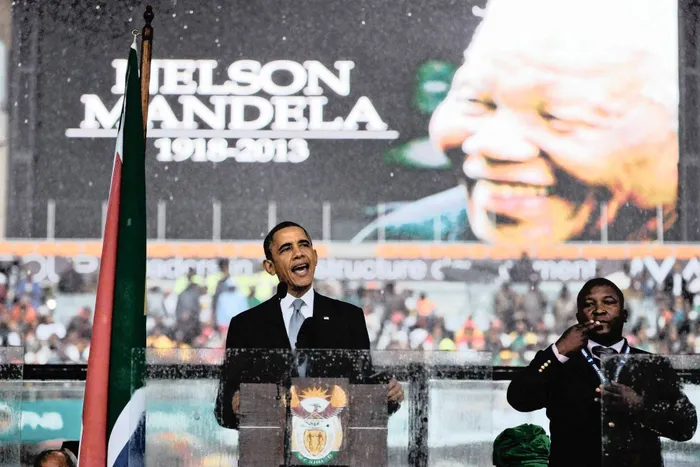
Former US president Barack Obama gives a speech at the memorial service of Nelson Mandela in Soweto in December 2013. Obama will deliver a speech marking the 100th birthday of Mandela in Joburg on Tuesday.
Image: Picture: AP
Barack Obama is still a darling of America, with a recent survey showing that the former president continues to shine through in stark contrast to contemporaries like Donald Trump and JD Vance, who face growing dissent.
A recent Gallup poll, conducted in January 2025, reveals that Obama, who was known as ''Barry O'Bomber'' to teammates in high school because he was great at scoring baskets in basketball, enjoys the highest favourability rating among the five living former and current U.S. presidents, boasting a commendable 59% approval.
Since leaving office in late 2016, Obama's popularity has remained notably stable, typically fluctuating between 58% and 63% in Gallup polling.
In 2017, Sky News listed one of the reasons why Obama is still loved by Americans and many people around the world. What arguably stood out was one of the most touching gestures that remain to capture the minds and hearts.
In May 2009, a seemingly ordinary moment unfolded in the White House that would resonate far beyond its walls. Captured by renowned White House photographer Pete Souza, the image of Obama crouching down to greet a young boy named Jacob Philadelphia has become an emblematic representation of the intricate dialogue surrounding race and identity in America.
Jacob, the son of a White House staffer preparing to leave, approached Obama with a poignant question: “I want to know if my hair is just like yours.” In that moment, the intersection of innocent curiosity and a profound cultural discussion came to life. The president, with his characteristic warmth, encouraged the young boy, saying, “Why don’t you touch it and see for yourself?"
Jacob hesitated but was gently coaxed by Obama’s encouragement: “Touch it, dude.” When Jacob finally reached out, he found the courage to confirm, “Yes, it does feel the same.”
This simple act of touching a leader’s hair turned into a powerful symbol of representation, allowing Jacob — and by extension, countless other children — to see themselves reflected in the highest office of the land.
In a climate often fraught with discussions regarding race relations in the United States, Obama occasionally faced criticism for perceived shortcomings in addressing these issues.
Yet, the image captured by Pete Souza conveyed a profound message of identity and acceptance. As noted by the New York Times, the photograph showcased how the former president served as a “potent symbol” for Black Americans, illustrating how a child’s innocent interaction with a leader can galvanize broader discussions on race and representation.
The Washington Post articulated that the photo “speaks volumes about Obama and race,” highlighting its wider implications beyond the moment captured. It serves as a powerful reminder of the importance of visibility and representation in society—from a young boy’s inquiry to a president’s reassuring response.
To South Africans, Obama will most probably be remembered when, as a sitting president, he flew all the way from the US to share a moving speech during the memorial service of Nelson Mandela.
On that rainy day, December 10, 2013, Obama delivered a keynote tribute to Nelson Mandela at his memorial service in Johannesburg’s FNB Stadium. Obama honored Mandela as a "giant of history" and "the last great liberator of the 20th century," urging attendees to adopt his spirit of reconciliation, justice, and forgiveness in their own lives.
Who will forget that day when history was made as leaders of both the US and Cuba (the two nations that had been kept apart by frosty relations) broke the ice.
While walking to the podium, Obama shook hands with Cuban President Raúl Castro, an unprecedented gesture between the leaders of the two nations.
Obama was among several global leaders who spoke, but his speech was widely seen as the centerpiece of the memorial, which was held four days after Mandela’s death at age 95.
Speaking to thousands gathered to honour the legacy of one of history's most revered figures, Obama’s heartfelt words resonated deeply, reflecting not only on Mandela’s impact on his own life but also challenging current and future leaders to embrace the values that defined the late president’s life.
He stressed that simply honouring Mandela's memory is not enough; actionable steps must be taken in the pursuit of justice.
His plea was clear: the pursuit of unity must be at the forefront of political agendas, not only in America but across the globe.
Obama's remarks stood in stark contrast to other global leaders who have taken to polarising the political climate, often prioritising rhetoric over tangible resolutions. The emotional authenticity of Obama's delivery was an indication that people no longer tolerate insincerity in leadership.
As seen also during events featuring controversial figures like Trump, when approval dwindles (and booing increases), the reactions can be blatantly audible. Our society craves substance over superficiality, and many are increasingly disillusioned by leaders who fail to embody the qualities that Mandela exemplified.
People are particularly struck by instances where leaders exhibit a lack of empathy or understanding. Recent lapses in judgment from figures like Trump, who has faced backlash over dismissive attitudes and insensitive comments, have further solidified calls for a shift towards leaders who focus on unifying their constituents rather than alienating them.
His actions, including derogatory gestures aimed at past leaders, have been seen not just as childish attacks but as a significant departure from the principles that inspire trust and respect in political discourse.
Politically and economically, European leaders are turning away from the United States, arguably the world's most powerful country.
The current First US citizen finds himself amid an incessant storm of criticism for a catalogue of controversial decisions and statements that many believe reflect poorly not just on him, but on the country he represents.
From his alarming tariffs that threaten international trade relationships to noticeable displays of condescension towards those who question his methods, his presidency continues to paint a picture characterised by turmoil and divisiveness.
One of the most pressing points of concern surrounds his handling of the media. Journalists, often on the front lines of democratic oversight, have frequently faced dismissive responses when probing into the more troubling aspects of his past—particularly the spectre of his alleged associations with the infamous Epstein files.
Trump recently shared a racially charged post that featured the heads of former President Barack Obama and First Lady Michelle Obama superimposed onto the bodies of apes.
This highly offensive imagery was condemned across various social media platforms and among public figures and citizens alike. The image sparked an immediate and fierce wave of backlash. The post remained visible for a short time before it was taken down.
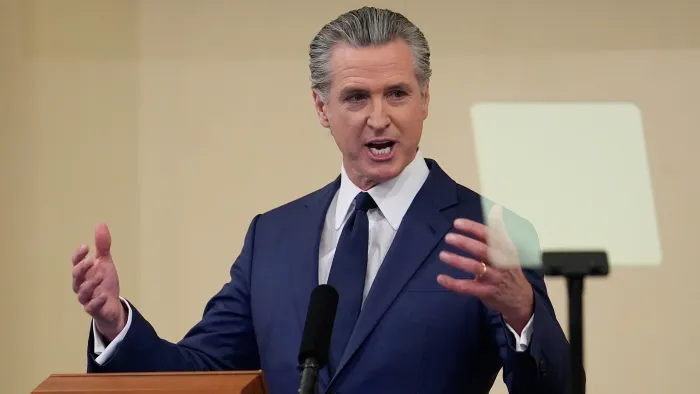
California governor Gavin Newsom is a fiierce critic of Donald Trump.
Image: Godofredo A. Vásquez/AP Photo
But the world isn't simply watching Trump do as he pleases. There is a fair amount of pushback.
Leaders such as the feisty New York mayor Zohran Mamdani and the outspoken California governor Gavin Newsom have taken a stand against the president's seemingly bullying tactics.
The latter did not hold back after being denied an opportunity to speak at a scheduled event at the World Economic Forum in Davos, Switzerland, in January 2026. Newsom was due to participate in a "fireside chat" with Fortune magazine.
The incident occurred amid escalating tensions between the Trump administration and the second-term Democratic governor, shortly after Newsom chastised European leaders for not opposing Trump more forcefully.
Trump and Newsom have been at odds often since the president began his second term in the White House a year ago. One of their disputes was Trump's deployment of National Guard troops to Los Angeles to quell immigration protests. This deployment, according to Newsom, was an illegal "political stunt" and an abuse of power.
In an age where the pursuit of power frequently obscures the importance of integrity, the emergence of principled leaders serves as a vital counter-narrative. These individuals, often facing overwhelming adversity, are exemplars of a steadfast commitment to a moral compass.
These trailblazers exemplify unwavering courage in the face of formidable opposition, reminding us all of the importance of ethical leadership in shaping a better future.
THE STAR